
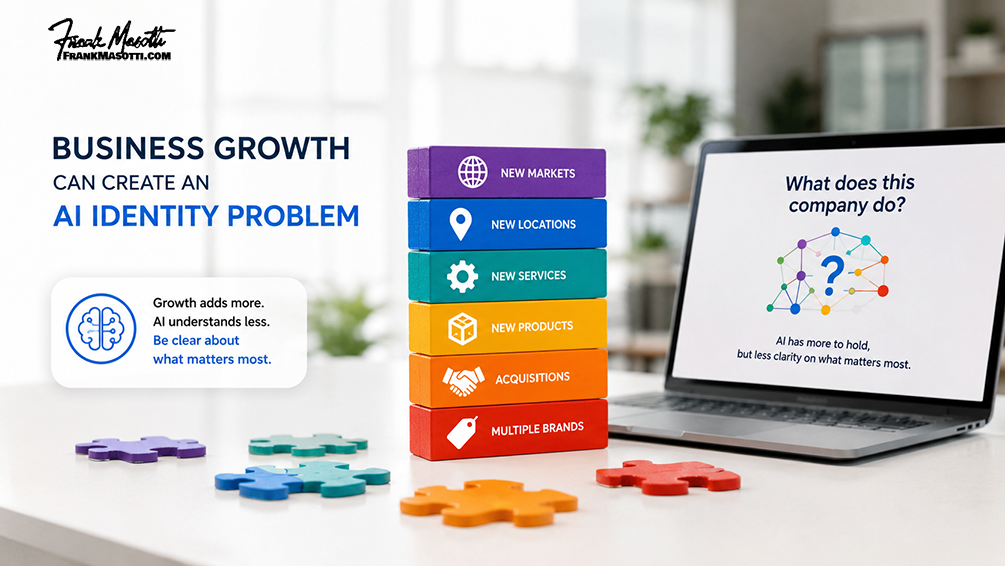
Growth is the one business change that only ever adds. A rebrand replaces your name. A relocation replaces your address. A pivot replaces your direction. Growth replaces nothing. You keep the original service and add four more. You keep the first location and open two others. You keep the founding market and enter a second one. Everything you were is still true. Everything you have become is true as well.
That is exactly what creates the problem. Systems like ChatGPT, Claude, and Gemini build their understanding of your company by weighing accumulated evidence, and evidence that only accumulates does not resolve into a sharper answer. It resolves into a broader one. So the direct answer to the question in the title is this: growth does not make AI understand you better. It usually makes AI describe you less specifically, because you have handed it more to hold and nothing that says which part matters most.
The uncomfortable version of that sentence is that a business can become harder to describe as it becomes more successful. The focused shop you ran at year three was easy for AI to summarize. The larger company you run at year fifteen is not, and the description your prospects receive often reflects the smaller, simpler business that was easier to characterize.
Addition Without Subtraction Is a Specific Kind of Problem
Most AI misunderstanding involves a conflict. Your website says one thing, an old directory says another, and something has to give. Growth is different, because nothing is in conflict. Every claim in the file is accurate.
The trouble is that AI builds a picture of your business from information across the web by weighing volume and consistency. That method works well when a business has one clear story repeated many times. It works poorly when a business has six accurate stories repeated unevenly. The model is not choosing between right and wrong. It is trying to decide what a company with this much surface area actually is, and nothing in the evidence answers that.
So growth does not produce a wrong answer you could point at. It produces a general one, which is the outcome owners are least equipped to notice, because nothing in it is false.
Growth Splits the Signal That Made You Recognizable
Your original service earned its place in AI’s understanding the hard way. Years of reviews mentioning it. Directory categories built around it. Articles, referrals, and profiles all describing the same work. That repetition is precisely how AI decides what your business is known for, and for a long time it worked entirely in your favor.
Then you grew. The new service lines have real revenue now, maybe more than the original. But they have a fraction of the accumulated mentions, because associations form through repetition rather than announcement. Meanwhile the original service keeps collecting evidence too, since you never stopped offering it.
So AI leads with the founding work and treats the rest as secondary, which is one route to the problem covered in Why AI May Recognize Your Business but Misunderstand Its Specialty. A prospect asking about you hears an accurate description of the company you were when the evidence was concentrated. Nothing about that answer is stale in the usual sense. Every fact still applies. It is simply weighted to a version of your business you have outgrown.
Growth Strains the One Field That Can Only Hold One Value
Expansion frequently pushes a company across a category boundary. The contractor that added design work now sits between two categories. The agency that built a software product is no longer clearly an agency. The supplier that started manufacturing is both.
Your services can multiply freely inside AI’s understanding. Your category cannot, and that distinction does most of the damage. As covered in How Conflicting Business Categories Can Confuse AI, category is the one thing about your company that has to land on a single value, which means growth into a second category does not create a richer entry. It creates a decision the model makes silently, using whichever category the older and heavier evidence supports.
That decision then governs which questions you get returned for. You can be described accurately and still be absent from the conversation you grew into, because the model filed you under what you used to be.
Growth Multiplies the Names AI Has to Sort
There is a structural version of this problem that larger companies run into and smaller ones never do, because growth tends to produce names. A second location with its own listing. A division with its own brand. An acquired company that kept its name for two years and then did not. A trade name on the invoices that differs from the legal name on the filings. Each is a potential entity in its own right, and AI connects services, people, and locations to a business through the name they appear beside.
Nothing automatically tells these systems that four names belong to one organization. If the relationship is not stated plainly in places AI reads, the evidence splits across several thin files instead of consolidating into one strong one. In the worst version, the acquired brand and the parent company are held as separate businesses, and neither one looks as substantial as the combined operation actually is. That is the same mechanism behind entity confusion between similar businesses, arriving through the front door rather than by accident.
Your Website Grew the Same Way Your Business Did
Websites expand by accretion. A page gets added for each new service, each new location, each new market, and almost nothing gets retired, because removing a page feels like removing a capability.
What accumulates is a site that lists everything and ranks nothing. The homepage headline still reflects the positioning from two expansions ago. The about page describes a company half the current size. A service page from year four sits at a forgotten URL, still calling the business a specialist in one thing. All of it accurate. None of it stating what the company has become.
That leaves AI to infer structure that was never written down, which is the gap examined in Why AI May Know Individual Facts About a Business but Miss the Bigger Picture. Scale is the detail that goes missing most reliably. You may have gone from six people to ninety, and unless a sentence somewhere says so, AI has no basis to describe you as anything other than the small operation the older evidence documented.
Why This Costs the Most at Exactly the Wrong Moment
A growing company is the one that can least afford a vague AI description, because growth means selling to people who do not already know you.
Your existing customers are unaffected. They watched you expand. The buyers who matter to your growth plan are in the new market, the larger accounts, the segment you built the new capability to serve, and they have no history with you at all. Many of them are asking AI about businesses before they visit a website, so the first thing they learn is a summary weighted toward the company you were before you built the thing they need.
They do not tell you the description was thin. They compare it against a competitor whose narrower business was easier to summarize, and that competitor wins a comparison it should have lost. The answer they received sounded completely assured, because AI sounds equally certain whether its picture is current or not.
Finding Out Which Version of Your Business AI Grew Into
Growth is measurable everywhere except here. You can see revenue, headcount, locations, and market share. What you cannot see is whether the understanding sitting inside these systems grew along with the company, and you cannot settle it by asking one model one question, since a single answer proves almost nothing and the three major systems rarely hold the same picture.
That is the question the AI Business Understanding Report is built to answer. I document what ChatGPT, Claude, and Gemini currently say about your business, which for a company that has expanded means finding out how large they believe you are, which services they lead with, whether your newer capabilities appear at all, whether your divisions and locations are held as one organization or several, and where the three models disagree about who you have become.
Your business grew. Whether AI’s understanding of it grew is a separate fact, and it is one worth establishing before your next expansion depends on it. Ordering a report shows you which version of your company AI is describing to the customers you built the new one for.