
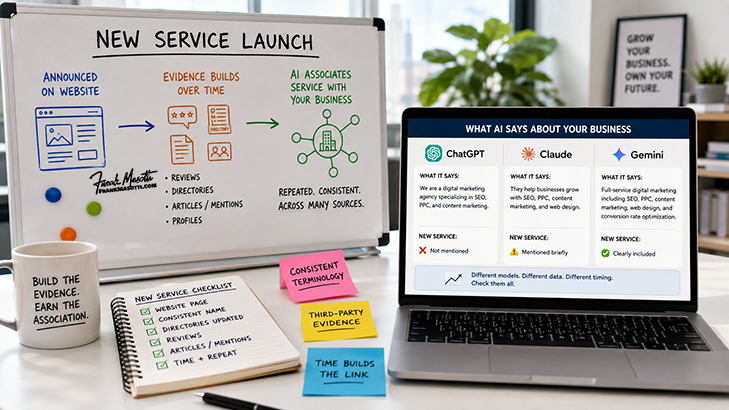
You added a new service. The website has a page for it, the team is trained, maybe the first clients are already in. So when someone asks ChatGPT, Claude, or Gemini what your business offers, the new service should be part of the answer. It usually is not, and it can stay missing for a long time.
The reason is simple to state and easy to underestimate: AI does not associate a service with your business because you announced it. It associates a service with your business because the information it reads keeps saying, in many places and over time, that your business does that work. A new service has almost none of that evidence behind it on day one. Your established services have years of it. So AI keeps answering with the version of your business the evidence supports, which is the business you were before the new service existed.
That gap between what you now offer and what AI says you offer is invisible from the inside, and it sits exactly where you least want it: on the offering you are trying to grow. Here is why the association takes so long to form, and how to find out whether it has.
AI Connects Services to Businesses Through Evidence, Not Announcements
Systems like ChatGPT, Claude, and Gemini organize what they know around entities, a concept I unpack in Why AI Thinks in Entities. Your business is an entity. And your services, when they are established enough, can become entities in their own right. What matters for this question is the connection between the two: the link that says this business performs this service.
That link is not a fact AI accepts on your word. It is a pattern AI infers from seeing your business name and the service described together, repeatedly, across the sources it reads: your website, directories, reviews, articles, profiles, and everything else with your name on it. How AI Connects a Business Name With Its Services, People, and Locations walks through this mechanism in detail. The short version is that associations are earned through repetition and consistency, the same way a reputation is.
Now look at a brand new service through that lens. On launch day, the evidence connecting your business to it consists of whatever you just published. One page, maybe a few. Meanwhile the evidence connecting your business to your original services is everywhere: every old review that describes a past project, every directory listing, every mention on someone else’s website. From where AI sits, your business is overwhelmingly associated with the work you have always done, and faintly, if at all, associated with the work you just added.
The Answer AI Gives Is the One the Evidence Supports
This imbalance shapes what prospects hear. When someone asks AI what your business does, the answer draws on the whole accumulated file, and the strongest associations come out first. How AI Decides What Your Business Is Known For covers why: AI leads with what it has seen most often, not with what you published most recently.
So the typical result is not an error you could point to. AI names your business correctly, describes your established services accurately, and simply leaves the new one out, or mentions it as an afterthought. The answer sounds complete and confident, because AI sounds certain even when its understanding is incomplete. Nothing about it signals that a whole service line is missing. A prospect hearing that answer has no reason to suspect there is more, and you have no way of knowing the answer was given.
There is a related failure worth naming. Sometimes AI does pick up the new service but files it wrong, treating it as your main work or blending it awkwardly with the old, which is its own problem. Why AI May Recognize Your Business but Misunderstand Its Specialty looks at that version. Between full omission and misfiled inclusion, there is a lot of room for AI to describe your service lineup in a way you would not.
Why Updating Your Website Is Not Enough
The natural objection: the service is on my website, and AI reads websites. Both true, and still not enough. AI reads your website, but that does not mean it adopts your website’s version of your business. Your website is one source among many, and on the question of what services you offer, it is the one source with an obvious motive to say whatever you want said. AI weighs it against everything else, and everything else still describes the business without the new service.
Structured data helps AI parse your pages, but it has the same boundary problem. Schema stops at the edge of your website. It cannot reach the hundreds of third party pages that mention your business and say nothing about the new offering.
There is also a timing problem underneath all of this. AI models learn from snapshots of the web taken at a point in time. A service added after the snapshot is not in the model at all. Live search can partially compensate, but it searches the same web where the new service barely appears yet. And because ChatGPT, Claude, and Gemini learn from different data on different schedules, one model catching up tells you nothing about the others.
The Business Cost Lands on Your Growth Plan
A business rarely adds a service casually. The new offering usually exists because you see demand there, or margin, or the direction you want the company to grow. Which means the prospects who matter most to your plans are precisely the ones searching for the thing AI does not yet associate with you.
Those prospects are increasingly asking AI about businesses before they ever visit a website. When one of them asks who offers this service in your area, you are absent from the answer, because the association that would put you there has not formed. When one of them asks about your business specifically, they hear a description of your old lineup and conclude you do not do the new work. Either way, the demand you added the service to capture flows quietly to competitors whose association is already established. No error message, no bounced email, no signal at all. Just a new service that underperforms for reasons that never appear in any report you currently receive.
If this pattern sounds familiar, it is the same one that follows a full pivot, which I wrote about in Can AI Tell When a Business Has Changed Direction? Adding a service is a smaller change, but it fails in AI the same way: the name stays constant, the old evidence keeps speaking, and nothing forces AI to notice that anything is new.
What Actually Builds the Association
The association forms the way every association forms in these systems: through plain, repeated, consistent statements across the sources AI reads. Your website describing the new service clearly and prominently, in language a machine cannot misread. The same service name used everywhere, because consistent terminology matters far more than variety; three different labels for one offering reads to AI like three faint signals instead of one strong signal. Third party evidence accumulating: updated directory listings and profiles, reviews that mention the new work by name, coverage and mentions on sites you do not control. And then time, because volume and repetition are what tip the file.
None of that is exotic. What makes it hard is that while the evidence builds, you cannot see whether it is working. There is no dashboard showing which services AI currently attributes to your business, and asking AI a single test question cannot show you, because one phrasing of one question to one model on one day proves almost nothing about the pattern.
Finding Out Whether AI Has Caught Up
This is the question the AI Business Understanding Report answers. It documents what ChatGPT, Claude, and Gemini actually say about your business right now, which after adding a service means finding out whether the new offering appears at all, whether it appears the way you describe it, which models have picked it up and which have not, and what prospects asking about that service are being told in the meantime.
You already know what your business offers. Whether AI knows is a separate fact, and the only way to establish it is to look. If you have added a service in the last year or two, ordering a report shows you exactly which version of your service lineup AI is presenting to the customers that service was built for.