
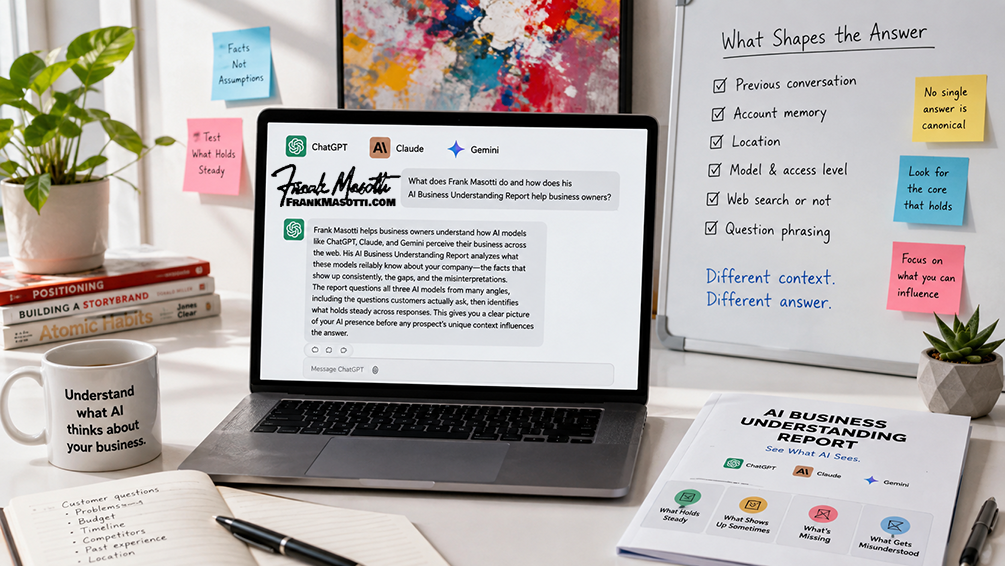
A prospect asked ChatGPT about your business last week. You will never read what it said.
The obvious explanation is privacy. That conversation happened in their account, on their screen, and nothing about it was ever going to reach you. That is true, and it is the smaller half of the problem.
The larger half is that the answer was never a fixed thing sitting somewhere waiting to be looked up. It was assembled in the moment, inside their session, out of material that mostly belongs to them rather than to you. If that prospect forwarded you a screenshot and you typed the identical question into your own account a minute later, you would not get the same response. Not a reworded version of the same conclusion. A different answer, potentially with a different verdict attached.
So the direct response to the question in the title: you never get to see it because it is private, and you could not reproduce it even if it were not. There is no canonical AI answer about your business waiting to be retrieved. There is a range of answers, and where any given one lands depends partly on you and partly on the person doing the asking. Separating those two things is the whole practical move, and it turns this from a hopeless problem into a manageable one.
The Test That Ends the Inquiry Too Early
Most owners who get curious about this do the sensible thing. They open ChatGPT, type their business name, ask what the company does, and read the answer. If it comes back accurate, they stop. The question feels handled.
Part of why that test is unreliable is already well understood. You asked about your company by name, using your own vocabulary, in a question that told the model what you do before it answered anything. Your prospect did none of that. How AI Understands Context covers how a question frames the reading before the model consults a single fact about your business, which is one of the reasons asking ChatGPT yourself does not settle it.
But suppose you correct for all of that. Suppose you ask twenty questions, phrased the way a customer would phrase them, never naming yourself once. You have now addressed every variable that lives on your side of the screen. You still have not reproduced what your prospect saw, because the remaining variables live on theirs.
What the Prospect Brings Into the Room
Your test runs in an empty room. Theirs does not. By the time the question about your business gets typed, that session usually contains several things you have no way to replicate.
There are the turns that came before. People rarely open a chat and immediately ask about one company. They describe a problem first, often at length. They mention a deadline, a budget ceiling, a bad experience with a previous vendor, two competitors they are already weighing. All of that sits in the conversation, and the model reads your business through it. The question about you is the last line of a long paragraph you never saw.
There is what the account itself holds. Persistent memory across chats is now ordinary rather than exotic. A prospect whose assistant has learned over months that they run a small operation on a tight budget and resent being upsold will receive a differently shaped answer than a prospect whose account holds none of that. None of it is about you. All of it shapes how you get described.
There is location, which is frequently inferred rather than stated, and which quietly decides whether you are treated as local, regional, or beside the point.
There is the model itself. A prospect on a free tier and a prospect paying monthly are often not talking to the same system, and different models do not know the same things about the same business. You may be testing something your prospect cannot access.
And there is whether the model searched the web at all during that session. Some answers are assembled from what the model already holds and some pull in live results mid response. Those two paths can produce meaningfully different descriptions of the same company on the same afternoon.
Same Model, Same Week, Two Different Answers
Even holding all of that constant, these systems do not return one settled response.
I ran into this while examining how the models understood my own business. In one Claude response, my background, my companies, and my methodology came back in real detail. In another response during the same research period, Claude said it had no information about me. Same person, same business, same model, days apart at most.
That is not a malfunction. It is how the systems behave. One AI question cannot show you how AI understands your business for exactly this reason, and the same business gets described differently depending on how the question is asked is the companion problem. Put the two together and the conclusion is unavoidable. Any single answer is a sample, not a record.
The Part That Is Actually Yours
This could read as a reason to give up on the whole question. It is not.
Ask a model about your business enough times, from enough directions, and some things move while other things hold. What moves with the asker’s context belongs to the asker. What comes back the same regardless of who is asking, what they mentioned first, or how they worded it, belongs to you. That stable core is your business as these systems actually hold it, built from information gathered across the web rather than from anything that happened in one session.
The core is the only part you can change, and it is the part worth knowing. If your specialty surfaces in nineteen answers out of twenty, it is established. If it surfaces in three, it is not, and a flattering result in your own test proves nothing against that. If all three models reach for the same wrong category when the question does nothing to steer them, that category is what you are as far as the next customer is concerned.
Why a Good Result Is the Dangerous One
The cost here is not that AI describes you badly. It is that a favorable test hands you false clearance.
An owner checks, gets a solid answer, and closes the question for a year. Meanwhile the answers that mattered were produced in sessions loaded with a stranger’s constraints, a stranger’s competitors, and a stranger’s assumptions, at any of the four stages where a buying decision actually gets settled. Some of those answers were fine. Some were a shrug. Nothing distinguishes the two from where you sit, because the tone stays confident whether the underlying picture is complete or not, and the prospect who got the shrug does not call to tell you.
That is the real exposure. Not a wrong answer you could find and fix, but a verification step that felt complete and was not.
What Can Actually Be Established
I should be plain about the limit here. I cannot show you the answer your prospect received. Nobody can. That session is gone, and it was never a document in the first place.
What can be established is the core, and that is what the AI Business Understanding Report is built to do. I question ChatGPT, Claude, and Gemini about your business from many directions, including the category questions and comparison questions a customer would actually ask, and I record what each model returns. Then I look at what holds. Which facts appear every time, which appear occasionally, which never appear at all, and which parts of the description shift depending on how the question is framed. Reading three models side by side is what makes that separation visible, since agreement across all three tells you something a single answer never can.
What you end up with is not a transcript of a conversation you missed. It is a written account of what these systems reliably believe about your company before any prospect’s context gets added to it.
The answer your prospect read is unrecoverable. The understanding it was built from is not. If you want to know what that understanding contains, ordering a report is how you find out, and it is a more useful thing to know than one reassuring answer you gave yourself.