
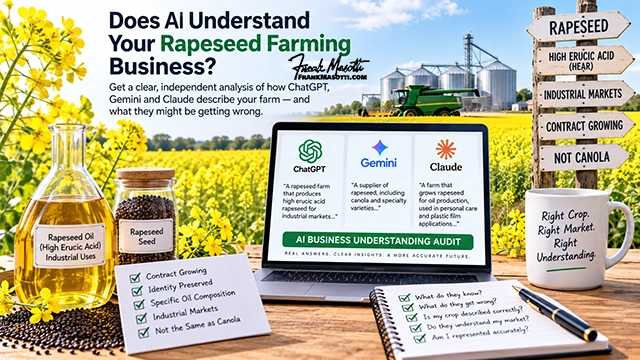
If a processor researches your rapeseed farm through ChatGPT, Gemini, or Claude, will the answer explain what makes your crop suitable for that buyer? Does AI recognize the type of rapeseed you produce, or describe the operation as a canola supplier without establishing whether that description fits? The $495 Frank Masotti AI Business Understanding Report examines what all three systems currently understand about your farm, identifies important misunderstandings and omissions, and compares their conclusions. For a rapeseed grower, that can reveal whether AI understands the characteristics that connect the crop to its intended market.
What Is a Rapeseed Farming AI Visibility Audit Report?
A rapeseed farming AI visibility audit report evaluates how AI systems understand, describe, and potentially recommend a particular rapeseed farming business.
This is not an audit of how you use artificial intelligence on the farm, and it is not an audit performed by AI. I manually examine what ChatGPT, Gemini, and Claude say about your business.
An AI visibility audit considers whether the farm appears in relevant answers and how those answers represent it. For rapeseed farming, the interpretation needs to go beyond recognizing an oilseed crop. The useful question is whether the model connects your farm with the right production characteristics and commercial purpose.
Why Does a Rapeseed Farm Need an AI Audit?
Rapeseed presents a particular interpretation problem because closely related crop names can conceal important differences in oil composition and intended use.
Canola was developed from rapeseed through breeding that reduced erucic acid in the oil and glucosinolates in the meal. Naming also varies by market. The U.S. Canola Association explains that canola is described as double low rapeseed in Europe and China. The word “rapeseed” therefore does not, by itself, establish that a grower produces a crop outside the canola category. U.S. Canola Association
High erucic acid rapeseed, commonly called HEAR, creates a different commercial context. Perdue AgriBusiness offers grower contracts for HEAR and markets the resulting oil for applications including personal care and plastic film production. That is a specific supply relationship built around a particular oil. Perdue HEAR grower program, Perdue HEAR oil
For a farmer growing HEAR, an AI description that emphasizes low erucic acid would reverse a defining characteristic of the crop. It could sound like a favorable description while giving a prospective buyer the wrong reason to consider the farm.
The opposite assumption also deserves examination. A model should not infer HEAR production simply because a farm uses the word rapeseed.
That is why the distinction from canola farming has to be established for the particular operation. A general explanation of the relationship between the crops does not tell you whether AI has classified your farm correctly.
Does AI Recognize the Production Practices Behind the Crop?
For specialty rapeseed, the crop’s identity can matter throughout production and handling.
The Canola Council of Canada describes HEAR as a specialty crop outside the canola definition and explains the importance of identity preserved production to keep it separate from canola market channels. Its guidance also distinguishes HEAR from specialty canola with high oleic or low linolenic oil profiles. Those descriptions refer to different characteristics. Canola Council guidance on seed traits
Suppose your farm publicly describes how it keeps a contracted HEAR crop separate during storage and handling. An AI answer might recognize rapeseed production while leaving those practices out entirely. A prospective processor would learn what you grow without learning about the documented handling practices relevant to that relationship.
An answer could also go further than the evidence supports. It might turn a statement about separate storage into a claim that your farm guarantees a particular purity level or holds a certification you never claimed.
Both deserve attention. You want the practices you actually document represented accurately, and you want to know if AI adds assurances on your behalf.
The audit examines that representation. It does not test seed lots or certify the farm’s compliance with a buyer’s requirements.
What Can an AI Audit Reveal About Your Rapeseed Farm?
The findings can show how much of your farm’s commercial identity survives in the models’ answers.
For example, a model could correctly associate your farm with rapeseed and still misunderstand the trait that defines your production. It could recognize HEAR but confuse high erucic acid with high oleic oil. It could describe a specialty production relationship without establishing whether the information concerns your current operation.
These are hypothetical examples of findings worth examining:
| Possible finding | Why it matters to the grower |
|---|---|
| HEAR production is described as low erucic canola. | The answer contradicts the oil characteristic central to that crop. |
| High erucic and high oleic production are treated as interchangeable. | A buyer receives a description of a different specialty. |
| Documented separation and handling practices are omitted. | The answer leaves out evidence relevant to how the farm manages its specialty crop. |
| A purity guarantee or certification appears without support. | AI attributes an assurance to the farm that needs to be checked. |
| A past HEAR trial is described as an established current specialty. | An experimental crop becomes a claim about the business today. |
The last example is particularly useful for a farm that has tested rapeseed through a trial or limited contract. A reference to one season of HEAR production does not establish that the operation continues to grow it commercially.
An audit can identify whether that earlier activity appears in the current answers and how confidently the models present it. This is a practical reason to examine how outdated information can shape AI’s understanding.
Recommendation visibility adds another question: if an answer presents your farm as a suitable producer, what characteristics does it use to justify that recommendation? A recommendation based on an oil specification you do not produce would give the prospective buyer a misleading explanation of the fit.
How the Frank Masotti AI Business Understanding Report Works
I manually evaluate your rapeseed farming business across ChatGPT, Gemini, and Claude using the same structured question set. Each question begins in a fresh conversation, and the systems are evaluated independently. I preserve the original responses and compare what they communicate about the business.
The report methodology explains this process, including how the evaluation avoids supplying a company description or coaching the models toward a preferred answer.
For a rapeseed grower, that independence matters. Giving a model your HEAR specifications before asking it to describe the farm would introduce the very information you want to know whether it can identify for itself.
One system might recognize the specialty accurately. Another might describe canola production. A third might identify the farm but lack enough information to establish the rapeseed type. Those would be three materially different findings.
The multi model comparison shows where those differences occur and what they mean for the way your operation is represented.
What Does a Rapeseed Farmer Receive?
The Frank Masotti AI Business Understanding Report costs $495 as a one time purchase.
You receive a 10+ page PDF report containing:
- Manual analysis of your business across ChatGPT, Gemini, and Claude.
- Comparison of what the three systems understand, misunderstand, and omit.
- Findings about recognition, associated attributes, and recommendation visibility.
- Agreements, disagreements, interpretation drift, and outdated or incorrect information identified in the responses.
- Strategic observations and recommendations based on the findings.
The finished report is delivered the next business day after the analysis is completed. You can review completed reports before ordering.
What Happens After the AI Audit?
You have evidence showing whether the models understand the rapeseed operation you actually run.
If an answer substitutes canola characteristics for HEAR production, you can see that mismatch. If documented handling practices are missing, you know they did not appear in the evaluated responses. If the models correctly preserve the farm’s specialty and commercial role, the report records that finding as well.
The recommendations follow what the analysis reveals. You can use them to decide which misunderstandings or gaps deserve attention and who should address them.
My service provides diagnosis and recommendations. I do not sell an SEO package, GEO service, AI visibility optimization program, or implementation retainer afterward.
Does AI Understand the Rapeseed Business Your Buyers Need to Understand?
Your buyer has a reason for wanting a particular rapeseed crop. Its oil characteristics, the production arrangement, and the way it is handled can all be part of that reason.
Does ChatGPT connect those characteristics with your farm? Does Gemini describe the same operation? Does Claude recognize your specialty or substitute a broader idea of rapeseed production?
For $495, the Frank Masotti AI Business Understanding Report gives you a manual examination of what all three currently understand, with findings and recommendations specific to your business.
Order your Frank Masotti AI Business Understanding Report and find out whether AI understands the rapeseed farm behind your name.