
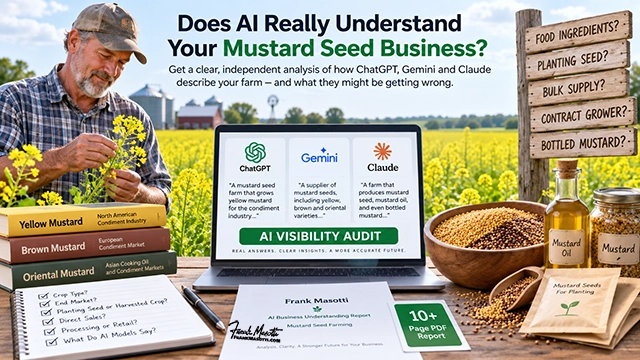
Mustard Seed Farming AI Visibility Audit Report
A buyer researching your mustard seed farm through ChatGPT, Gemini, or Claude could come away with the wrong idea about what you grow or what you sell. Does AI associate your operation with the mustard type you actually produce? Does it understand your market, or describe you as a supplier of everything from planting seed to bottled mustard? The $495 Frank Masotti AI Business Understanding Report examines what all three systems currently understand about your operation, identifies important gaps and misunderstandings, and compares their conclusions so you can see how your farm is being represented.
What Is a Mustard Seed Farming AI Visibility Audit Report?
A mustard seed farming AI visibility audit report evaluates how AI systems understand, describe, and potentially recommend a particular mustard seed farming business.
This is not an audit of your use of artificial intelligence on the farm, and it is not an audit performed by AI. I manually examine the answers that ChatGPT, Gemini, and Claude provide about your business.
An AI visibility audit asks whether your business appears in relevant answers and how it is represented. For a mustard seed grower, that includes whether the systems understand the crop, its intended market, and the commercial role of the farm.
An answer that says you “grow mustard” leaves several important questions unresolved.
Why Does a Mustard Seed Farm Need an AI Audit?
Mustard type matters. Yellow, brown, and oriental mustard have different market associations. The Agricultural Marketing Resource Center describes yellow mustard’s major market as the North American condiment industry, brown mustard’s European condiment market, and oriental mustard’s use in Asian cooking oil and condiment markets. Its mustard overview also emphasizes arranging a contract before growing the crop.
Those distinctions give a mustard farmer specific reasons to examine what AI understands.
Suppose your operation grows yellow mustard for a condiment buyer. An AI description that associates the farm with mustard oil production has placed the crop in a different commercial context. A description that lists yellow, brown, and oriental mustard together may sound knowledgeable while attributing crops to you that you do not grow.
The model could also describe mustard varieties in detail without establishing which one belongs to your business. Agricultural knowledge and knowledge of your farm are two different things.
You want to know whether the answer reflects your operation or fills the gaps with a general explanation of mustard production.
That is a practical example of AI recognizing a business while misunderstanding its specialty.
Does AI Understand How Your Mustard Crop Is Sold?
For an operation growing mustard under contract, producing the crop does not automatically mean having seed available for an unrelated buyer.
Imagine someone asks an AI system whether your farm would be a suitable source of bulk mustard seed. If the model knows that you grow mustard, it might describe you as a potential supplier. The useful question is what else it says.
Does it acknowledge that purchasing arrangements need to be confirmed? Does it assume you sell directly? Does it present a past harvest as current inventory? Does it confuse a relationship with a mustard buyer with an open offer to supply anyone?
These are possible findings to examine, not claims about what any model has already said about your farm.
For the grower, the distinction is straightforward. A crop committed to an existing buyer is not the same commercial opportunity as uncommitted seed offered for sale. An AI answer can get the crop right and still create the wrong expectation about doing business with you.
The audit can show whether that distinction appears in the models’ understanding or whether they make unsupported assumptions about availability.
Does “Mustard Seed” Mean the Same Thing to AI as It Does to Your Buyer?
A person looking for mustard seed might want an ingredient for food production, seed for planting, or a small packet for a garden.
Your farming operation serves a particular purpose within that range. The words “mustard seed” alone do not establish it.
If you grow a harvested crop for a condiment processor, does AI describe that relationship accurately? Or does it portray your farm as a seed dealer selling planting material?
If you actually produce planting seed, does that role appear clearly? Or does the model describe your output entirely as a food ingredient?
There is also a difference between growing the raw crop and making the finished product. A connection with the condiment industry does not establish that your farm mills mustard flour, blends seasonings, bottles prepared mustard, or sells retail products.
A useful answer needs to place your business at the correct point in that process. Otherwise, someone can recognize the farm’s name and still misunderstand what they could buy from it.
What Can an AI Audit Reveal About Your Mustard Seed Farm?
The report examines the understanding expressed in the answers, including what is accurate, missing, uncertain, or unsupported.
For a mustard seed operation, meaningful findings could include:
Whether the models identify the mustard type you actually grow.
Whether they associate production with the appropriate end market.
Whether they distinguish a harvested mustard crop from planting seed.
Whether they assume direct sales or current availability without establishing either.
Whether they attribute processing or retail products to the farm.
Whether descriptions of earlier mustard production are presented as current activity.
The relationship between these findings matters as much as each individual detail.
A model might correctly identify yellow mustard production but incorrectly describe retail sales. Another might understand the farm’s relationship with a commercial buyer but remain uncertain about the mustard type. A third might recognize the operation while offering little more than a general farming description.
Those answers would leave a prospective buyer with different impressions of the same business.
The analysis documents those differences instead of treating every mention of your farm as equally useful recognition.
How the Frank Masotti AI Business Understanding Report Works
I manually evaluate your business across ChatGPT, Gemini, and Claude, then compare what each system independently understands.
The analysis examines recognition, business category, associated attributes, omissions, misunderstandings, recommendation visibility, outdated information, and agreements or disagreements between the models. You can review the report methodology for the evaluation process.
For a mustard grower, the interpretation matters. “Mustard producer,” “mustard seed supplier,” and “mustard manufacturer” can imply different activities. I examine what the surrounding answer actually communicates about the business.
Comparing the systems also helps distinguish a problem appearing in one model from a pattern appearing across all three. The multi model comparison preserves those differences and explains their significance.
What Does a Mustard Seed Farmer Receive?
The Frank Masotti AI Business Understanding Report costs $495 as a one time purchase.
You receive a 10+ page PDF report containing:
Manual analysis of ChatGPT, Gemini, and Claude.
Comparison of their understanding of your business.
Findings about recognition, attributes, omissions, misunderstandings, and recommendation visibility.
Agreements, disagreements, and outdated or incorrect information identified in the responses.
Strategic observations and recommendations based on the findings.
The finished report is delivered the next business day after the analysis is completed. You can also review completed reports before ordering.
What Happens After the Audit?
You have evidence showing how the three systems describe your mustard seed operation and which conclusions deserve attention.
If a model assumes you sell planting seed, you can see that finding. If it assigns the wrong mustard type or describes a contracted crop as generally available, you can assess the misunderstanding. If the answers accurately represent your operation, the report documents that too.
The recommendations follow the findings. They give you a basis for deciding what information or business descriptions deserve review.
I provide the diagnosis and recommendations. I do not sell an implementation service or an ongoing marketing retainer afterward.
Find Out Whether AI Understands Your Mustard Seed Business
You know which mustard you grow, the market it serves, and the arrangements under which you sell it.
Does ChatGPT understand those distinctions? Does Gemini? Does Claude?
Or do their answers leave someone expecting a different crop, a different product, or a purchasing arrangement your farm does not offer?
Order the Frank Masotti AI Business Understanding Report for $495 and find out what the three AI systems currently understand about your mustard seed farming business.