
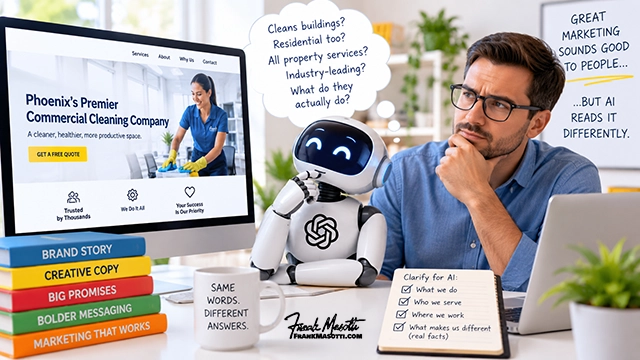
If your website reads well, converts well, and still produces a vague or oddly broad description when you ask ChatGPT, Claude, or Gemini what your business does, the cause is probably not bad writing. It is marketing writing, doing exactly what marketing writing is built to do, in front of a reader it was never built for.
Here is the direct answer. Marketing language is a register with its own conventions, and human readers discount those conventions without noticing. When a page says “industry leading” or “we do it all” or “your success is our priority,” a person applies a quiet correction: this is promotion, not a fact sheet. AI does not apply that correction consistently. It reads a promotional claim and has to decide whether it is a fact about your business, and it decides differently depending on the kind of claim. Some marketing phrases it treats as literal and over applies. Others it treats as noise and discards. Either way, the description that comes out is not the one you would have written.
This is different from metaphors being taken literally, covered in Why AI Takes Your Words Literally, and different from sentences that can be parsed two ways, the subject of Ambiguous Sentences Create Ambiguous AI Answers. Marketing language can be literal and unambiguous and still teach AI the wrong thing, because the problem is not the sentence. It is the genre.
The Discount Humans Apply and AI Does Not
Every adult who has read an advertisement knows how to read one. “Best pizza in town” is not a measurement. “Trusted by thousands” is not a customer count. We absorb these phrases as tone and move on to the parts of the page that tell us something. That discounting is so automatic that nobody thinks of it as a skill, but it is one.
An AI system building a picture of your business is doing something else. It is trying to attach properties to an entity: what this business does, for whom, where, and how it differs from others. AI thinks in entities, and every sentence it reads is a candidate source of properties. When the sentence is written in marketing register, the model faces a choice a human never consciously makes. Is this a property, or is this promotion?
It resolves that choice in three predictable ways, and each one damages your description differently.
Pattern One: Superlatives Collapse Into the Category Average
Take “Phoenix’s premier commercial cleaning company.” A human learns that you are a commercial cleaner in Phoenix with a confident tone. AI learns the same two facts, and then has to do something with “premier.”
The trouble is that “premier,” “leading,” “trusted,” and “top rated” appear on a large share of the sites in your category. They do not distinguish you from your competitors, because your competitors use them too. It is not that AI believes you are premier or disbelieves it. The word carries no information that separates you from anyone else, and the model moves on with the two facts it could actually use.
Strip out every word that every competitor also uses and what remains is the category. As I explained in How AI Decides What Your Business Is Known For, the model leads with what it can confirm, and on a page built from superlatives, the only confirmable thing is the industry you are in. The result sounds like every other commercial cleaner in the city, which is the outcome your marketing was written to prevent.
Pattern Two: Scope Language Gets Taken at Full Face Value
The second pattern runs the opposite direction. Where superlatives get discounted to zero, scope claims get accepted completely.
“We handle projects of any size.” “One stop shop for all your property needs.” “Full service digital agency.” A human reads these as enthusiasm. AI reads them as a scope statement, and it has no way to know the sentence was written to sound accommodating rather than to define your service list.
So the model widens your entity to match. The residential remodeler who wrote “no job too big or too small” gets described as taking commercial work. The bookkeeping firm that wrote “full service financial solutions” gets credited with tax planning and CFO services it does not provide. When a prospect asks whether you handle something you do not, the answer is a confident yes, because your own page said so in language you never intended as a promise.
This is the marketing language version of a problem I described in Why AI May Recognize Your Business but Misunderstand Its Specialty. The model knows who you are. It just believes you do more than you do, and the excess came straight from copy that was trying to sound generous.
Pattern Three: Benefit Language Never Attaches to Your Entity
The third pattern is the quietest. Good marketing copy is usually written from the customer’s side. “Peace of mind for your family.” “Get your weekends back.” “You focus on growth. We handle the rest.” Every one of those sentences does real persuasive work for a human reader. And in every one, the grammatical subject is the customer, not the business.
AI is building a profile of your company, and a sentence about how your customer will feel contains no property of your company. It cannot file “peace of mind” under your services. A page that is ninety percent benefit language is, from the model’s point of view, ninety percent empty, no matter how well it converts.
And gaps do not stay gaps. As I wrote in What Missing Information Can Reveal About AI’s Understanding of a Business, when the model finds no stated properties, it fills the space with the defaults for your category. A landscaping firm that specializes in desert native design but describes itself entirely through how relaxed its clients feel gets described as a landscaper, full stop, because the specialty was never stated as a property. It was only implied through an outcome.
These patterns do not stop at your homepage. Your directory listing, your social bio, and the blurb a partner pulled from your promotional copy speak in the same register, and AI builds its picture of your business from information across the web. If every source is persuading rather than stating, the failures compound.
The Business Consequence
The cost lands in the moment that matters most. Your prospect may ask AI about you before contacting you, and what they receive is a description assembled from these resolutions. It is generic, because the superlatives washed out and only the category survived. Or too broad, because scope language became a service list and the prospect who wanted a specialist hears a generalist. Or thin, because the page was written about the customer and the model found nothing to say about you.
None of those outcomes produce a complaint, and the answer sounded assured, because AI sounds certain even when its understanding is incomplete. From inside your business, the site is performing. The one reader it fails is the one now introducing you to a growing share of your market, and that reader never sends feedback.
What Actually Fixes It
The fix is not to strip the marketing out. Persuasive writing still moves human readers, and that is still its job. The fix is to make sure every page also contains plain attribute statements, written with your business as the subject, that say what you do, who you do it for, where, and what you do not do. “We provide bookkeeping and payroll for restaurants in Maricopa County. We do not offer tax preparation.” That sentence will never win an award. It is also the only sentence on the page a model can file without guessing.
Then let the benefit language work around it. The customer gets the feeling. The model gets the fact. As Writing for Understanding Instead of Keywords argues, the writing that performs in AI answers is the writing that states something, and stating something is compatible with sounding like yourself.
The hard part is knowing which of the three patterns your copy triggered, because you cannot tell by rereading it. You know what “full service” was supposed to mean. The model does not, and the only evidence of what it decided is in the answers it gives.
See What Your Marketing Taught AI
That is what the AI Business Understanding Report is built to show. I question ChatGPT, Claude, and Gemini about your business from multiple angles, read every answer, and trace what they say back to its likely source. When a model describes you too broadly, the report shows which scope claim it accepted. When it describes you generically, it shows that the superlatives left nothing behind. When it has almost nothing to say, it shows that the benefit language never landed as a property. Because the three models resolve marketing language differently, and they do not all know the same things, the disagreements between them are often where the diagnosis starts.
Your marketing was written to persuade a person, and it probably does. Whether it also taught three AI systems the right facts about your business is a separate question, and ordering a report is how you get it answered.