
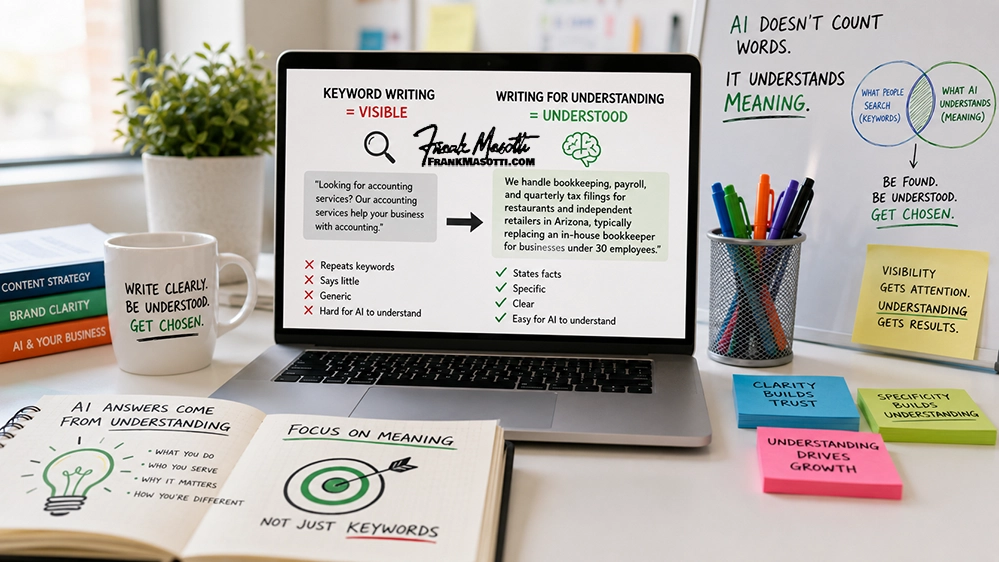
If you are wondering whether you should still write your website around keywords now that AI answers so many customer questions, here is the direct answer. Keywords tell a search engine which queries a page might match. They tell an AI system almost nothing about what your business actually is. When ChatGPT, Claude, or Gemini describes your business, it is not retrieving the phrases you optimized for. It is working from an interpretation of what your writing means. If your content was engineered around phrases instead of meaning, the interpretation suffers, and the interpretation is what gets repeated to your potential customers.
That does not mean keyword research is worthless or that search traffic stopped mattering. It means the priority order has flipped. For years, the safe move was to write for the keyword first and let clarity come second if it came at all. Now the writing that performs in AI answers is the writing a system can understand: specific, consistent, and direct about what you do, who you serve, and why it matters. Keywords describe how people search. Understanding determines what AI says when they do.
Most businesses have not made that shift, and most do not know they need to. The habits built over a decade of SEO are still shaping the writing, and the damage those habits cause shows up in a place almost nobody is measuring.
Why Keyword Habits Persist After Their Job Changed
Keyword writing became standard practice for a rational reason. Search engines matched queries to pages, and pages that contained the query language matched better. So content briefs started with keyword lists, headers were written to hold target phrases, and copy was measured by whether the right terms appeared often enough. The process produced pages, the pages drew traffic, and the metrics confirmed the method.
Nothing in that loop flags what AI systems now do with the same content. Traffic dashboards do not show you that ChatGPT describes your business in vague generalities. Rank trackers do not tell you that Gemini has confused your core service with a side offering. The keyword approach still looks like it is working on every report you actually receive, while a growing share of customer research happens in a channel those reports never touch. The problem stays hidden because the old measurements keep validating the old writing.
How AI Reads Differently Than a Keyword Matcher
A language model does not count occurrences of a phrase and award weight accordingly. It interprets sentences. When it processes your services page, it is building an answer to questions like: what does this company do, for whom, and how is that different from the thousand other companies using similar words. Repeating a target phrase five times does not strengthen that answer. It just gives the model the same information five times, usually wrapped in sentences that exist only to carry the phrase.
Keyword writing also carries specific tics that actively work against comprehension. One is forced variety. SEO advice long held that you should rotate synonyms to avoid repetition penalties, so a firm might call the same offering a consulting service in one paragraph, an advisory solution in the next, and strategic support in a third. A human reader smooths that over. An AI system reading literally has to decide whether those are one service or three, and as covered in Why Consistent Terminology Matters, it does not always decide correctly. AI systems take your words at face value, which means every stylistic variation you introduced for a search engine is a small ambiguity you introduced for an AI.
The other tic is the sentence that says nothing. Keyword pages are padded with copy like “we provide innovative solutions tailored to your unique needs,” which exists to surround a phrase, not to convey a fact. A model can extract nothing from it because there is nothing in it. As Why Clear Writing Beats Clever Writing for AI lays out, the writing AI handles best is the writing that states things plainly. Filler is worse than neutral. It dilutes the few specific claims your site actually makes.
The Same Facts, Two Ways of Writing Them
Consider two versions of a services page for the same accounting firm. The keyword version leads with “Looking for small business accounting services? Our small business accounting services help small businesses with accounting.” It matches the query perfectly and communicates almost nothing the query did not already contain. The understanding version says “We handle bookkeeping, payroll, and quarterly tax filings for restaurants and independent retailers in Arizona, typically replacing an in house bookkeeper for businesses under thirty employees.” No search phrase is repeated. Every clause adds a fact: the services, the industries, the geography, the size of client, the role being replaced.
Ask an AI system what each firm does, and the difference is stark. The first firm gets described in the same generic terms as every competitor who used the same template, because generic input produces generic interpretation. The second gets described specifically, and specificity is what makes a business recommendable when someone asks AI for an accountant who knows restaurants. This is the gap between visibility and comprehension: being visible to AI is not the same as being understood by AI, and keyword writing reliably produces the first without the second.
Volume does not rescue the approach either. A business that publishes fifty keyword targeted pages has not given AI fifty times the understanding. It has often given AI fifty slightly different phrasings of the same vague claims, which is its own problem, one covered in More Content Does Not Automatically Make Your Business Easier for AI to Understand. Understanding compounds through consistency and specificity, not page count.
What This Costs When Nobody Is Watching
The consequence lands quietly. A potential customer asks ChatGPT to recommend a provider, or asks Claude what your company does before a sales call, or asks Gemini to compare you against a competitor. The answer they get is assembled from what AI understood, not from what you meant. If a decade of keyword writing left the understanding thin, the answer is thin: a generic description, a hedge, or a confident recommendation of the competitor whose site happened to read more clearly. You never see the exchange, no analytics event fires, and the customer who quietly ruled you out never appears in any report.
The uncomfortable part is that you cannot fix this by intuition. You wrote the site, so you read it knowing what everything means. The only way to know whether the writing is working is to look at the output: what AI systems actually say about your business today.
Find Out What Your Writing Produced
That is the specific question the AI Business Understanding Report answers. It examines what ChatGPT, Claude, and Gemini currently say about your business and traces vague or incorrect answers back to their causes, which frequently include exactly the keyword era habits described here: rotating terminology, filler copy, and pages that match queries without stating facts. It is a manual analysis of understanding, not an automated scan of keyword placements and technical checkboxes, because the problem lives in meaning, and meaning is not something software scores.
Keywords still have a job. They tell you what your customers ask. But the answer those customers receive is built from what AI understands, and understanding comes from writing that says something. If you want to know whether your writing does, ordering a report will show you what three AI systems concluded from it. That is a more useful measurement than how many times a phrase appears, because it is the one your customers are already reading.