
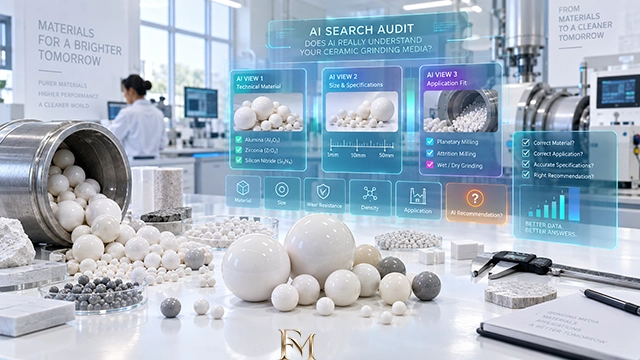
AI Search Engine Audit for Ceramic Grinding Ball Manufacturers
A manufacturer of ceramic grinding balls can produce a highly specialized industrial product while still being described far too generically by ChatGPT, Claude, or Gemini.
The problem is not simply whether an artificial intelligence search engine recognizes the company name. The more important question is whether it understands what kind of grinding media the company manufactures, what materials are available, what applications the products are designed for, and why a buyer would choose those products instead of another type of grinding media.
The Frank Masotti AI Business Understanding Report examines exactly that question. I manually evaluate what ChatGPT, Claude, and Gemini understand about one company, compare their answers, identify misunderstandings and omissions, and document what the three models actually associate with the business.
What Does AI Understand About Your Ceramic Grinding Ball Manufacturing Business?
A ceramic grinding ball manufacturer is not simply a “ceramics company.”
That description leaves out most of what an industrial buyer needs to know.
A buyer may be looking for alumina grinding balls, zirconia media, steatite media, ceramic beads, a particular diameter range, high density media, low wear characteristics, or grinding media intended for a specific milling process.
Ceramic grinding media can be used in grinding, mixing, dispersing, and other milling applications where properties such as wear resistance and contamination control can matter. Manufacturers also serve very different end markets, including ceramics, pigments, coatings, chemicals, mineral processing, glass, advanced materials, and other industrial applications.
The AI understanding problem is therefore much more specific than whether the model knows that your company manufactures ceramic products.
It needs to understand which ceramic products you actually manufacture and what they are intended to do.
Does AI Know the Difference Between Grinding Media and Other Ceramic Balls?
This is one of the biggest category questions for this business type.
Ceramic balls are manufactured for many purposes that have nothing to do with grinding. Depending on the material and specification, ceramic balls may also appear in bearings, valves, catalyst applications, precision components, chemical processing, or other industrial uses.
A company manufacturing ceramic grinding balls could therefore be identified correctly at the broad product level while still being placed in the wrong functional category.
ChatGPT might recognize the company as a ceramic ball manufacturer.
Gemini might associate the company primarily with grinding media.
Claude might describe a broader range of technical ceramics than the manufacturer actually produces.
None of those descriptions necessarily looks absurd at first glance.
But to a purchasing manager searching specifically for grinding media, those differences matter.
An AI search engine audit should determine whether the models make that distinction correctly.
Does AI Understand Which Ceramic Materials You Manufacture?
“Grinding ball” is only the beginning of the product description.
The ceramic composition can be central to the buying decision.
A manufacturer may produce grinding media using alumina, zirconia, zirconia toughened alumina, steatite, or another technical ceramic formulation. Different manufacturers specialize in different materials and compositions.
An AI system that collapses all of those products into “ceramic balls” may technically identify the product while missing the information that differentiates the manufacturer.
That can create several possible problems.
AI could associate a manufacturer with zirconia media that it does not produce. It could overlook an important alumina product line. It could treat different ceramic formulations as interchangeable. It could recognize a product family but miss the grades, densities, sizes, or compositions that matter to customers.
For manufacturers selling technical industrial products, these are not trivial details.
They are part of the product itself.
Does AI Understand What Your Grinding Media Is Used For?
The application is another area where incomplete AI understanding can create a distorted picture of the company.
Ceramic grinding media may be used in ball mills, bead mills, agitator mills, and other equipment for reducing particle size, mixing materials, or dispersing products.
The end use can also vary considerably.
One manufacturer may have strong recognition in ceramic raw materials and glazes. Another may serve coatings and pigments. Another may emphasize advanced materials, minerals, chemicals, electronic materials, or highly contamination sensitive processes.
If AI searches connect your company to the wrong applications, the model may effectively place your products in front of the wrong buyer.
The opposite problem can occur as well.
A company may have decades of experience supplying a particular industry while ChatGPT, Claude, or Gemini never associates that market with the company at all.
An owner looking at the corporate website naturally knows the connection exists.
A buyer asking an AI system for manufacturers may not.
Does AI Recognize the Product Characteristics Buyers Actually Care About?
Industrial buyers do not choose grinding media because the balls are ceramic.
They evaluate whether the media fits the process.
Depending on the application, buyers may care about characteristics such as:
- Density
- Hardness
- Wear rate
- Chemical resistance
- Contamination characteristics
- Impact resistance
- Available diameter or bead size
- Material composition
- Consistency
- Compatibility with a particular milling process
- Suitability for wet or dry grinding
- Ability to meet a particular application requirement
A manufacturer may have excellent information about these characteristics in technical sheets and product pages while the major AI models form a much simpler description of the company.
That is one of the reasons AI visibility alone does not tell the whole story.
Being mentioned is not the same as being understood.
What Happens If AI Associates the Wrong Strengths With the Manufacturer?
AI systems frequently describe businesses using attributes.
For a ceramic grinding ball manufacturer, those attributes might involve product quality, durability, precision, wear resistance, technical expertise, material range, manufacturing capability, customization, or suitability for particular industrial applications.
The question is whether those associations reflect the actual company.
An AI model could emphasize price when the manufacturer competes primarily on technical performance.
It could describe the company as a general ceramic supplier when grinding media is the core business.
It could associate the manufacturer with high precision ceramic balls rather than milling media.
It could overlook a specialization that distinguishes the company from dozens of other suppliers.
It could also associate the company correctly with one product family while failing to recognize another major part of the catalog.
These are exactly the kinds of differences that can become visible when ChatGPT, Claude, and Gemini are evaluated independently.
Could the Three AI Models Describe the Same Manufacturer Differently?
Absolutely.
One model may understand the company primarily through its material.
Another may understand it through the product category.
Another may emphasize the industries served.
That is why examining only one AI system provides an incomplete picture.
My methodology evaluates ChatGPT, Claude, and Gemini separately using the same structured process. I then compare the responses to determine where the models agree, where they disagree, what appears to be missing, and what information may be misunderstood.
For a ceramic grinding ball manufacturer, that comparison could reveal that all three models recognize the core product correctly.
It could also reveal something very different.
Perhaps only one model understands that the company specializes in alumina media.
Perhaps another incorrectly associates the manufacturer with steel grinding balls.
Perhaps a model recognizes the company but cannot connect it with the industries it serves.
Perhaps all three know the business exists but provide such generic descriptions that a buyer would have little reason to distinguish it from another manufacturer.
You cannot know which situation exists without examining the answers.
What Can a Ceramic Grinding Ball Manufacturer Learn From the Report?
The report is designed to answer practical questions about how the business is currently understood.
For example:
Does AI identify the company as a ceramic grinding media manufacturer?
Does it recognize the correct materials and product families?
Does it distinguish grinding balls from precision ceramic balls or unrelated ceramic products?
Does it understand the company’s major applications and customer industries?
What product attributes does AI associate with the company?
Does it connect the manufacturer with the kinds of purchasing questions potential customers could ask?
What important capabilities are missing?
What information appears outdated or incorrect?
Which competing manufacturers appear when AI is asked for alternatives or recommendations?
Do ChatGPT, Claude, and Gemini agree about what the company does?
These findings can be considerably more useful than a generic AI visibility score because they show the owner the actual picture the models have formed.
If you want a broader explanation of what AI misunderstanding can look like, I have also covered how you would know if AI misunderstands your business.
This Is a Diagnostic Report, Not an AI Marketing Service
I do not sell SEO, GEO, AEO, AI optimization, or an ongoing marketing retainer.
The purpose of the analysis is diagnosis.
I manually evaluate the company across ChatGPT, Claude, and Gemini and produce a 10+ page written report showing what the models understand, what they misunderstand, what they omit, the attributes they associate with the company, recognition and recommendation patterns, disagreements between models, and strategic observations.
The report also includes recommendations based on the findings.
It costs $495 as a one time purchase and is delivered the next business day after the analysis is completed.
The report does not promise to change AI answers or guarantee that your company will be recommended.
It gives you something more basic that should come first.
Evidence.
Do ChatGPT, Claude, and Gemini Actually Understand Your Grinding Media Business?
You know whether your company manufactures alumina or zirconia media.
You know the sizes you produce.
You know which mills your products are designed for.
You know the industries you serve, the applications where your products perform well, and why customers choose your grinding media.
The question is whether ChatGPT, Claude, and Gemini know those things too.
If an engineer, purchasing manager, distributor, or prospective customer asks an AI system about your company, the answer is based on the model’s understanding of the business, not yours.
You should not have to guess what that understanding looks like.
For $495, the Frank Masotti AI Business Understanding Report will show you what ChatGPT, Claude, and Gemini currently understand about your ceramic grinding ball manufacturing business, where their answers differ, and what deserves your attention.