
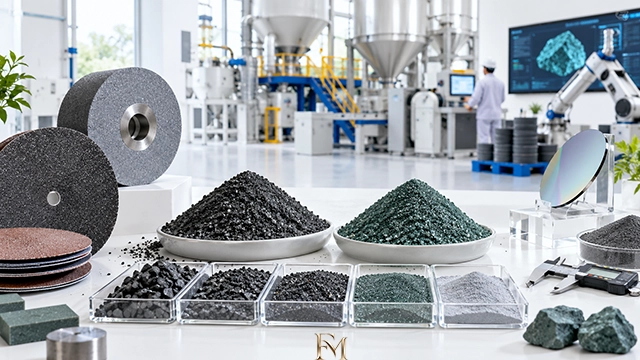
AI Search Engine Audit for Silicon Carbide Abrasive Manufacturers
A silicon carbide abrasive manufacturer can be understood correctly at a very broad level and still be misunderstood where it matters commercially.
ChatGPT, Gemini, or Claude may recognize that your company produces or supplies silicon carbide. But does the model understand whether you manufacture black silicon carbide, green silicon carbide, macrogrits, microgrits, powders, or specialized grades? Does it know which products are intended for bonded abrasives, coated abrasives, blasting, lapping, polishing, or other applications?
More importantly, does AI understand that your company manufactures abrasive material rather than simply placing you somewhere inside the much larger silicon carbide industry?
The Frank Masotti AI Business Understanding Report manually evaluates what ChatGPT, Gemini, and Claude currently understand about your company, where their descriptions agree, where they differ, what they leave out, and whether they recognize your business in relevant recommendation situations.
For a silicon carbide abrasive manufacturer, those distinctions can matter considerably.
What Does AI Understand About Your Silicon Carbide Abrasive Manufacturing Business?
An AI search engine audit for a silicon carbide abrasive manufacturer examines how major AI systems understand the company itself.
It is not an audit of how your manufacturing operation uses artificial intelligence.
The questions are much more specific.
Does AI recognize your company as an actual silicon carbide abrasive manufacturer?
Does it understand which forms and grades of silicon carbide you produce?
Does it know the applications those products are designed for?
Does it distinguish manufacturing from distribution?
And when someone conducts AI searches for a silicon carbide abrasive supplier with particular capabilities, does your company fit the models’ understanding of that request?
That last question can expose problems that a simple company name search would never show.
Silicon carbide is used well beyond abrasives. It also appears in refractories, technical ceramics, metallurgical applications, semiconductor related manufacturing, wear components, and other specialized markets. An artificial intelligence search engine could know quite a bit about silicon carbide while having an incomplete picture of where your company actually fits.
Does AI Understand the Difference Between Black and Green Silicon Carbide?
For many silicon carbide abrasive manufacturers, identifying the material simply as “silicon carbide” is not enough.
Black and green silicon carbide can occupy different positions within an abrasive product line.
Green silicon carbide is generally associated with higher purity and is widely used where sharp cutting characteristics and precision grinding, lapping, or polishing are important. Black silicon carbide is used across a broad range of grinding, blasting, bonded abrasive, coated abrasive, refractory, and general industrial applications.
A manufacturer may produce one, the other, or both.
That creates a straightforward AI understanding test.
If your company manufactures both black and green silicon carbide, do ChatGPT, Gemini, and Claude recognize both product families?
If your business specializes heavily in one, do the models understand that specialization?
Do they associate the correct applications with the correct products?
Or has your entire operation been reduced to the generic description “silicon carbide supplier”?
A description can be factually close and still erase the information a purchasing professional needs.
Grit, Powder, and Particle Size Are Not Minor Details
Silicon carbide abrasive manufacturing does not stop at the chemical name.
A customer may need coarse grain for one application and finely classified powder for another. Manufacturers can offer macrogrits, microgrits, powders, and other carefully classified material across substantial particle size ranges.
Standards and specifications such as FEPA, ANSI, JIS, or customer specific requirements may influence what a buyer is actually looking for.
That means an AI system may recognize your company without understanding enough to make a useful recommendation.
Suppose an engineer asks an AI system for a manufacturer of green silicon carbide microgrit for precision lapping.
Knowing that your company “makes silicon carbide” is not enough.
The model needs to connect your company with the right silicon carbide type, particle range, product form, and application.
The same issue applies when a buyer needs black silicon carbide grain for bonded abrasives or material specifically sized and shaped for coated abrasive production.
The broader abrasive grain manufacturing category shares some of these sizing issues, but silicon carbide introduces its own material distinctions and end use questions.
Does AI Put Your Company in the Correct Silicon Carbide Market?
This is one of the biggest reasons silicon carbide manufacturers deserve to be examined separately.
Silicon carbide is not only an abrasive.
The same material family is associated with refractories, ceramics, metallurgical uses, thermal management, wear resistant parts, and semiconductor applications.
That creates multiple opportunities for category confusion.
An AI system might understand that your company manufactures silicon carbide but associate you primarily with refractory products when abrasive grain represents the core business.
Another model might emphasize semiconductor applications because silicon carbide has become strongly associated with that industry, even though your company has nothing to do with semiconductor wafers or power electronics.
A third might identify the company as a general industrial material supplier and never clearly explain that you manufacture abrasive grain and powder.
None of those descriptions necessarily requires an obvious factual hallucination.
They can result from emphasis.
What does the model think is important about your company?
What market does it put you in first?
What applications does it associate with your name?
What does it leave out?
Those questions are central to how AI interprets a business.
Does AI Understand How Your Silicon Carbide Is Actually Used?
Silicon carbide abrasive material can enter very different downstream processes.
Depending on the manufacturer’s product range, those uses can include:
- Bonded grinding wheels
- Coated abrasive sheets, belts, and discs
- Honing and sharpening products
- Abrasive blasting
- Loose abrasive grinding
- Lapping
- Polishing
- Cutting and finishing stone
- Glass processing
- Carbide grinding
- Precision surface finishing
Not every silicon carbide manufacturer serves all of those applications.
That is precisely why the distinction matters.
If your company produces specially shaped grain for coated abrasives, an AI model should not simply assume that every silicon carbide grade you sell is interchangeable across bonded, coated, blasting, and polishing applications.
If you specialize in microgrits for precision finishing, a description centered on blasting media would give a prospective customer the wrong impression.
If your business primarily serves bonded abrasive manufacturers, AI should understand your relationship to that part of the supply chain.
Recommendation quality depends on these distinctions.
A useful recommendation requires more than recognizing the company name.
Manufacturing Silicon Carbide Is Different From Selling Silicon Carbide
The distinction between manufacturer and distributor is another area worth testing.
Silicon carbide production traditionally involves producing the material at extremely high temperatures from silica and a carbon source, followed by processing that can include crushing, sizing, classification, purification, and preparation into specific grains and powders.
Other companies purchase finished or semi finished silicon carbide and distribute, repackage, classify, or convert it.
Those businesses can all appear online under similar terminology.
“Silicon carbide supplier” can describe many different operations.
If your company actually manufactures abrasive silicon carbide, does AI understand that?
If you manufacture crude material and further process it into tightly controlled abrasive grades, does that distinction appear?
If another company merely resells material from outside manufacturers, does AI incorrectly place the two businesses in the same category?
For an industrial buyer specifically searching for a manufacturer, that distinction can influence which companies belong in the answer.
What Happens When ChatGPT, Gemini, and Claude Disagree?
There is no reason to assume all three models have formed the same picture of a silicon carbide abrasive manufacturer.
ChatGPT might recognize your black and green silicon carbide product lines but overlook microgrits.
Gemini might associate the company strongly with abrasive products while also attaching refractory markets that are no longer important.
Claude might recognize specific grades and applications but describe the company primarily as a distributor.
One model might recommend the company for coated abrasive grain while another fails to mention it when asked a similar supplier question.
Those differences are not something I collapse into one score.
They are the findings.
My AI Business Understanding Report methodology evaluates ChatGPT, Gemini, and Claude independently and manually compares what each model understands.
That lets you see where the models agree, where they conflict, what only one model recognizes, and what appears to be missing across all three.
What Could a Silicon Carbide Abrasive Manufacturer Learn From the Analysis?
The analysis can show whether ChatGPT, Gemini, and Claude understand:
- That your company actually manufactures silicon carbide abrasives
- Whether you manufacture black silicon carbide, green silicon carbide, or both
- Which grit sizes, powders, microgrits, or other classifications they associate with you
- Whether they understand important purity or specification distinctions
- Whether they recognize your bonded abrasive applications
- Whether they recognize your coated abrasive applications
- Whether they associate your materials with blasting, grinding, lapping, polishing, or precision finishing
- Whether they confuse abrasive products with refractory, ceramic, metallurgical, or semiconductor markets
- Whether they mistake manufacturing for distribution
- Whether outdated products or applications remain associated with the company
- What attributes the models associate with your business
- Which competing manufacturers appear in relevant recommendation situations
- Where ChatGPT, Gemini, and Claude disagree
Some findings could be obvious errors.
Others can be more subtle.
AI may describe your company accurately enough that nothing immediately looks wrong while omitting the exact capabilities that distinguish you from another silicon carbide supplier.
That is one reason AI visibility and AI understanding are not the same thing.
Being mentioned does not tell you whether the model has understood the business correctly.
What Does the $495 Report Include?
I manually evaluate your business across ChatGPT, Gemini, and Claude.
There is no automated scanner and no software generated visibility score.
The $495 one time report is a 10+ page PDF covering what the three models understand about your company, misunderstandings and omissions, attributes associated with the business, recognition patterns, recommendation visibility, agreements and disagreements between the models, strategic observations, and recommendations based on what the analysis finds.
The completed report is delivered the next business day after analysis is finished.
I do not sell an SEO package, GEO implementation service, AI visibility retainer, or optimization program afterward.
The point is diagnosis.
You can also review completed AI Business Understanding Reports to see how the analysis is presented.
Do ChatGPT, Gemini, and Claude Actually Understand Your Silicon Carbide Abrasive Business?
You already know whether you manufacture black silicon carbide, green silicon carbide, or both.
You know your grit ranges, powders, purity requirements, specifications, manufacturing capabilities, and applications.
You know whether your customers manufacture grinding wheels, coated abrasives, polishing products, or use your material directly in industrial processes.
You also know the enormous difference between describing your company as a silicon carbide manufacturer and actually understanding what kind of silicon carbide manufacturer it is.
The unanswered question is whether ChatGPT, Gemini, and Claude know those things too.
And when an engineer, purchasing department, abrasive product manufacturer, or industrial customer asks AI to identify a company capable of supplying the particular silicon carbide abrasive they need, does AI understand enough about your business to know whether you belong in the answer?
The Frank Masotti AI Business Understanding Report costs $495 and gives you a manual comparison of what ChatGPT, Gemini, and Claude currently understand about your silicon carbide abrasive manufacturing business.
Find out what the three models actually think your company does.