
AI Search Engine Audit for Abrasive Grain Manufacturers
An abrasive grain manufacturer can make products that look deceptively simple when reduced to a few words: aluminum oxide, silicon carbide, garnet, emery, abrasive powders, or graded grain.
But the business behind those materials can be considerably more specialized.
A customer may need a particular abrasive material, chemistry, particle size distribution, grain shape, toughness, friability, treatment, or grade for a specific manufacturing process. The material may ultimately be used in a bonded grinding wheel, coated abrasive, blasting operation, lapping process, polishing compound, refractory product, flooring system, or another industrial application.
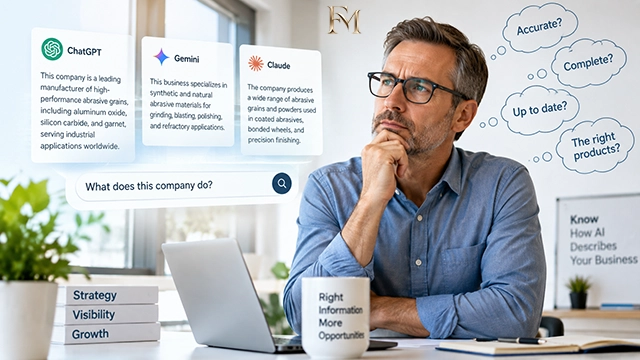
The question is whether ChatGPT, Gemini, and Claude understand enough about your company to make those distinctions.
The Frank Masotti AI Business Understanding Report manually evaluates what all three models currently understand about your company, where their descriptions agree, where they differ, what they leave out, and whether they recognize your business in relevant recommendation situations.
For an abrasive grain manufacturer, that can reveal far more than whether AI knows your company name.
What Does AI Understand About Your Abrasive Grain Manufacturing Business?
An AI search engine audit for an abrasive grain manufacturer is not an examination of how your plant uses artificial intelligence.
It examines what artificial intelligence understands about the company itself.
Does AI recognize you as an abrasive grain manufacturer?
Does it understand whether you produce natural abrasive grains, synthetic abrasive grains, or both?
Does it recognize the specific materials you manufacture?
Does it understand the particle sizes, grades, treatments, and applications associated with those materials?
Does it place your company at the correct point in the abrasive supply chain?
Those questions matter because abrasive grains are not interchangeable commodities simply because they all abrade another material.
Fused aluminum oxide, silicon carbide, zirconia alumina, garnet, emery, and other abrasive materials can have very different physical properties and intended applications. Even within one material family, grain size, shape, chemistry, toughness, friability, and treatment can affect where the product belongs.
An artificial intelligence search engine that understands only that your company “sells abrasives” has not necessarily understood the business very well.
Manufacturing Abrasive Grain Is Not the Same as Manufacturing Finished Abrasives
This is one of the most important distinctions AI needs to get right.
Your company may manufacture abrasive grain that another company uses to manufacture grinding wheels, coated abrasive belts, discs, sheets, or other finished products.
That does not mean you manufacture those finished products yourself.
An AI system could easily collapse those stages of the supply chain and describe an abrasive grain producer as a grinding wheel manufacturer, sandpaper company, blasting supply business, or general abrasive distributor.
The reverse problem is possible too.
A company that actually processes, sizes, grades, treats, or manufactures abrasive grain could be described merely as a supplier or distributor.
Those descriptions can sound close enough to pass casual inspection while still giving a prospective industrial buyer the wrong picture of what the company actually does.
This is why I distinguish AI understanding from simply being visible.
A company can appear in AI searches and still be understood incorrectly.
Does AI Understand the Materials You Actually Produce?
Abrasive grain manufacturing can span substantially different material families.
Synthetic abrasive grains can include fused aluminum oxide, silicon carbide, zirconia alumina, ceramic alumina, and other engineered materials.
Natural abrasive materials can include garnet and emery, among others.
A company may specialize in one material or serve several categories.
That creates plenty of room for incomplete AI understanding.
ChatGPT might associate your company strongly with aluminum oxide but overlook your silicon carbide products.
Gemini might understand that you supply synthetic abrasive grains but miss natural materials that remain commercially important to your business.
Claude could recognize your product names while misunderstanding what those materials are used for.
A manufacturer could also be associated with a material it no longer produces because old catalogs, directories, distributor listings, archived pages, or other historical information remain connected with the company online.
The important question is not whether an AI model can explain what silicon carbide or garnet is.
It is whether the model correctly understands your company’s relationship to those materials.
For companies specifically involved in fused alumina, I have also examined the narrower issues involved in fused aluminum oxide abrasive manufacturing.
Grain Size and Classification Can Change the Meaning of the Product
For abrasive grain buyers, material type is only part of the question.
Particle size matters.
Abrasive grains and powders can be produced and classified across wide size ranges. Depending on the product and market, buyers may work with macrogrits, microgrits, powders, flour abrasives, or other graded products.
Standards such as FEPA, ANSI, JIS, ISO, or other specifications may also matter depending on the market and application.
That creates a very specific AI understanding problem.
Suppose your company is known online for manufacturing aluminum oxide.
Does AI also understand the grit ranges you supply?
Does it recognize that your company produces material for bonded abrasives rather than assuming every grade belongs in a coated abrasive application?
Does it understand that particular powders are produced for lapping, polishing, refractory, or industrial applications?
Does it know whether you offer standard grades, custom sizing, treated grains, or narrowly controlled particle distributions?
An AI recommendation based only on material name could miss precisely the information an engineer or purchasing professional actually needs.
Grain Properties Can Matter More Than the Category Name
Two abrasive grains with the same general material description can behave differently.
Industrial buyers can care about properties such as:
- Hardness
- Toughness
- Friability
- Grain shape
- Chemical composition
- Purity
- Particle size distribution
- Surface treatment
- Fracture characteristics
- Bulk density
- Thermal properties
Not every characteristic matters for every product.
That is exactly the point.
A buyer looking for material for aggressive stock removal may ask a very different question from someone sourcing grain for precision lapping or fine polishing.
Someone manufacturing a bonded abrasive may care about different characteristics than a company producing coated abrasives.
A blasting operation can introduce still another set of requirements.
If your company has developed its reputation around particular grain characteristics, specialized grades, or applications, an AI audit can show whether those distinctions have become part of the models’ understanding of the company or disappeared into the generic category of “abrasives manufacturer.”
Does AI Understand Where Your Abrasive Grains Are Used?
Abrasive grains can feed multiple downstream industries and processes.
Depending on the manufacturer, those can include:
- Bonded abrasives
- Coated abrasives
- Grinding
- Cutting
- Blast finishing
- Surface preparation
- Lapping
- Polishing
- Flooring
- Refractory applications
- Precision manufacturing
- Automotive applications
- Aerospace applications
- Electronics and semiconductor processing
- Steel and metalworking
A manufacturer does not need to serve every one of those markets.
In fact, assuming that it does can itself become an AI misunderstanding.
The useful question is whether ChatGPT, Gemini, and Claude associate your company with the applications and industries you actually serve.
If an important portion of your business supplies abrasive grain for bonded products, does AI know that?
If you have specialized powders for polishing or lapping, are those capabilities recognized?
If your company primarily serves blasting and surface preparation customers, does AI understand that emphasis rather than presenting you as a source for every abrasive application?
Artificial intelligence search increasingly allows buyers to describe what they need instead of searching only for company names.
That means AI understanding of applications can matter alongside recognition of the manufacturer itself.
What Happens When the Three Models Understand Your Company Differently?
There is no reason to assume ChatGPT, Gemini, and Claude have formed identical pictures of an abrasive grain manufacturer.
One could understand your material range well but misidentify your primary market.
Another might correctly recognize the company as a manufacturer while overlooking specialty grades.
A third might recognize several applications but mistakenly place the company in finished abrasive manufacturing.
One model might identify your business when asked for manufacturers of a specific abrasive grain while another recommends different suppliers.
Those disagreements are not noise to be averaged into a visibility score.
They are findings.
My AI Business Understanding Report methodology evaluates ChatGPT, Gemini, and Claude independently and then compares their answers manually.
That comparison helps identify what all three consistently understand, what only one or two recognize, where their descriptions conflict, and what important information appears to be missing across the models.
This is also why comparing three AI models provides information that asking a single chatbot cannot.
What Can an Abrasive Grain Manufacturer Learn From the Report?
The analysis can reveal whether the three models understand:
- That your company actually manufactures abrasive grain
- Which natural and synthetic materials they associate with the company
- Whether they confuse raw abrasive grain with finished abrasive products
- Which particle sizes, grades, powders, or treatments they recognize
- Which industrial applications they associate with your products
- Whether important materials or capabilities are missing
- Whether outdated products remain associated with the company
- What attributes the models connect with your business
- Which competitors appear in relevant recommendation situations
- Whether the company is recognized for specific product and application questions
- Where ChatGPT, Gemini, and Claude disagree
Some findings may be outright errors.
Others may be technically correct but incomplete.
For an industrial manufacturer, that difference matters.
“Manufacturer of abrasive products” might sound reasonable while completely missing that your company specializes in manufacturing and grading abrasive grain supplied to other abrasive product manufacturers.
An AI description does not have to be obviously false to be commercially unhelpful.
What Does the $495 Report Include?
I manually evaluate your business across ChatGPT, Gemini, and Claude.
This is not a software scan and there is no automated visibility score.
The $495 one time report includes a 10+ page PDF covering the models’ understanding of your business, misunderstandings and omissions, associated attributes, recognition patterns, recommendation visibility, agreements and disagreements between the three models, strategic observations, and recommendations based on what the analysis finds.
The completed report is delivered the next business day after the analysis is finished.
I do not sell an SEO package, GEO service, AI optimization retainer, or implementation program afterward.
The purpose is diagnosis.
You can see how this works in the completed AI Business Understanding Reports or review the full report methodology.
Do ChatGPT, Gemini, and Claude Actually Understand Your Abrasive Grain Business?
You already know the difference between the materials you manufacture.
You know which grades matter.
You know which specifications customers request.
You know whether you manufacture natural grains, synthetic grains, specialty powders, graded material, or some combination of them.
You know which downstream applications your products were designed to serve.
The unanswered question is whether ChatGPT, Gemini, and Claude know those things too.
And if a purchasing professional, engineer, product manufacturer, or industrial customer asks an AI system to identify suppliers capable of providing the material they need, does that AI understand enough about your company to know where you fit?
The Frank Masotti AI Business Understanding Report costs $495 and gives you a manual comparison of what ChatGPT, Gemini, and Claude currently understand about your abrasive grain manufacturing business.
Find out what the three models actually think your company does.