
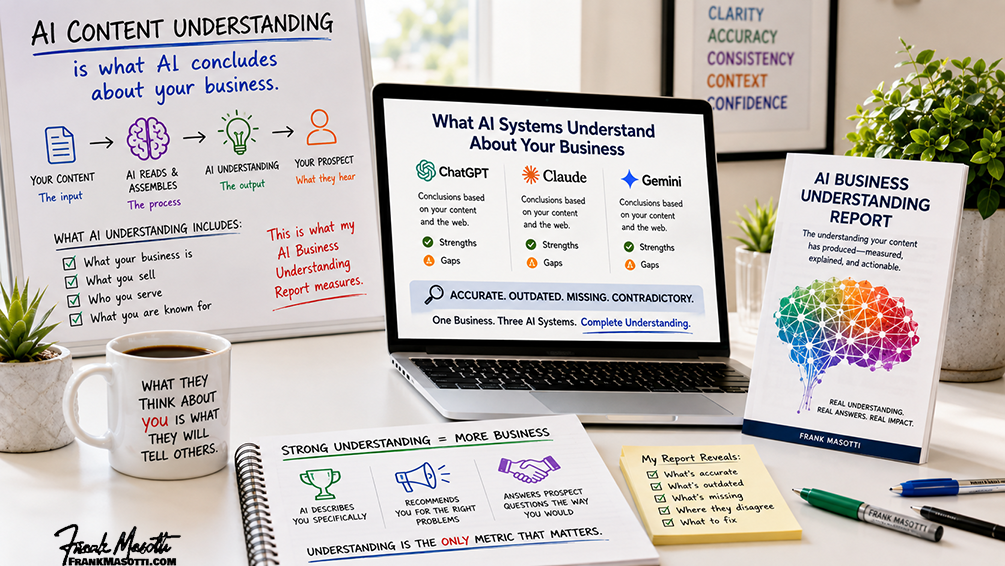
AI content understanding is what an AI system concludes about your business after reading your content. Not whether it found your pages, not whether it can quote them, but what it decided they mean: what your business is, what you sell, who you serve, and what you are known for. When someone asks ChatGPT, Claude, or Gemini about your company, the answer is assembled from that understanding, not from your content itself.
That is also the exact subject of my AI Business Understanding Report. The report does not audit your content, score your pages, or check your technical setup. It examines the thing your content produced: the understanding now sitting inside the three major AI systems, ready to be repeated to your next prospect. If you have been searching for what AI content understanding means and whether yours is any good, this post explains the first part, and the report exists to answer the second.
The Measurement Everyone Has Is on the Wrong Side
Every content metric you have ever seen measures the input side. Traffic tells you people arrived. Rankings tell you Google matched your page to a query. Engagement tells you someone scrolled. Even the newer AI visibility scores mostly count mentions and citations, which tells you your content was found and used, not what it was taken to mean.
AI content understanding lives on the output side, and nothing on a standard dashboard reaches it. Your content can rank well, read beautifully, and win awards while quietly producing an understanding that is vague, outdated, or wrong. The gap goes unnoticed because the two sides fail independently: AI crawling is not the same thing as AI understanding, so confirming that AI systems read your content tells you almost nothing about what they understood from it.
This is why the phrase matters at all. Content used to have two audiences, people and search engines, and we built measurements for both. It now has a third audience that reads everything, forms conclusions, and then speaks to your prospects on your behalf. Understanding is the only measurement that audience responds to.
How Content Becomes Understanding
The mechanism is worth knowing, because it explains why good content sometimes produces poor understanding.
AI systems read literally. Why AI Takes Your Words Literally covers this in depth, but the short version is that a model extracts meaning from what your sentences actually state, not from what a human reader would charitably infer. A page that says “solutions for the modern enterprise” states almost nothing, so almost nothing is what the model banks. A page that says you install commercial HVAC systems in the Phoenix metro area states four facts, and all four become part of the understanding. The same rule punishes loose sentences: ambiguous sentences create ambiguous AI answers, because a model asked to be specific can only be as specific as its inputs.
Understanding is also assembled, not copied. As explained in How AI Builds a Picture of Your Business From Information Across the Web, your website is one voice among many. Directories, old press coverage, reviews, and partner pages all contribute, and the model weighs them together. Your content is the voice you control, which makes it your strongest tool for shaping the result, but it does not get the final word by default.
Finally, understanding compounds through consistency rather than volume. Publishing constantly does not help if the pages repeat the same vague claims in rotating vocabulary, a trap covered in More Content Does Not Automatically Make Your Business Easier for AI to Understand. What sticks is repetition of specific, stable facts, because that repetition is how AI decides what your business is known for.
What Poor Understanding Looks Like in Practice
Abstract until you see it, so here is what weak AI content understanding actually produces. A model describes a specialized firm in generic category language, indistinguishable from every competitor. A model confidently lists a service the business discontinued three years ago, because old content still says so somewhere. A model hedges with phrases like “appears to offer” because the sources it read never quite committed to a claim. A model attributes a specialty to the wrong company, or blends two businesses into one description.
None of these are exotic failures. They are the ordinary result of content that was written for rankings or for humans skimming, then read by a system that takes words literally and assembles conclusions from everything it can find. And every one of them gets delivered to prospects in a calm, confident tone that gives no hint anything is off.
Why This Is Worth Money to Fix
The business case rests on one shift in behavior: customers are asking AI about businesses before they visit their websites. The first description many prospects hear no longer comes from your homepage. It comes from a model’s understanding of your content, filtered through whatever gaps and errors that understanding contains.
When the understanding is strong, your content keeps working in rooms you are not in. The model describes you specifically, recommends you for the right problems, and answers a prospect’s questions the way you would. When it is weak, the damage is silent. The prospect hears a vague or wrong description, forms an impression, and moves on. No analytics event fires. Your content did its job by every metric you track, and still lost the customer, because the metric that decided the outcome is one you have never seen.
Measuring the Output Side
This is the whole reason my AI Business Understanding Report is named the way it is. Understanding is the product of your content, and the report measures the product.
I question ChatGPT, Claude, and Gemini about your business from many angles, the way real prospects do. I read every answer and document what each model believes: what is accurate, what is outdated, what is missing, where the three disagree, and where the description drifts from reality. Then I trace the problems back toward their likely sources in your content and the other information AI is drawing from, so the findings are actionable instead of just alarming. The full process is laid out in how it works, and the mechanics behind what I am testing are explained in How AI Understanding Actually Works.
What you get is the measurement your dashboards cannot give you: a plain written account of what your content taught the three major AI systems to say about your business.
The Question That Remains
You now know what AI content understanding is. What you cannot know from the inside is whether yours is accurate, because you read your own content already knowing what it means. The only honest test is to look at the output, and the output is sitting in three AI systems right now, shaping what your next prospect hears.
Ordering a report is how you look. It will show you the understanding your content has produced, exactly as ChatGPT, Claude, and Gemini hold it today, and where that understanding needs to change.