
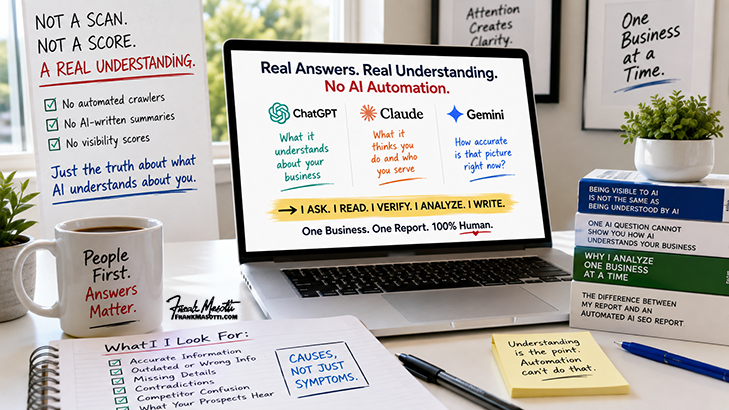
If you are wondering whether my AI Business Understanding Report is produced by AI automation, the answer is no. No automated scanner crawls your site. No AI writes the analysis. No software assigns you a score. I sit down with ChatGPT, Claude, and Gemini, ask them about your business the way your prospects do, read every answer myself, and trace what I find back to its causes by hand. The report you receive is written by me, about your business specifically, based on what I actually observed.
That answer surprises people, and the surprise is worth examining. The report is about AI, so the assumption is that AI must be producing it. Almost everything else in this space works that way. You paste in a URL, software runs for a minute, and a dashboard appears with a visibility score and a list of technical checkboxes. So when someone finds my AI Business Understanding Report, the natural question is which tool I am running behind the scenes.
I am not running one. And that is not a limitation I am working around. It is the entire point of the service.
Why AI Automation Cannot Answer This Question
Start with what the report is actually for. It answers one question: what do ChatGPT, Claude, and Gemini currently understand about your business? Not whether your pages load fast, not whether your markup validates, not how often your name appears somewhere. What these systems believe you do, who they think you serve, and whether that picture is accurate, outdated, blended with a competitor, or quietly wrong in ways that cost you customers.
That is a question about meaning, and meaning is where AI automation stops working.
An automated scan can count things. It can confirm your schema is present, measure how often your business gets mentioned, and check pages against a list of technical criteria. Those are real measurements of real things. But none of them can tell you that Gemini describes you as a residential contractor when you moved to commercial work four years ago. None of them can notice that Claude has merged your company with a similarly named business two states away. None of them can recognize that ChatGPT answers questions about you in vague generalities because your own sources contradict each other. Software can detect the presence of information. It takes a person to judge whether an answer is right, and judging answers is the whole job.
I wrote about this distinction at length in the difference between my report and an automated AI SEO report, and the pattern behind it shows up across this entire industry: being visible to AI is not the same as being understood by AI. Automated tools measure visibility because visibility is what software can measure. Understanding is a different question, and it is the one your customers actually experience.
The Irony of Using AI to Check AI
There is a second reason I keep AI automation out of my AI Business Understanding Report, and it is the one people find most convincing once they hear it.
Suppose I automated the analysis. I could feed AI answers about your business into another AI and ask it to summarize what it found. That would be faster and cheaper. It would also mean handing you a stack of unverified AI output as the solution to a problem caused by unverified AI output. The entire reason you would order this report is that AI systems sometimes describe businesses confidently and wrongly. An automated pipeline inherits exactly that weakness. If the summarizing model misreads an answer, blends two findings, or smooths over a contradiction, nobody catches it, because no person ever looked.
The value of the report is that a person did look. I read what each model says, I compare the three against each other, and I check their claims against what is true about your business. When the models disagree, I do not average the disagreement into a score. I document it, because what agreement between ChatGPT, Claude, and Gemini can tell you is often the most useful finding in the whole report. And because understanding cannot be probed with a single prompt, I ask many questions from many angles, since one AI question cannot show you how AI understands your business.
This is also why I analyze one business at a time. Manual work does not scale the way AI automation scales, and I am fine with that. A report built on attention cannot be mass produced without losing the attention.
What the Automated Alternative Actually Gets You
I am not claiming automated tools are useless. They are useful for what they measure. If you want to track mentions or monitor technical health across hundreds of pages, software is the right instrument, and I have covered the category honestly in What is the best AI visibility tool?
The problem is what happens when an automated score stands in for understanding. A business owner sees a strong visibility number and concludes everything is fine, while Gemini is still describing the business they used to be. Another sees a weak score, pays for optimization work, and never learns that the real issue was a name collision with another company that no checklist would ever surface. In both cases the tool did its job. It measured what it measures. It just was not measuring the thing that determines what your next prospect hears, which is why a good AI visibility score is a much less settled idea than the dashboards suggest.
Meanwhile the actual stakes sit somewhere no scanner reaches. Your prospect may ask AI about you before contacting you, and the answer they receive is assembled from whatever the model understood, correctly or not. If that answer is wrong, you do not get an error report. You get silence.
What You Actually Receive
So here is what my AI Business Understanding Report is, stated plainly. It is a manual investigation. I question all three major AI systems about your business, in depth and from multiple directions. I read everything they say. I identify what is accurate, what is outdated, what is missing, and where the models contradict each other or reality. Then I write it up in plain language, with the evidence shown, so you can see exactly what your prospects are being told and why. The full process, from consultation to delivered report, is laid out in how it works, and you can judge the depth for yourself in the library of completed reports.
No AI automation at any step that matters. Not because I am opposed to software, but because the question you are paying to have answered is a question software cannot answer.
If you want a score, plenty of tools will generate one in sixty seconds. If you want to know what ChatGPT, Claude, and Gemini actually understand about your business, and what to do about the places they get it wrong, that takes a person paying attention. That is what I do, one business at a time, and ordering a report is how you get that attention pointed at yours.