
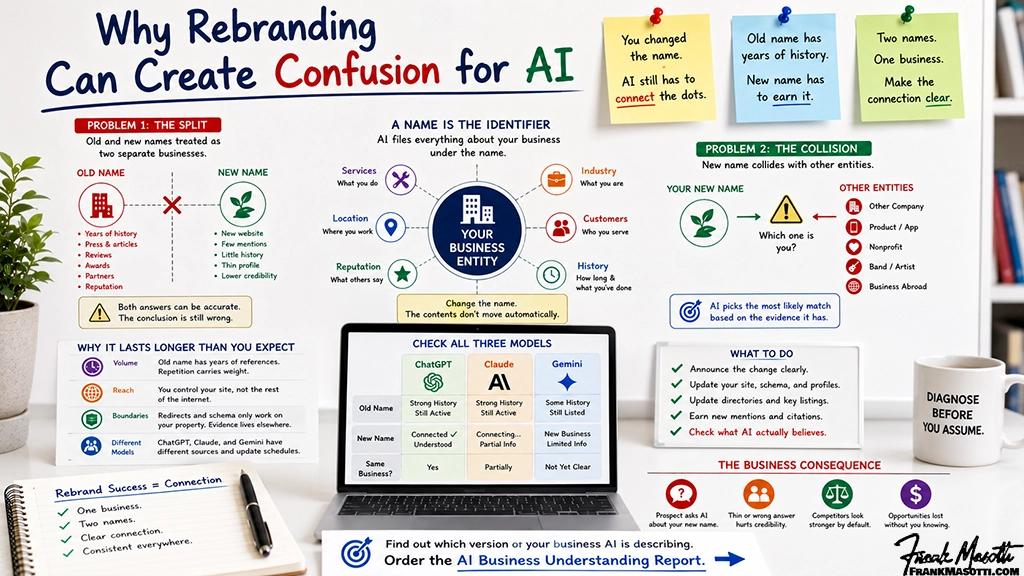
If you have rebranded and AI still describes your company under the old name, or describes the new name as though the business opened last month, the cause is not that AI missed your announcement.
The cause is that a name is not a detail about your business. A name is the label AI files your business under. Change the label, and the contents do not automatically move with it.
Most business changes are updates to an existing record. A new service, a new location, a new market. The record stays where it is and the contents change. A rebrand is a different request entirely. A rebrand asks artificial intelligence to accept that two different names refer to the same organization, and that everything attached to the first name now belongs to the second.
That is a much larger ask, and nothing about launching a new website forces a model to agree to it.
A name is how AI holds everything else together
AI models do not store businesses as pages. They work with entities. An entity is a thing that can be identified, distinguished from similar things, and described. If that idea is new to you, I explained it in what is an entity and why does AI care, and why models are built to think in entities rather than pages.
The practical point is this. Everything a model believes about your company sits attached to an identifier, and for most businesses the primary identifier is the name. Your services, your location, your industry, your reputation, your customers, your history. All of it hangs on that one hook.
When you rebrand, you publish a new hook while the rest of the internet continues holding years of information on the old one. Whether those two hooks get connected is a decision the model makes, not a decision you make.
Two things can go wrong. They are different problems and they need different diagnoses.
The first problem: the split
In a split, the old name and the new name are treated as two separate businesses.
Everything that took years to accumulate stays attached to the old identity. Press coverage, awards, case studies, partner pages, directory listings, interviews, conference bios, supplier references, review histories. The new identity has a website, a few recent mentions, and very little else.
Ask a model about the new name and you may get an answer that is accurate and thin. A small company, recently established, limited information available. Ask about the old name and you may get a description of an active business that no longer operates under that name.
Read separately, neither answer contains an obvious error. Read together, the picture is badly wrong. This is the same pattern I described in how AI can combine accurate facts into an inaccurate conclusion. The individual statements survive fact checking. The conclusion does not survive contact with reality.
For a company with a long operating history, the split is expensive in a specific way. Your credibility is the thing that got stranded.
The second problem: the collision
The second failure runs in the opposite direction.
New names tend to be shorter, broader, and more abstract than the names they replace. A descriptive founding name gets retired in favor of something cleaner and more flexible. That instinct is understandable from a branding perspective, and it creates a real difficulty for AI, because the traits that make a name feel modern are often the traits that make it ambiguous.
Short and abstract names are frequently already in use. A software product, a nonprofit, a consultancy in another country, an app, a band. When a model encounters a name that already belongs to several things, it has to decide which one you are, and it makes that decision using the information available rather than the information you wish were available.
The result can be a description of your company that quietly absorbs details belonging to something else. That is not a fringe scenario. It is the ordinary behavior of a system that resolves ambiguity by choosing the most likely candidate, and it is closely related to what happens when AI finds conflicting information about a business.
Why the confusion lasts longer than owners expect
Two forces work against a clean transfer.
The first is volume. Your old name may have accumulated references for a decade. Your new name has been in circulation for months. When a model weighs how consistently the internet says something, weight of repetition matters, which is one reason AI may trust old information about your business well after you consider the change complete.
The second is reach. You control your own website completely. You control almost nothing else. Redirects move traffic on your domain. They do not rewrite a directory listing, a trade publication archive, a partner site, or a profile someone else maintains. Structured data has the same boundary, which is why schema stops at the edge of your website. Everything you publish is one voice among many in the picture AI builds from information across the web.
There is a further complication. The three major models are not working from identical sources and do not update on the same schedule. One may have connected your two names cleanly. Another may still hold them apart. Checking a single model tells you about that model only, which is the point I made in if ChatGPT understands my business, Gemini and Claude probably do too.
What this actually costs
The damage from a rebrand that AI has not absorbed shows up in ordinary buying situations.
A prospect hears your new name from a referral and asks a model who you are. If they get a thin answer, they do not conclude that AI is behind. They conclude that you are small, new, or unproven. Verification failed, and neither of you knows it happened.
A buyer comparing three vendors gets a comparison built from whichever record the model is holding. Your competitor is described with a decade of context. You are described with a website.
And the reputation you spent years building continues to work for a name that no longer answers the phone.
The usual fixes are correct and incomplete
Announcing the change, redirecting the old domain, updating your structured data, and refreshing your profiles are all worth doing. Every one of them is also limited to property you control.
The step most owners skip is the diagnosis. Before you can decide whether the transfer worked, you have to find out what each model currently believes about both names, and whether it believes they are the same company. Interpretations can often be changed, but not by guessing at which of the two problems you have.
What I check when a business has rebranded
The AI Business Understanding Report is a manual comparison of how ChatGPT, Claude, and Gemini currently understand a specific business. When a company has rebranded, I check both names deliberately.
I document whether each model connects the old name to the new one, which identity is holding the history and credibility, whether the new name is colliding with an unrelated organization, what each model believes the business does today, and where the three models disagree with each other. Disagreement is useful information. It usually marks the exact place where the record is incomplete.
A rebrand is finished the day you launch it. The transfer of understanding is not finished on any particular day, and it does not announce itself when it completes.
If you have changed your name and you do not know which version of your company AI is describing to your next customer, that is a question worth answering with evidence rather than assumption. You can order the AI Business Understanding Report here.