
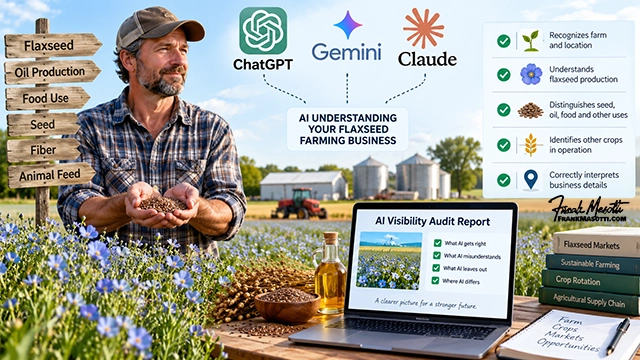
A flaxseed farmer knows whether the operation is producing flax for commodity markets, food use, oil production, seed, or as one crop within a larger farming operation. ChatGPT, Gemini, and Claude have to figure those distinctions out from the information they can find and interpret about the business. Someone researching flaxseed producers, oilseed farms, agricultural suppliers, or potential business relationships can ask an AI system about your operation without you ever seeing the question or the answer.
The $495 Frank Masotti AI Business Understanding Report manually examines what ChatGPT, Gemini, and Claude currently understand about your flaxseed farming operation. It shows what they understand correctly, what they misunderstand or leave out, and where the three AI systems have formed different conclusions about the same farm.
For flaxseed farming, the details matter. An AI system might recognize the farm as an agricultural operation without strongly associating it with flaxseed. It could understand that the farm grows flax while confusing seed production with other uses of the flax plant. It might recognize several crops grown by the operation but fail to understand which ones are important to the business today.
You already know those answers. The question is whether the AI systems know them too.
What Is a Flaxseed Farming AI Visibility Audit Report?
A flaxseed farming AI visibility audit report examines how AI systems understand, describe, categorize, and potentially recommend a particular flaxseed farming operation.
This is not an audit of how you use artificial intelligence on the farm. It is not an AI system grading your farming practices, and it is not an automated website scanner.
An AI visibility audit in this context examines the business from the other direction. Instead of asking how the farm uses AI, it asks what AI understands about the farm.
For a flaxseed operation, that can include whether ChatGPT, Gemini, and Claude recognize the business as a farm, associate it with flaxseed production, understand other crops connected with the operation, identify its location correctly, recognize relevant characteristics, and understand what kind of flax producer it actually is.
That last distinction is important.
Flax can be associated with seed, oil, food products, animal feed, fiber, agricultural seed, and other uses. A model knowing that a business is connected with “flax” does not necessarily mean it understands the role the farm actually plays.
Recognition is useful.
Correct interpretation is better.
Why Does a Flaxseed Farm Need an AI Audit?
Flaxseed farming gives AI several distinctions to get right.
The first is what the operation actually produces.
A farm growing flax for seed is not automatically the same thing as a business associated with flax fiber, processed flax products, flaxseed oil, or other parts of the industry. The words and industry relationships surrounding the crop can connect a farming operation with businesses that do very different things.
An AI system has to sort those relationships out.
There is also the question of what kind of flaxseed production is involved. One farm may grow flax as a commodity oilseed crop. Another may emphasize food grade production. Another may produce certified or other planting seed. Organic production can create another meaningful distinction.
Then there is the rest of the farm.
A flaxseed producer may also grow wheat, canola, barley, pulses, or other crops depending on the operation and region. Flax may be a major part of the business, a specialty crop, or one component of a much broader crop rotation.
If an AI system recognizes the other crops but barely associates the farm with flaxseed, it has one version of the business.
If another strongly identifies the operation with flaxseed but misses the broader crop operation, it has another.
Terminology can create another wrinkle. Flaxseed and linseed can refer to the same crop while being used differently depending on the market, product, or context. An AI system can encounter both terms while trying to determine what a particular farming business actually produces and where it fits within the flax industry.
Geography matters as well. The farm’s mailing address may identify one town while the actual farming operation covers land across a larger area. Storage, delivery points, buyers, processors, and other agricultural relationships may extend the business footprint beyond the address AI most easily associates with the company.
Those are not generic farming questions.
They are part of determining whether AI has built the right picture of a flaxseed farming operation.
What Can an AI Audit Reveal About a Flaxseed Farming Business?
A useful AI audit can show whether ChatGPT, Gemini, and Claude have connected the right facts to the right business and whether those facts produce an accurate overall interpretation.
For a flaxseed farm, I would want to know whether the models recognize flaxseed production as an important part of the operation.
Do they understand the farm as an oilseed producer?
Do they confuse flaxseed production with flax fiber or another part of the flax industry?
If the operation produces food grade, organic, planting seed, or another specific type of flaxseed, is that distinction visible in the models’ understanding?
Do the models recognize other crops grown by the operation?
Do they understand the correct geographic area?
Are they associating the farm with processors, suppliers, products, or activities that belong elsewhere in the flax industry?
Are older descriptions of the farm still influencing how it is characterized today?
Then the three answers have to be compared.
ChatGPT might strongly associate the business with flaxseed production while giving only a vague description of the larger farm.
Gemini might recognize the crop mix but treat flax as a minor detail.
Claude might correctly understand the farming operation while using terminology or attributes that suggest a different market than the one the farm actually serves.
The point is not that any particular flaxseed farm has these problems.
The point is that you cannot know which problems exist until you examine the answers.
That is also why one AI question cannot show you how AI understands your business.
Flaxseed Farming Can Create Business Category Confusion
One of the more interesting questions for a flaxseed farm is whether AI understands where the business stops and the rest of the flax industry begins.
A farmer grows the crop.
Other businesses may clean or process seed, crush flaxseed for oil, manufacture food products, produce animal feed ingredients, work with flax fiber, distribute agricultural seed, or sell products made from flax.
A farming operation can appear online in connection with some of those businesses because they are part of the same supply chain.
That does not make them the same kind of business.
If ChatGPT knows your farm is connected with flaxseed but misunderstands that relationship, the individual facts it found can be accurate while the conclusion is wrong.
I have written separately about how AI can combine accurate facts into an inaccurate conclusion. Flaxseed farming provides a practical example of why that distinction matters.
The question is not simply whether AI found information about the farm.
It is what AI concluded from that information.
What If Your Flaxseed Operation Has Changed?
Farms do not remain frozen in time.
A flaxseed producer can increase or reduce flax acreage, add another crop, leave a market, enter a specialty market, change buyers, add storage, change ownership, bring another generation into the operation, or restructure the business.
Information describing the farm before those changes does not necessarily disappear.
Old agricultural directories, articles, association references, business listings, buyer information, and other sources can continue existing alongside newer information.
That matters because outdated information can continue shaping AI’s understanding.
A model could accurately describe what the farm looked like several years ago while missing what the operation has become.
For the farmer, the change is obvious.
For an AI system assembling its understanding from information spread across the web, it may not be.
An AI audit gives you a way to see which version of the operation the models currently appear to understand.
Why Compare ChatGPT, Gemini, and Claude?
There is no reason to assume ChatGPT, Gemini, and Claude have constructed identical pictures of the same flaxseed farm.
One may recognize the farm immediately.
Another may have limited information about it.
One may understand its flaxseed production correctly while another emphasizes different crops.
One may distinguish the farm from processors and other flax related businesses while another produces a broader agricultural description.
That disagreement is useful information.
As I explain in What Is a Multi Model Comparison, and How Do I Use It in My Report?, comparing multiple systems can expose differences that disappear when you look at only one AI answer.
If all three independently understand the operation correctly, that is a finding.
If two agree and one reaches a different conclusion, that is a finding.
If all three omit the same important characteristic of the farm, that is a finding too.
The goal is not to turn those answers into a single visibility score.
The goal is to understand what the answers actually mean.
How the Frank Masotti AI Business Understanding Report Works
The Frank Masotti AI Business Understanding Report is performed manually.
I evaluate the same flaxseed farming business across ChatGPT, Gemini, and Claude using a structured methodology. Each system is evaluated independently so I can examine what it understands without using the other models to fill in missing information.
I then compare the results.
I look at recognition, business category, important attributes, misunderstandings, omissions, recommendation visibility, outdated information, agreements and disagreements between models, and other interpretation patterns revealed by the responses.
You can read the complete AI Business Understanding Report methodology and see how the report works before ordering.
This is not software producing an automatic AI audit report.
I read the responses, compare what the models are saying, identify meaningful differences, and write the analysis based on what I find.
What Does a Flaxseed Farmer Receive?
The Frank Masotti AI Business Understanding Report costs $495 as a one time purchase.
You receive a 10+ page PDF report based on a manual evaluation of your flaxseed farming business across ChatGPT, Gemini, and Claude.
The report includes findings about AI understanding, misunderstandings and omissions, attributes associated with the business, recognition patterns, recommendation visibility, agreements and disagreements between the models, interpretation drift, outdated or incorrect information, strategic observations, and recommendations based on the findings.
The finished report is delivered the next business day after the analysis is completed.
There is no software to install.
There is no AI visibility dashboard to learn.
There is no monthly subscription attached to the report.
You are purchasing the manual analysis and the finished report.
What Happens After the AI Audit?
After the report, you no longer have to guess what the three AI systems currently understand about your flaxseed farming operation.
You can see where the models appear accurate.
You can see what they leave out.
You can identify incorrect or outdated information appearing in their understanding.
You can see whether they understand the role flaxseed plays within the larger farming operation.
You can see whether all three models have reached roughly the same conclusion or whether each has constructed a different version of the farm.
Then you have recommendations based on what the analysis actually found.
I do not sell an SEO package, GEO service, AI visibility optimization program, or implementation retainer after delivering the report.
The principle is diagnosis before prescription.
Find out what the problem actually is before deciding what, if anything, deserves to be changed.
Do ChatGPT, Gemini, and Claude Understand Your Flaxseed Farming Operation?
You know whether flaxseed is a major crop for your operation.
You know what type of flaxseed you produce, what other crops you grow, where you farm, who your markets are, how the operation has changed, and what separates your business from other companies connected with the flax industry.
ChatGPT, Gemini, and Claude have to construct that picture for themselves.
The unanswered question is how close their version is to yours.
Do all three recognize the farm?
Do they associate it with flaxseed production?
Do they understand what kind of flaxseed operation it is?
Do they distinguish the farm from processors, seed suppliers, fiber businesses, and other companies connected with flax?
Do they understand the other important parts of the farming operation?
And do all three AI systems agree?
For $495, the Frank Masotti AI Business Understanding Report will show you.
Order your AI Business Understanding Report and find out what ChatGPT, Gemini, and Claude currently understand about your flaxseed farming business.