
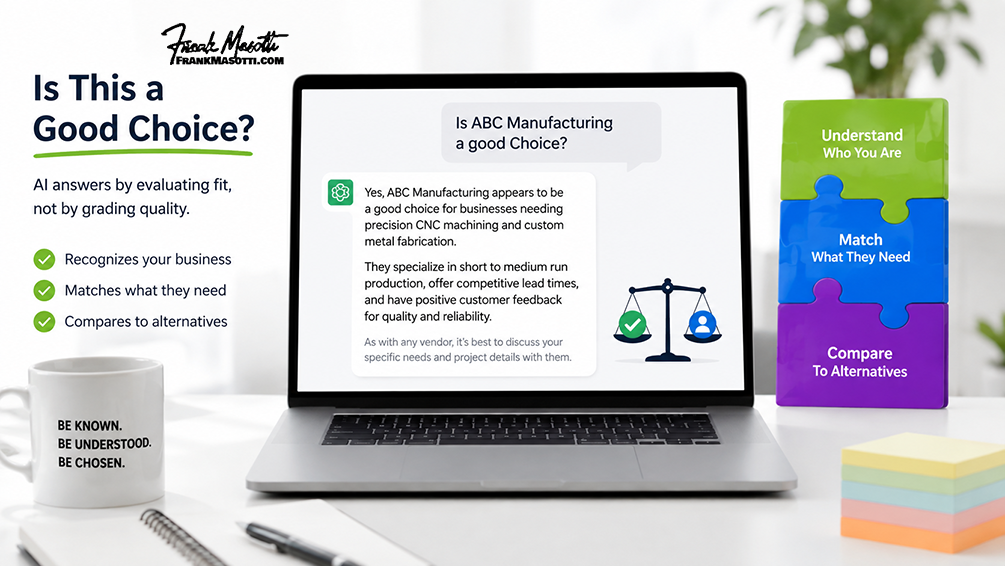
Someone types your business name into ChatGPT and asks a simple question: is this a good choice? It is one of the most consequential questions anyone can ask about your company, and you will never see the answer.
Here is what actually happens. AI does not answer that question by evaluating your quality. It answers it by evaluating fit. It takes whatever understanding it holds about what your business does, compares that against whatever the person said they needed, and produces a judgment about whether the two line up. Reviews, longevity, and credentials get mentioned when the model has them, but they are supporting detail. The core of the answer is a fit calculation running on a picture of your business that you have never reviewed and did not write.
That distinction explains something owners find baffling. A genuinely strong business can receive a lukewarm answer. Not because AI found something negative, but because the picture it holds is vague, dated, or slightly off your real specialty. The model then answers accurately about a business that is a little bit different from yours, and the person asking has no way to tell the difference. The rest of this post breaks down what AI is actually measuring when it decides whether you are a good choice, why a well run company can fail that test, and what it costs when it happens.
“Good Choice” Is a Comparison, Not a Grade
Nobody asks this question in a vacuum. The real query is almost never “is this business good.” It is “is this business a good choice for a small manufacturer,” or “for someone who needs this done quickly,” or “for a family with two young kids.” There is a qualifier attached, and that qualifier is doing most of the work.
Even when the qualifier is missing, the model supplies one. Asked a bare question about whether a company is any good, an AI system reaches for the category it believes you belong to and answers relative to that category. Good compared to what? Compared to the other businesses it holds in the same mental bucket, and compared to what it assumes a typical buyer in that space wants.
So the answer your prospect receives is a relative judgment, made against a set of alternatives you were never told about, using a description of your business you never approved. Three separate things have to be right for that answer to serve you, and only one of them is about your business at all.
The Three Checks Running Behind the Answer
Does the model recognize you as a distinct business? Before it can judge fit, AI has to know who you are. If your name resembles another company, or if you operate in a market with several businesses using similar wording, the model may be blending you with a neighbor. I covered that failure in Entity Confusion Between Similar Businesses. When it happens here, the consequence is sharper than usual: the recommendation your prospect reads may be an assessment of a competitor wearing your name.
Does what you do match what they asked for? This is the heart of the answer, and it depends entirely on what the model believes you are known for. That belief is assembled from patterns across many sources, and it does not update just because you changed. If you built a specialty over the last three years but the wider web still describes you the way it did five years ago, the model will match the older version against your prospect’s need. Why AI May Recognize Your Business but Misunderstand Its Specialty explains why recognition and understanding come apart, and How AI Decides What Your Business Is Known For covers how that reputation gets formed in the first place.
How do you compare to the alternatives it holds? AI answers recommendation questions comparatively, and it usually volunteers competitors without being asked. Two companies with nearly identical capabilities can land very differently, purely because one is described clearly and consistently across the web and the other is not. That is the mechanism behind Why Two Similar Businesses Can Be Understood Very Differently by AI, and it is the practical reason behind the question I hear most often, which I address directly in Why Does AI Recommend My Competitors But Not Me?
Notice that none of the three checks is a quality assessment. They are all understanding assessments. Your actual excellence is downstream of whether the model can describe you correctly.
What a Weak Answer Actually Sounds Like
Business owners imagine the bad outcome is AI saying something negative. That almost never happens. AI is not in the business of criticizing companies, and it has no verified performance data to criticize you with.
The bad outcome is softer and much easier to miss. It sounds like this: “They appear to be a general provider in this space. Depending on your specific needs, you may also want to look at a few other options.” Nothing there is an insult. Nothing there is even wrong, exactly. But a buyer reads that as a shrug, and a shrug at this stage of the decision is functionally a no.
That hedge is what incomplete understanding looks like when it reaches a customer, and it is worth learning to recognize. I broke the tells down in What AI Uncertainty Looks Like When It Describes a Business. The reverse failure is just as costly and harder to catch: the model has a strong but outdated pattern, so it answers with total assurance about work you no longer do. Confident tone tells your prospect nothing about whether the underlying picture is current, which is the problem I explored in Why AI Sometimes Sounds Certain When Its Understanding Is Incomplete.
Both outcomes look completely normal to the person reading them. That is what makes this hard to catch on your own.
The Same Question, Asked Differently, Gets a Different Verdict
There is one more layer. This is not a single answer sitting somewhere waiting to be looked up. The response changes with the phrasing of the question, because different phrasings pull on different parts of what the model holds. Ask about a business by name and you get one answer. Ask whether that business is a good fit for a specific project and you may get a noticeably different one. I unpacked that behavior in Why AI May Describe Your Business Differently Depending on How a Question Is Asked.
The answer also changes across models. ChatGPT, Claude, and Gemini were trained on different material and hold different pictures of the same company, so a favorable verdict from one tells you very little about the other two. That is the point of All AI Models Know the Same Things. They Don’t.
Why This Is the Most Expensive Moment to Lose
Most conversation about AI and business focuses on discovery, on whether AI mentions you at all when someone asks for options in your category. That matters. But the question in this post’s title is a different and later moment.
Someone asking whether you are a good choice already has your name. They found you, they are interested, and they are doing a final check before they call or fill out a form. This is the closest thing to a qualified lead that exists, and it is happening in a conversation you are not part of. Your Prospect May Ask AI About You Before Contacting You and Customers Are Asking AI About Businesses Before They Visit Their Websites both cover how routine this behavior has become.
When that check goes badly, you get no signal at all. There is no bounce, no form abandonment, no bad review to respond to. The prospect simply does not arrive. Your analytics look fine because the loss happened before any of your systems could observe it. And because the process rewards clarity rather than merit, the business that wins that comparison is often not the better operator. It is the one the model can describe with confidence. That is the practical meaning of Being Visible to AI Is Not the Same as Being Understood by AI.
How to Find Out What AI Is Telling Them
You cannot resolve this by asking ChatGPT about yourself once. A single question returns one output, from one model, on one phrasing, and it will probably be flattering enough to be reassuring. That is exactly the trap I described in One AI Question Cannot Show You How AI Understands Your Business.
The AI Business Understanding Report is built for this. I question ChatGPT, Claude, and Gemini about your business from multiple angles, including the fit and comparison questions a real prospect would ask, and I document what each model believes you do, who it thinks you serve, which competitors it raises alongside you, and where its picture has drifted from reality. I do the work by hand, one business at a time, because the interesting findings are in the wording of the answers rather than in a score.
The judgment AI makes about your business is already being delivered to people who were seriously considering you. Ordering a report is how you find out what it says.