
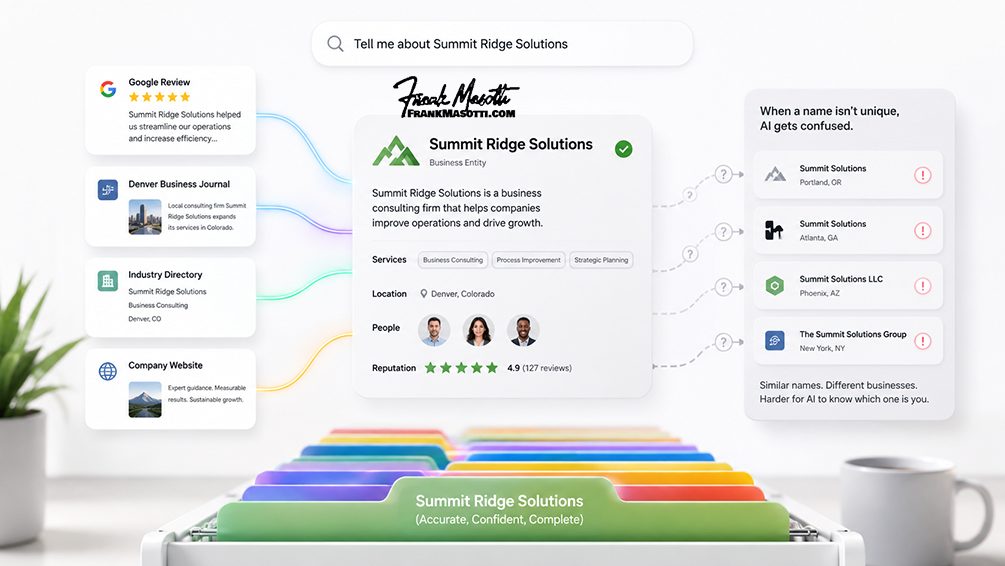
If you are choosing a business name, or trying to understand why AI keeps describing your company slightly wrong, the answer starts in the same place. Your name is the identifier AI uses to file everything it learns about you. A distinctive name gives it one obvious place to put each mention. A common name gives it a decision to make, thousands of times over, with no reliable way to make it correctly.
This is not a branding preference. It is a description of how the systems actually work. When ChatGPT, Claude, or Gemini answers a question about your business, it is drawing on a collection of information it has gathered and grouped under a name. The name is the thread that ties a review in one place to an article in another to a directory listing in a third. When that thread is unique, the grouping is clean. When the thread is shared with other companies, or with ordinary language, the grouping gets messy, and every answer built from it inherits the mess.
So a unique name helps for a specific, mechanical reason: it reduces the number of judgment calls AI has to make about what belongs to you. Fewer judgment calls means fewer wrong ones.
Your Name Is the Key Everything Gets Filed Under
AI thinks in entities, which means it organizes what it knows around distinct things rather than around pages. Your business is one of those things. So are your services, your locations, and the people who work there. Business names are entities, and if you want the underlying concept in plain terms, what an entity is and why AI cares covers it.
The practical part is what happens next. AI builds a picture of your business from information scattered across the web, one mention at a time. Most of those mentions are thin. A review that names you and describes a job. A local article that mentions you in a list. A supplier page with your name and a city. Almost none of them include enough context to prove which company is meant. They simply use the name and assume the reader knows.
That assumption works for humans. A customer in your town reading a review knows exactly which company their neighbor is talking about. AI has no such vantage point. It is reading everything at once, from everywhere, with no local knowledge to fall back on. All it has is the name and whatever sits next to it. That is also how AI connects a business name with its services, people, and locations: by noticing what keeps appearing near the name.
A unique name makes that process nearly automatic. Every mention lands in the same file because there is nowhere else it could go.
The Three Ways a Name Fails to Identify You
Names fail as identifiers in three distinct ways, and they are worth separating because they call for different responses.
The first is the obvious one. Another company somewhere shares your name or something close to it. This is how entity confusion between similar businesses starts, and it does not require the other company to be nearby or in your industry. Distance is a human concept. To AI, text from another state sits directly beside your own.
The second is quieter and more common. Your name is built from words that already carry heavy meaning elsewhere. Summit. Apex. Precision. Elite. Advantage. Momentum. Premier. These words appear constantly in ordinary business writing, which means a sentence containing your name is not obviously a sentence about you. It might be a sentence about a summit, or about precision. The name does not stand out from the language around it, so it does less work as a signal. Descriptive names have the same problem in a different form. A name that is mostly a category, something like Valley Dental Care, tells AI what you do while telling it very little about who you are.
The third is variation. Names that differ from a competitor’s by a single word, or that get written several different ways in the wild, create a steady stream of ambiguous mentions. Some of them get filed correctly. Some do not. This is one reason consistent terminology matters so much: when the name itself is weak, consistency in how it is written becomes the only thing holding the file together.
What a Distinctive Name Actually Buys You
The benefit compounds, which is the part most owners underestimate.
With a distinctive name, every new mention strengthens an already clear picture. A review adds to what AI knows about your reputation. An article adds context about your specialty. A listing confirms your location. Nothing has to be sorted first, because there is nothing to sort it against. Over time the file gets deeper and more confident, and answers about you get more specific.
With a generic name, the same volume of mentions produces a shallower result. Some of your evidence gets attached to someone else. Some of theirs gets attached to you. The file grows, but it grows blurry. This is a large part of why two similar businesses can be understood very differently by AI even when both are doing everything right. One of them has a name that sorts itself, and the other does not.
There is an asymmetry underneath this that is easy to miss. When two businesses share a name and one has far more coverage, the larger file becomes the default. Questions about the smaller company get answered with the larger one’s information, simply because that is where the evidence is concentrated. A distinctive name protects you from that outcome permanently. A shared name means you are always competing for your own identity, and the competition is decided by volume rather than by accuracy.
The damage from all of this is rarely total. AI does not usually get your business completely wrong. It gets it mostly right and mixes in details that belong to someone else, and AI does not need to get every fact wrong to misunderstand your business. One borrowed price range or one imported complaint inside an otherwise accurate answer is enough to lose a prospect.
If You Already Have a Common Name
Most business owners reading this are not naming anything. They already have a name, it is on the truck and the invoices and the sign, and changing it is not a real option. That is worth taking seriously, because renaming carries its own risk. Rebranding can create confusion for AI, and what happens to AI understanding when a business changes its name is often a period where the old name holds the reputation and the new one holds almost nothing. A name change to escape confusion can create a different confusion that lasts longer.
The better approach is to make the name work harder without replacing it. That means giving AI reliable anchors that travel with your name wherever it appears. Use your full name consistently rather than a casual short version. Put your city and state next to the name in your own content and in every listing you control. Describe your specialty the same way everywhere, so that the specialty itself becomes part of how you are identified. Your Organization schema helps here as well, by stating your exact name, location, and identity in a format designed to be unambiguous. Organization Schema Explained covers what it does and what it does not do.
What it does not do is reach past your own domain. Schema stops at the edge of your website, and the mentions creating the ambiguity are almost always somewhere else. You can strengthen the anchors on your side. You cannot make every review, article, and listing on the web specify which company it means.
The Part You Cannot See From Inside
None of this shows up in your analytics. Your prospect may ask AI about you before contacting you, and if the answer they receive is blended with a namesake, they do not call to tell you. They just do not call. The cost of a weak identifier arrives as an absence, from people who believe they already learned what they needed to know.
It is also uneven across systems. All AI models do not know the same things, so one model may keep you and your namesake perfectly separate while another has merged you completely. Checking a single model and getting a clean answer proves very little about what the others are saying.
Finding Out What Your Name Is Actually Doing
A unique name is an advantage you either have or you do not. What you can control is knowing where you stand, and that requires looking at the answers themselves rather than at your own website.
That is what the AI Business Understanding Report documents. It records how ChatGPT, Claude, and Gemini each describe your business, which is exactly where a name doing too little work becomes visible: borrowed details, vague answers, a specialty that belongs to a company with a similar name, or three models that disagree about who you are. If your name is common, descriptive, or shared with anyone else, ordering a report is how you find out whether it is identifying your business to your prospects, or quietly identifying someone else.