
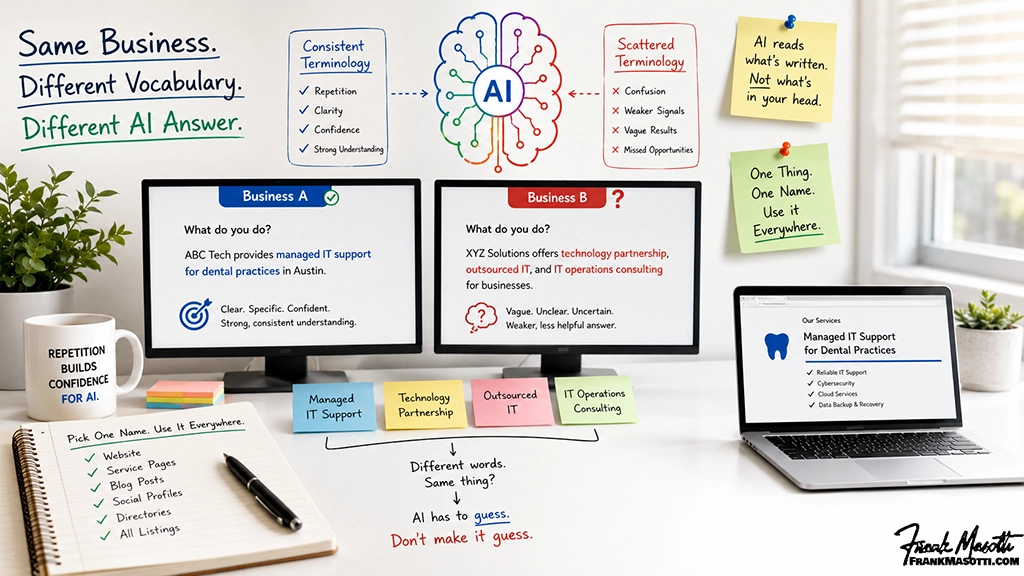
If your website is already clear, already literal, already free of anything a reader could misread, and an AI model still describes your business as smaller or vaguer than it is, there is one more thing worth checking. Count how many different words your own site uses for the same thing.
Here is the direct answer to the question that brought you here. Consistent terminology matters because an AI model has to decide whether two different words point at the same thing, and the main evidence it has for that decision is repetition. When you name your core service four different ways across four pages, you are not giving the model four descriptions of one thing. You are giving it four weak signals it now has to sort out, and the sorting happens silently.
This is a separate failure from ambiguity. A sentence like “we provide managed IT support for dental practices” is not open to interpretation. The problem starts when the next page calls it “technology partnership,” the services page calls it “outsourced IT,” and your LinkedIn profile calls it “IT operations consulting.” Every one of those sentences is clear. Together they describe a company with four small offerings instead of one strong one.
The Hidden Problem: You Were Taught to Vary Your Words
Almost every writing rule a business owner absorbed in school pushed in the opposite direction. Do not repeat yourself. Find a synonym. Vary your sentence openings. Keep the reader engaged by keeping the language fresh.
That instruction was written for a reader who tracks meaning across a document and gets bored by repetition. It assumes a human who knows that “technology partnership” in paragraph three is the same offering described as “managed IT support” in paragraph one, because a person carries context forward automatically.
An AI model reading your site is not carrying that context forward the way you think it is. It is building a structured picture of your business from all of your published material at once, and that process depends heavily on which terms appear repeatedly and which appear once. Repetition is not laziness to a machine. Repetition is confidence.
Why This Stays Invisible
Nothing about vocabulary drift looks like a mistake. Each page reads well on its own. No sentence is wrong. No claim conflicts with another claim, so this does not show up as the kind of conflicting information problem an owner might already be watching for. There is nothing to correct, which is exactly why it survives every review.
It also compounds quietly over time. The homepage was written in one year, the services pages in another, the blog by someone else entirely, the directory listings by whoever set up the account. Each writer chose reasonable language. Nobody was ever assigned the job of deciding what the business calls things.
The Mechanism: How AI Decides Two Words Mean One Thing
AI models do not store your business as a document. They store it as an entity with attributes attached to it, which is the reason AI thinks in entities rather than in pages. One of those attributes is what you do. That attribute has to be filled with something specific.
When your site uses one term consistently, the model sees the same string attached to the same entity repeatedly, across your homepage, your service pages, your posts, and your listings. That repetition is a strong signal, and the term ends up firmly attached to your business. When a prospect asks a question using that term, you are a confident match.
When your site uses four terms once each, the model faces a harder problem. It can conclude those are four names for one service, four separate services, or a mix. Language models are good at recognizing that similar phrases are related, but recognizing that two phrases are related is not the same as concluding they are identical. The safe conclusion, and often the one that gets made, is that this business does several loosely defined things rather than one specific thing well.
That resolution produces a description that is technically accurate and commercially useless. It is the same outcome described in the post on how more content does not automatically make your business easier for AI to understand. Adding pages that each introduce new vocabulary makes the picture blurrier, not sharper.
The Reverse Failure: One Word for Two Things
The mirror version does just as much damage and is easier to miss. If you use a single loose term to cover two genuinely different offerings, the model has no reason to separate them.
A firm that calls both its one time assessment and its ongoing retainer “our program” has given AI one entity attribute where two belong. Prospects asking about either one get an answer built from a merged description of both. Nothing was misstated. The distinction simply was never encoded in language, so it does not exist in the model’s picture of you.
Consistency is not the same as using fewer words. It means one name per thing, and one thing per name.
The Term Your Prospect Actually Types
There is a second cost that has nothing to do with internal confusion. The term you settle on has to be a term your market uses.
Businesses often develop private vocabulary. A proprietary process name, a phrase invented in a branding exercise, an internal shorthand that leaked into the public site. Used consistently, that language is still clear. It is just clear about something nobody is searching for.
When a prospect asks an AI assistant about your category before contacting anyone, they use the ordinary term for the work. If your site never uses that ordinary term, the model has to bridge from your private label to the common one, and it may not make that jump. The fix is not to abandon your branded language. It is to state the plain term first and let the branded name follow it, so both get attached to the same entity.
Why the Drift Extends Past Your Website
Even a perfectly consistent site is only part of the record. Directory listings, association profiles, old press mentions, and social profiles all describe you in whatever words were current when they were written, and AI builds its picture from all of it.
This is also where structured data hits its limit. Schema markup can state your name, your category, and your services in a machine readable form, but it only restates what your site already says, and it stops at the edge of your website. It cannot reach a five year old listing that calls your business something else. Consistency has to be chosen and then applied outward.
The Business Consequence
The cost is not a wrong answer a customer complains about. It is a description that makes you sound smaller and less specialized than you are, delivered to a prospect you never learn about.
It also explains a pattern owners find confusing when they test the models themselves. Terminology drift affects each model differently depending on which sources it weighted, which is one reason ChatGPT, Gemini, and Claude often do not agree about the same business. Where they disagree about what you offer, scattered vocabulary is a common cause.
What Fixing It Looks Like
The work is small and mostly clerical. Write down every offering. Pick one name for each. Pick the name your customers already use. Then apply it everywhere, starting with the pages that get read most and moving outward to your listings and profiles.
Where you need variety for a human reader, put it in the sentences around the term rather than in the term itself. The name stays fixed. Everything else can breathe.
Where the Report Fits
The hard part is not choosing a word. It is seeing which words are currently doing the work, because your own familiarity with your business makes every version sound equally obvious.
The AI Business Understanding Report shows you the language three separate models use when they describe your business in their own words. When those descriptions reach for different terms for the same offering, you are looking directly at the drift, reflected back from the outside. That is part of why three models get checked rather than one.
Saying the same thing the same way is not repetitive. It is how a machine learns that it is the same thing.