
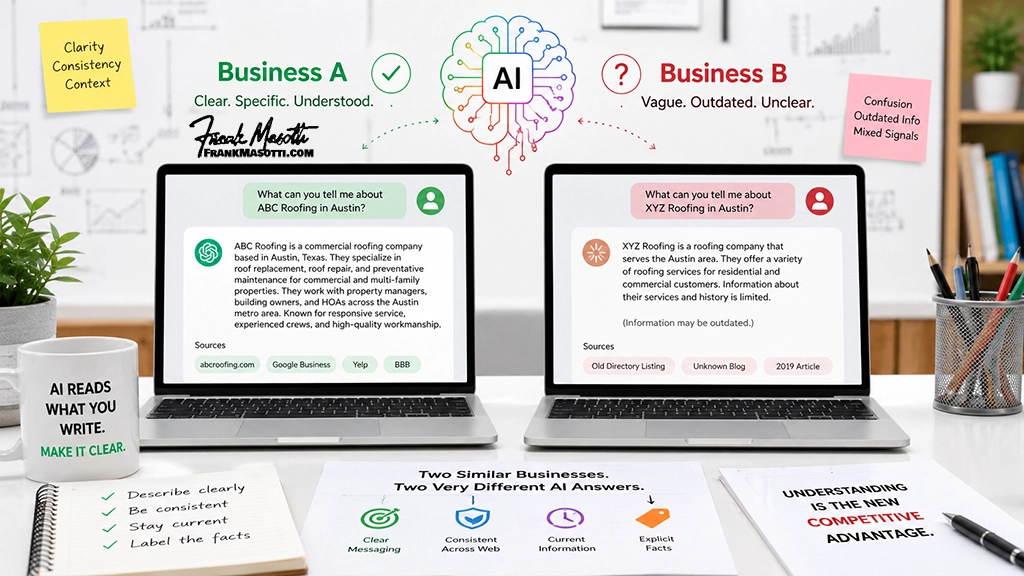
Two businesses can offer the same service, in the same city, at the same level of quality, and receive very different answers when a customer asks ChatGPT, Claude, or Gemini about them. One gets a confident, specific, flattering description. The other gets something vague, dated, or slightly wrong.
That is rarely a reflection of which company is better. It happens because AI is not comparing the two businesses. It is comparing the written record each business has left behind.
A model cannot visit your office, meet your team, or watch you handle a difficult customer. It works from what has been published about you and from how well those published statements hold together. Two companies that are nearly identical in the real world can look very different on paper, and the paper is the only version AI ever reads.
AI compares records, not businesses
Every business arrives at a model as a collection of statements gathered from many places. Your website contributes some. Directories, review platforms, association listings, partner sites, news mentions, and social profiles contribute the rest. The model has to assemble those pieces into one coherent understanding of who you are, which is the process described in How AI Builds a Picture of Your Business From Information Across the Web.
Now run that process twice, once for each of two competing companies. The differences between the two results are not differences in quality. They are differences in how easy each collection of statements was to resolve into a single, confident answer.
That resolution is the whole game. AI organizes what it reads around identifiable things rather than around pages, which is why entities matter so much to how AI reads a business. One company may resolve cleanly into a specific business doing specific work for specific customers. The other may resolve into something blurry, or into a mix of two companies with similar names, or into a version of itself from four years ago. Both companies had their sites read. Only one was understood, and being read is not the same as being understood.
The differences AI notices are rarely the differences you compete on
Ask most owners what separates them from the business down the road and you hear real answers. Better judgment. Faster response. People who stay for years. Work that holds up after the invoice is paid.
Those differences are genuine. They are also almost entirely absent from the written record unless someone sat down and stated them in plain language. AI does not infer character from tone, and it does not award credit for quality it cannot see documented. It takes your published words at face value, which is why AI takes your words literally and why clear writing outperforms clever writing in this context.
So the comparison shifts onto ground you never chose. Not who is better, but whose description is more specific. Not who is more trusted locally, but whose category is stated more plainly. Two businesses compete on service and get evaluated on legibility.
Where the divergence usually starts
Four things tend to separate the clear record from the blurry one.
The first is how plainly each business names what it does. One site says it provides commercial roof replacement and repair for property managers in a named metro area. The other says it delivers tailored solutions for property challenges. Both companies do the same work. Only one has given AI a usable category, and category confusion is one of the most consequential misreadings a business can carry.
The second is how consistently that description repeats away from the website. If the site, the directory listings, and the profiles all describe the same company in compatible terms, the model has agreement to work with. If they disagree, the model has to pick a winner, and conflicting information does not resolve in favor of the most accurate source. It often resolves in favor of the most repeated one, which is what makes conflicting information across sources so costly.
The third is how cleanly the current business is separated from its past. A company that expanded, narrowed, rebranded, or dropped a service line often leaves the old version standing in places it no longer controls. That is how AI ends up describing the business you used to be, and why older information sometimes carries more weight than your current site.
The fourth is whether anything on the site labels the facts explicitly rather than leaving them to be inferred from layout. That labeling layer is real but narrow, and it helps to understand what schema actually does before treating it as a fix for everything above.
Why the stronger business often reads as the weaker one
Here is the part that surprises owners. The gap frequently runs backward from what the market would predict.
A business built on referrals, repeat clients, and reputation may barely need to publish anything to stay busy. Word of mouth leaves almost no written trail. Meanwhile a younger, less established competitor with a marketing budget has documented itself thoroughly, consistently, and in plain language across a dozen platforms.
AI reads both records. The established company looks thin. The newer one looks clear. That is the mechanism behind the fact that a business can be well known and still be poorly understood by AI, and it is also why visibility is not the same thing as understanding. Ranking does not close the gap either, since a strong Google position does not guarantee a strong AI interpretation.
Publishing more is not the automatic answer either. Volume without consistency creates more material to contradict, which is why more content does not automatically make a business easier for AI to understand.
Neither owner can see the difference from the inside
You cannot detect this by reading your own website. You arrive with full context already loaded, so gaps and ambiguities read as obvious to you and to nobody else.
You also cannot detect it by asking once. The answer you get on a Tuesday may be accurate enough to reassure you while the answer to a differently worded question is not, and one question cannot show you how AI understands your business. The output tends to sound settled either way, because AI often sounds certain when its understanding is incomplete.
The failure is also quieter than owners expect. Most of the facts will be right. The problem is the conclusion drawn from them, since AI can combine accurate facts into an inaccurate picture and does not need to get every fact wrong to misunderstand a business.
And the gap between you and a competitor may exist on one system and not another, because the models do not know the same things and strong understanding in ChatGPT does not carry over to Claude and Gemini. Checking all three is the only way to know which picture your customers are actually getting, which is why the report covers three models rather than one.
What the gap actually costs
The cost is not embarrassment. It is being left out of the shortlist.
Buyers increasingly form an impression before they ever make contact, and your prospect may ask AI about you before contacting you. If the clearer record belongs to your competitor, the model has an easier time explaining why that company fits the request. Recognition and recommendation are separate hurdles, which is the heart of why AI recommends competitors but not you.
You lose the comparison without ever being in it. Nobody tells you. There is no notification, no lost bid to review, no conversation where the objection surfaces so you can answer it.
Seeing your own record the way AI sees it
The starting point is not fixing anything. It is finding out what the models currently believe, where they agree, where they diverge, and which sources appear to be driving each conclusion.
That is what the AI Business Understanding Report documents. Every report is read and written by hand for one company, which is why I analyze one business at a time, and you can see the full method on the How It Works page or read through the completed reports to see the format. Once the picture is visible, the question of whether an AI interpretation can be changed stops being theoretical.
Two similar businesses. Two different records. Two different answers waiting for the next customer who asks.
You can find out which one is yours. Order the AI Business Understanding Report for $995, delivered the next business day, or schedule a short consultation first if you want to talk it through.