
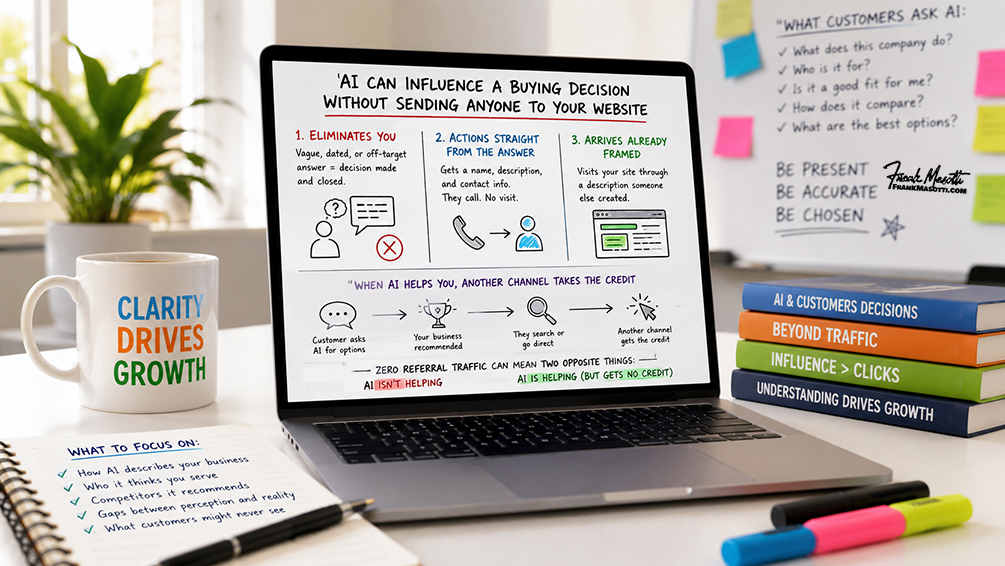
Open your analytics and look at how much referral traffic arrived from ChatGPT, Claude, and Gemini last month. For most businesses the number is small enough to dismiss. The reasonable conclusion is that AI has not become a real channel yet, and that whatever is being said inside those conversations has not started affecting revenue.
That conclusion rests on an assumption worth pulling apart, which is that influence arrives as traffic. For most of the internet era it did, closely enough that nobody had to separate the two. The direct answer to the question in the title is that AI can shape, narrow, and finish a buying decision without ever producing a visit, because the visit was never the influence. It was the evidence of influence, and that evidence has come loose from the thing it used to indicate.
There is a second half to this that makes the reporting worse rather than merely incomplete. When AI works in your favor, the credit for it lands somewhere else, on whichever channel happened to capture the final click. So the AI number in your reports sits near zero for two opposite reasons at the same time, and the two are indistinguishable.
The Click Was Always Evidence, Not Influence
For thirty years, wanting to know something about a business meant going to the business. Your website was the only place that held the answer to what you do, who you serve, what you charge, and how you differ from the company down the road. Curiosity produced navigation, and navigation produced a record. Analytics never measured persuasion. It measured the trips people took while they were being persuaded, and those trips were a reliable enough stand in that the distinction stopped mattering.
AI removed the trip for a specific class of question, and it happens to be the class that decides whether you get considered. What does this company do. Who is it for. Is it a good fit for a project like mine. How does it compare to the other two. Those questions once required a visit. Now a model answers them from a picture it assembled out of your website, directories, reviews, old coverage, and everything else carrying your name, which is the process described in how AI builds a picture of your business from information across the web.
The information moved. The measurement stayed where the information used to be.
Three Ways the Decision Finishes Without a Visit
The customer eliminates you. This is the most common version and the one that costs the most. Someone asks whether your business fits their situation, receives a description that is vague, dated, or aimed slightly off your actual specialty, and stops there. There was never going to be a visit. The decision was made and closed at precisely the point where a visit would have begun. What that answer usually sounds like is not an accusation but a shrug, a pattern I broke down in what does AI tell a customer who asks whether your business is a good choice, and the customer has no reason to doubt it because AI sounds just as certain when its understanding is incomplete as when it is right.
The customer acts straight from the answer. Some people do not need a website at all. They get a name, a description, and a phone number, and they call. You get a lead with no session behind it, which most owners quietly file as word of mouth or as a customer who found them somehow. The influence was total and it left no digital footprint on your side of the transaction.
The customer arrives already framed. Here the visit does happen, which is why this one hides so well. The visitor is not neutral when they land. They are reading your site through a description somebody else wrote, and AI may be creating that first impression before anyone visits your website. If the model told them you are a general provider, your specialty page reads as a claim rather than a fact. Two visitors with identical click paths can arrive from completely opposite briefings, and nothing in your analytics distinguishes them.
When AI Helps You, Another Channel Takes the Credit
Now consider the good outcome, the one you are presumably paying for.
A customer asks AI for options in your category. Your name comes back, described clearly and favorably. The customer does what people always do with a name they have just been given. They search it. They land on your site through branded search, or they type your domain directly, or they arrive through a directory listing. The click gets recorded, and the channel that captured it gets the credit.
The conversation that put your name in their head gets nothing, because there is nowhere for it to be recorded. This is the mechanism behind the research covered in customers are asking AI about businesses before they visit their websites: AI does not have to replace Google, your website, or your phone to change the outcome. It only has to determine which businesses make it that far.
So your losses leave no trace, and your wins are attributed to something else. Both produce the same reading. Zero is what an absent channel looks like, and it is also what a working one looks like when the measurement was built around a click that no longer needs to happen.
Why Referral Traffic Is the Wrong Number to Look At
The AI referral figure measures one narrow behavior: a customer clicking a source link inside an answer they already found satisfying. That is a formatting outcome, not an influence outcome. These systems are built to answer rather than to hand off, so a more complete answer produces fewer clicks, not more. Rising influence can show up in your reports as falling referrals.
It is also not one number, because it is not one channel. ChatGPT, Claude, and Gemini were trained on different material and hold different pictures of the same company, which is the point of all AI models know the same things, they don’t. And strength in the channel you can measure does not transfer, since a strong Google ranking does not guarantee a strong AI interpretation.
What This Actually Costs
The cost is not only the customer who quietly ruled you out. It is every decision you make from a picture in which AI reads as zero.
Budget moves toward channels that report activity, because reported activity is what a reasonable operator responds to. Effort goes into the parts of the funnel you can watch. Meanwhile the input deciding whether you appear on the list at all is a model’s understanding of your business, formed at the stages laid out in AI and customer decisions, which is also the honest answer to why AI recommends your competitors but not you. None of that work registers as a line item, so none of it gets funded, and the gap widens on a schedule nobody is watching.
The Only Way to See It Is to Look Directly
If the influence cannot be inferred from your traffic, the alternative is to observe it where it happens. That means asking the models what a customer would ask and reading what comes back, which is not the same as asking ChatGPT about yourself once. A single friendly answer on one phrasing is reassuring and close to meaningless, the trap described in one AI question cannot show you how AI understands your business.
That is what the AI Business Understanding Report is. I question ChatGPT, Claude, and Gemini about your business from many angles, including the fit, comparison, and recommendation questions a customer asks on the way to a decision. I read every answer myself, document what each model believes you do and who it thinks you serve, note which competitors it raises beside you, and mark where its picture has drifted from the business that actually exists. No score, no dashboard, just a written account of what is being said.
Your analytics can tell you about the people who arrived. They cannot tell you about the decision that finished before your site was ever opened. Ordering a report is how you read the half of the story your reports were never built to hold.