
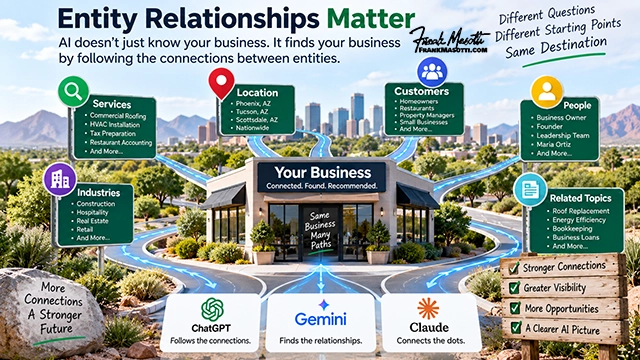
If you have been told that AI thinks in entities, and you have made sure your business is one, here is the part that usually gets left out. An entity by itself does not get you recommended. AI systems like ChatGPT, Claude, and Gemini answer questions by moving along the connections between entities, and a business with accurate facts and weak connections is a destination with no roads leading to it. The model may hold everything true about you and still never arrive at you when a prospect asks a question.
That is the direct answer to why entity relationships matter. The relationships are not decoration on top of the entity. They are the routes a question travels to reach it. A prospect rarely asks about your company by name. They ask who handles a certain kind of work, in a certain place, for a certain kind of customer. Each of those is a different entity, and the model has to get from the one the prospect named to the one you own. If the connection is missing, weak, or mislabeled, your business is not on the map for that question, no matter how complete your own file is.
Most owners check the entity and stop. They confirm AI knows the name, the city, the services. What they never check is whether AI can get to the business from the direction a customer would actually approach it, and that is where the recommendation is decided.
Questions Do Not Start at Your Business
Think about how a real question arrives. Someone types “who does commercial roof replacement in Phoenix” or “is there an accountant who works with restaurants” or “what firm did Maria Ortiz start.” None of those questions begins at your business entity. One starts at a service. One starts at a customer type. One starts at a person. Your business is the answer only if the model can travel from where the question began to where you are.
Why AI Thinks in Entities explains why AI sorts the world into distinct things in the first place, and that sorting is real work. But sorting produces a set of separate objects. What makes those objects useful for answering questions is the web of connections between them. A model asked for a roofer in Phoenix is looking for an entity that connects to the roofing service entity and to the Phoenix location entity at the same time. It is not scanning websites. It is following links inside its own understanding.
This runs in the opposite direction from the mechanism I described in How AI Connects a Business Name With Its Services, People, and Locations. That post is about how AI starts at your name and attaches things to it. This post is about what happens when nobody starts at your name. The prospect starts somewhere else, and the same connections have to hold from the other end.
Relationships Have Types, and AI Guesses the Type
Here is a detail that is easy to miss. A relationship between two entities is not just a line. It has a kind. Your business offers a service. Your business is located in a city. A person founded your business. Your business formerly provided something it no longer does. Each of those is a different type of connection, and the type changes what the model can do with it.
AI does not receive those types directly. It infers them from language. If the only evidence connecting your name to a service is that the two words appear near each other, the model knows they are related but not how. Did you provide it, review it, compete with it, or stop doing it? A sentence that says “we install commercial HVAC systems” states a clear relationship of one type. A page that mentions HVAC in a list of industry topics states a much weaker one. From the outside, both put your name next to the same word. From the model’s point of view, only one of them says you do the work.
This is why services can become entities in their own right and why it matters that the connection between the service and your business is stated as a real claim rather than left to proximity. It is also why old material is so costly. A relationship that used to be true, like a location you left or a service you dropped, does not get relabeled as “former” just because time passed. Unless something states that the connection ended, the model keeps it at its original type, and the road to your business still runs through a place you no longer are.
Trust Only Travels Along a Connection That Exists
The type problem has a second consequence, and it explains a failure I see constantly.
Suppose the founder of a firm is well documented. Credentials, speaking history, published work, a strong professional reputation. The person is a clear, confident entity in every model. Now ask the model about the firm, and the answer is thin. The reason is that a reputation does not flow from one entity to another on its own. It travels only along a relationship the model actually holds. If the evidence never plainly states that this person founded or leads this company, the person’s credibility sits on the person entity and stays there. The firm gets nothing from it.
People Are Entities covers why a person is a separate thing in the model’s understanding. The relationship between that person and the organization is what lets the two share credibility, and it has to be written down somewhere the model reads. The same rule applies to locations, awards, certifications, and partnerships. A credential attached to the wrong entity, or floating with no clear connection, contributes nothing to the entity your prospect is asking about.
Owners find this frustrating because from the inside it is obvious. Of course the founder’s expertise is the company’s expertise. But AI reads pages, not rooms, and what is obvious inside the building was never typed out anywhere the model could find it.
A Complete Entity Can Still Be Unreachable
Put those pieces together and you get the outcome that surprises people most. A business can pass every entity check and still be invisible to the questions that generate work.
The model knows the name, the address, the founding year, and the service list. Ask about the business directly and you get a clean, accurate answer. Then a prospect asks who in your city handles the exact problem you specialize in, and you are not in the response. Nothing in your entity was wrong. The path from the problem to your business simply did not exist in the model’s understanding, or it existed weakly enough that a competitor with a stronger connection came up first.
This is a large part of why AI may recognize your business but misunderstand its specialty. Recognition is a question about the entity. Recommendation is a question about relationships, and why AI recommends your competitors but not you usually has this shape. The competitor is not better documented as an entity. They are better connected to the thing being asked about. Strong relationships are also how AI decides what your business is known for, because the connections that appear most often and most clearly become the ones the model reaches for first.
There is a mirror image of this problem too. When relationships are stated loosely, they can attach to the wrong entity entirely, which is how entity confusion between similar businesses begins. A road built carelessly can lead to someone else’s door.
Why the Owner Cannot See the Missing Roads
You test your business by asking about it by name, because that is the question you know the answer to. That test starts at your entity and reads outward, and it will usually look fine. It cannot show you whether a question starting from a service, a city, or a customer type ever finds its way to you. The only way to see that is to ask the way a prospect asks, from the outside in, across many angles and across all three models, since each one has assembled its own set of connections from its own sources.
Meanwhile, your prospect may ask AI about you before contacting you, and the questions they ask are the outside in kind. When the path is missing, they are handed a competitor. No error appears on your side, because from the entity’s own perspective nothing is broken.
Your website can strengthen the connections you control. Stating plainly what you offer, where you operate, who leads the company, and what you no longer do gives the model relationships with clear types. Organization schema can restate those relationships in a form built for machines, though it only confirms what your content already says, and schema stops at the edge of your website. Many of the connections a model holds about you come from sources you do not own, and those are the ones you most need to see before deciding what to fix.
Seeing Which Connections Actually Exist
That is what the AI Business Understanding Report is built to show. I question ChatGPT, Claude, and Gemini about your business from the directions prospects actually use: by service, by location, by problem, by customer type, and by the people associated with the company. Then I document which routes lead to you, which lead to someone else, which relationships are mislabeled or outdated, and where the three models disagree about how your business is connected to the things people ask about.
The entity is the easy part. Whether anything connects it to the questions that matter is the part you cannot check from the inside. If you want to know which roads currently lead to your business, and which ones are missing, ordering a report is how you find out.