
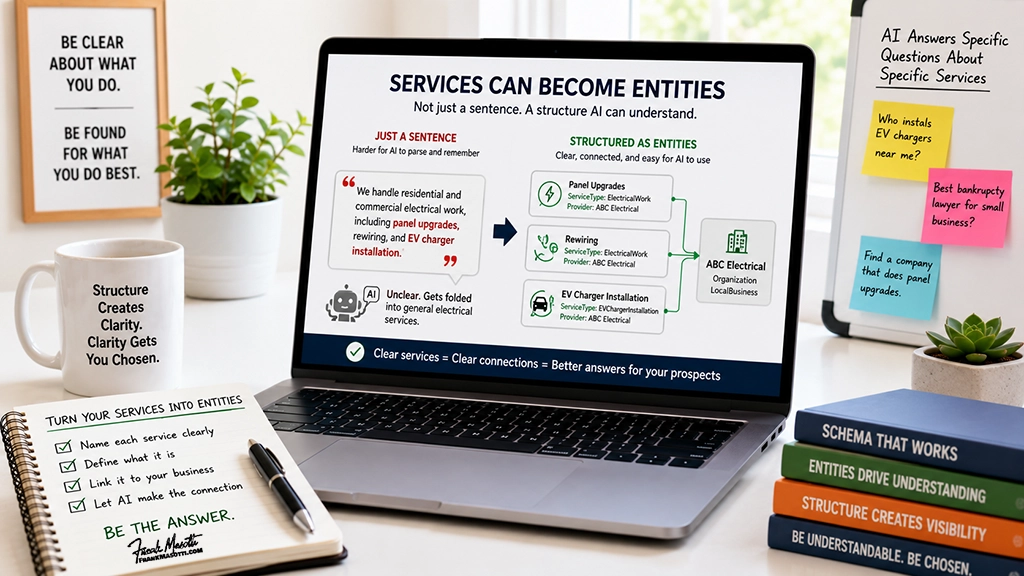
If you run a service business, you have probably wondered whether AI actually knows what you do, or whether it only knows your name. The honest answer is that a service can become its own entity to AI, something with a name, a category, and a clear connection back to the business that provides it. But most services never get there. They stay as a phrase inside a longer paragraph, and a phrase is not the same thing as an entity.
That distinction sounds small. It is not. It is the difference between AI being able to answer a specific question about what you do and AI only being able to answer a general one about who you are. If someone asks ChatGPT, Claude, or Gemini to recommend a business that handles the exact service you specialize in, the model needs to know that service exists as a distinct thing you offer. Not just that you exist. Not just that you are in a related industry. That specific service, attached to your name.
Why This Gap Stays Hidden
Most service businesses describe what they do in flowing sentences. A contractor’s site might say something like “we handle residential and commercial electrical work, including panel upgrades, rewiring, and EV charger installation.” Read by a person, that sentence works fine. A human sees three distinct services and understands each one without effort.
That is exactly why the gap goes unnoticed. The business owner reads the page, sees every service accounted for, and moves on. Nobody stops to ask whether AI, encountering that same sentence buried inside a paragraph on one page among dozens of scattered mentions, will treat EV charger installation as its own real offering or quietly fold it into the general idea of electrical work. As explained in How AI Connects a Business Name With Its Services, People, and Locations, the model is not reading your page the way a visitor does. It is gathering fragments from many sources at once and trying to decide what belongs together. A sentence with no structure gives it very little to work with.
What Actually Turns a Service Into an Entity
An entity, in the way AI systems use the term, is a specific thing the model can identify as one consistent object with its own attributes, separate from everything else that might share its name or sit nearby in the text. What Is an Entity and Why Does AI Care? lays out this definition in more depth, but the short version is that a name alone does not make something an entity. A name plus attributes plus a defined relationship to something else does.
For a service, that means giving it its own identity instead of leaving it as a word choice inside a sentence. Schema.org has a Service type built for exactly this, with properties like serviceType, provider, and areaServed. The provider property is what does the real work. It links the service back to your Organization or LocalBusiness entity, the same way an employee record links back to a company. Once that connection exists, AI is no longer guessing whether “EV charger installation” is something you casually mentioned or something you actually offer as a defined line of work. The relationship is explicit.
This is the same logic covered in Products Are Entities Too, which makes the case for physical products needing this same structural clarity. Services need it even more, and for a simple reason. Most product businesses already think in catalogs, with individual listings, SKUs, and prices. Most service businesses think in paragraphs. Capability gets described in prose, not itemized, which means the default way service businesses talk about themselves is exactly the format AI has the hardest time parsing into distinct offerings.
What Happens When a Service Stays Unstructured
Picture two electricians. Both do panel upgrades, rewiring, and EV charger installation. One describes all three in a single paragraph on the services page, the same way most businesses do. The other has each service defined as its own entity, connected back to the business through the provider relationship, with a clear service type and area served.
Ask an AI model to recommend an electrician for a panel upgrade, and both businesses have a reasonable shot at being mentioned, because panel upgrades and electrical work are close enough that a general association still connects the dots. Now ask specifically for someone who installs EV chargers. This is where the difference shows up. For the business with structured services, the model can point to a defined entity that says exactly this is something they do. For the business relying on a sentence buried in a paragraph, the model has to infer that connection from weaker signals, and Why AI Thinks in Entities explains why that inference often fails quietly rather than obviously. Fragments need a stable destination to attach to. Without one, the safer move for the model is to fold the specific service back into the general category it already has more confidence about. EV charger installation does not disappear from the business’s actual capabilities. It disappears from the answer.
Neither business would know this was happening. Both services pages look complete. Both businesses are, in reality, equally capable of doing the work. The only difference is which one AI can confidently attribute to a name when a prospect asks a specific question, and that difference was decided by structure, not by capability.
The Business Consequence
Prospects are increasingly asking AI for a specific service rather than searching for a business name. Someone does not usually ask an AI model “tell me about Smith Electrical.” They ask “who installs EV chargers near me” or “find a bankruptcy attorney who handles small business cases.” That query is the moment your specific service either gets matched to your name or gets passed over in favor of a competitor whose services were structured clearly enough for the model to trust.
This is a variation on the same pattern covered in Organization Schema Explained: most businesses put real effort into describing who they are as a company and far less into defining, individually, what they actually sell. The result is a business that AI can identify by name but cannot confidently match to the specific need a prospect just described. You are not invisible. You are just not the answer to the exact question being asked, even when you are perfectly capable of doing the work.
Seeing What AI Currently Understands
Most business owners have never checked whether ChatGPT, Claude, and Gemini can name their individual services, as opposed to describing the business in general terms. That is the specific question the AI Business Understanding Report is built to answer. It looks at what all three models currently say when asked about the services you offer, not just about your business as a whole, and shows you exactly which offerings come through clearly and which ones have quietly blurred into a general description. It does not guess whether your services read as distinct entities to AI. It checks, and shows you what it finds.
A service you offer and a service AI can name are not automatically the same thing. Closing that gap starts with knowing whether it exists. If you want to see what AI currently understands about the specific work you do, ordering a report is the direct way to find out.