
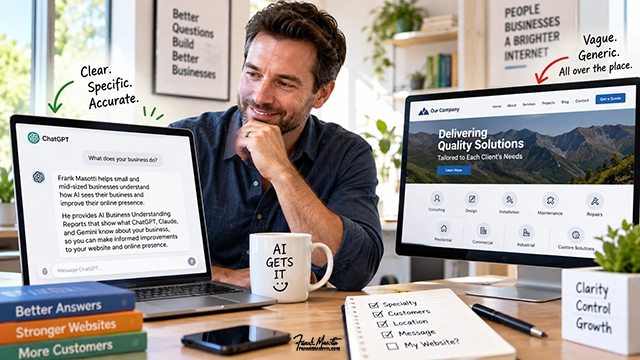
You asked ChatGPT, Claude, or Gemini what your business does, half expecting a mess. Instead you got a clean answer. Two or three plain sentences that named your specialty, your customers, and your area more clearly than anything on your own homepage. The natural reaction is relief. AI understands you. Nothing to fix.
Here is the direct answer to the question in the title. When AI explains your business better than your website does, your website has stopped being the primary source of information about your business. The clear description was assembled from what everyone else says about you: reviews, directory listings, old coverage, partner pages, and the way customers describe your work in their own words. Your site contributed, but it contributed less than the sources you do not control. The answer is good. The reason it is good is a problem.
That reason decides how durable the answer is. A description built mostly from your own specific pages is anchored to something you maintain. A description built mostly from other people’s pages is anchored to a source mix that shifts without telling you. Right now the mix produces a better summary than your site. Nothing guarantees it will next quarter.
Why AI Can Out Explain the Company It Is Describing
It sounds backwards, but AI is not competing with your knowledge. It is competing with your writing. AI builds a picture of your business from information across the web, then restates that picture in plain declarative sentences. Reviews are already written that way. A customer says you replaced their flat commercial roof in four days and the crew cleaned up. A directory lists your category, city, and service radius. A local article names the kind of project you handled. None of that is marketing. It is people stating facts about you because they had no reason to do anything else.
Your website was written under different pressure. It had to sound established, cover every service, and satisfy whatever keyword list the last SEO project produced. So the homepage says you deliver quality solutions tailored to each client’s needs, and the services page lists nine things at equal weight. A human visitor gets the idea. A model reads it literally, and why AI takes your words literally is the whole issue: filler sentences carry no extractable fact, so the model leans on the sources that do.
The AI did not know more than you. It had better raw material than your site gave it, because that material was written by people who were only trying to describe you, not sell you.
The Answer Is Clear, but It Is Not Yours
This is the part that stays hidden, because success does not invite investigation. A model described your business well because third party sources described your business well. You did not author that description. You cannot edit it. You do not know which sources it came from or how much weight each one carried.
Hold this next to the more familiar failure. Owners usually assume that if AI gets a business wrong, the website must be the problem, and often it is not, because the rest of the web outvoted the site. The same mechanism runs in reverse here. The rest of the web outvoted your site again. This time it happened to vote in your favor.
That is a fortunate outcome, not a managed one, and it is fragile in a specific way. The sources doing the explaining are not maintained by anyone. Reviews age. A directory changes its categories. The article that named your specialty disappears in a redesign. A competitor with a similar name starts collecting reviews that use the same words. Each shift changes the mix, and because your site was never the anchor, nothing steady sits underneath the description to hold it in place. Schema stops at the edge of your website, and so does everything else you control. The description you liked lives entirely beyond that edge.
Sometimes “Better” Means “More Generic”
Models are fluent about categories they have seen thousands of times. A tidy description of a commercial roofer, a family dentist, or a bookkeeping firm can be produced from the category template alone, with your name filled in at the top. What makes AI confident in an answer is pattern strength, not verification, and the strongest pattern available is often the industry average. So an answer can be clearer than your website while being less specific to you than your website. It explains a business like yours very well. It explains your business only roughly.
The tell is what is missing. If the answer is smooth but never mentions the thing that sets you apart, the specialty you built the last three years around, the client size you work best with, the problem you solve that competitors avoid, then the clarity is borrowed from the category rather than from you. That is the mechanism behind why AI may recognize your business but misunderstand its specialty. The prose is confident. The differentiator is gone. A prospect cannot tell a whole dimension was left out, because the answer does not sound incomplete.
What It Costs When the Site Cannot Keep the Promise
Now follow the prospect. They asked AI, got the clear version, and decided you were worth a look. They arrive at your website carrying that plain description. AI may be creating your first impression before anyone visits your website, and in this case the impression was better than the site.
Then the site has to live up to it. The prospect was told you specialize in one thing. Your homepage lists nine. They were told you work with a certain kind of client. Your copy says you serve everyone. The specific claim that got them there is not stated anywhere they can find, so it starts to feel like AI overstated things, or like they are looking at the wrong company. The mismatch reads as a credibility gap, and the gap belongs to you, because your site failed to confirm what they had already been told.
The reverse failure is quieter. Some prospects skip the site and call directly, because the answer already covered what they needed. That works until the answer drifts. When the description degrades, those calls simply stop, with no traffic drop to explain it because there was never traffic in that path. You lose a channel you never saw working.
What the Good Answer Is Actually Telling You
Read correctly, a clear AI description of a vaguely written business is a diagnostic. It shows you what your site should have been saying all along, in the register it should have been saying it. The facts the model extracted from reviews and listings are the facts your own pages ought to state first, plainly, and consistently. That is the argument in writing for understanding instead of keywords, and here the model has handed you a worked example for your own business.
The goal is not to paste the AI answer onto your homepage. It is to make your site the source that answer could have been built from, so third party sources become confirmation instead of foundation.
You cannot do that work from one answer, though. One clear response from one model on one day says little about the pattern, which is the point of one AI question cannot show you how AI understands your business. And because all AI models do not know the same things, the model that explained you well may be the outlier. Gemini can hold the clean version while ChatGPT holds the generic one, and your prospects are spread across all three.
Finding Out Where the Clarity Comes From
That is what the AI Business Understanding Report is built to show. I question ChatGPT, Claude, and Gemini about your business from many angles, read every answer, and document what each one believes. When an answer is clearer than your site, I trace where that clarity appears to come from, whether it is specific to you or borrowed from your category, and which details went missing. Where the three models agree, what agreement between ChatGPT, Claude, and Gemini can tell you is often the most useful finding in the report. Where they diverge, you see which version of your business each prospect is meeting.
A good AI answer is worth having. A good AI answer you did not write, cannot see the sources of, and cannot maintain is worth understanding before you rely on it. If AI is currently explaining your business better than your own website does, ordering a report is how you find out whether that is a foundation or a coincidence.