
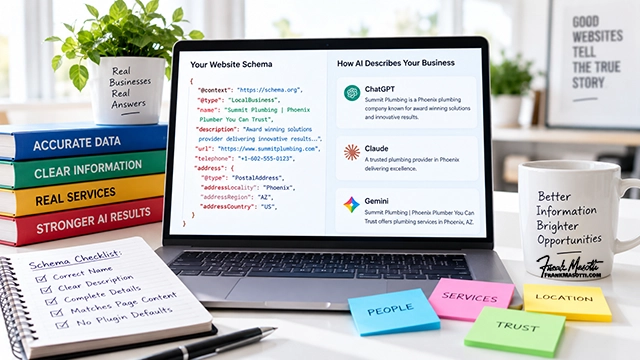
If you are looking for a list of common schema mistakes, here is the one most lists leave out. The mistakes that actually change how AI describes a business are almost never syntax errors. They are correct, valid, fully passing markup with the wrong information inside it. A validator checks whether each field holds the right kind of value. It has no opinion about whether the value is true, specific, or even about your business. So a site can pass every check and still hand ChatGPT, Claude, and Gemini an official record that says the wrong thing in the most trusted format available.
That distinction matters because schema is weighted heavily precisely because it is meant to be definitive. Prose gets interpreted. Markup gets accepted. When the markup is right, that is an advantage nothing else on your site can match. When the markup is filled with defaults, marketing copy, or claims the page never supports, the same weighting works against you, and nothing in the tooling will ever say so.
The six mistakes below all share that property. Each one validates. Each one is common. Each one quietly teaches AI something you did not mean to teach it.
Mistake 1: Leaving the Plugin’s Defaults in Place
Most schema on small business websites was never written. It was generated. The SEO plugin filled the Organization block from whatever it could find in the site settings, and nobody went back to read what it chose.
What it usually chooses is the site title, which on many sites is not the business name. It is the business name plus a tagline, separated by a pipe or a dash, because that is how the title was written for a search listing. So the name field reads something like Summit Plumbing | Phoenix Plumber You Can Trust. That whole string is now the declared name of the entity. The description field gets the tagline. The logo is missing because no one uploaded one. The author on every post is admin.
None of that fails validation. All of it is a claim. AI systems organize what they know around named things, and a name is the key everything gets filed under, which is why business names are entities. A name with a slogan welded onto it is a weaker key than the real name, and it matches nothing in your reviews, your listings, or anyone else’s mention of you.
Mistake 2: Writing the Description Like an Ad
The description property is the one place in your markup where you get to state, in plain words, what the business is. It is also the field most often filled with copy that belongs on a billboard.
“Award winning solutions provider delivering innovative results for clients who demand excellence” is a real pattern, and it produces a specific failure. AI takes your words literally, and the description field is read as the business’s own definition of itself. A model asked what you do will look there first and find nothing it can repeat: no service, no customer, no location, no specialty. The tone that reads as confidence to a human reads as absence to a machine, a problem covered in Why AI Can Misread Marketing Language.
The fix is not clever. One or two sentences that name the services, the customers, and the place. The same sentences a good employee would use to explain the company to a stranger.
Mistake 3: The Empty Shell
The opposite mistake is just as common. The block is technically present and contains a name, a URL, and nothing else. No description, no address, no phone number, no founder, no links to the profiles that exist elsewhere on the web.
An empty block is not neutral. When AI has a named entity with almost no attributes, it does not leave the attributes blank. It fills them from the category it thinks you belong to, which means your business gets described with industry averages instead of your own facts. What Missing Information Can Reveal About AI’s Understanding of a Business looks at that pattern in detail. The shell told AI that you exist. It said nothing about what makes you different from the generic version of you, so the generic version is what gets repeated.
Mistake 4: Schema That Says More Than the Page Does
This one runs in the other direction, and it is the mistake people make on purpose. The markup lists eight services. The page mentions three. The description names a specialty that appears nowhere in the visible content. Review markup carries ratings the business assembled itself, or ratings that do not appear anywhere a visitor could read them.
Google’s structured data guidelines have long required that markup reflect content visible on the page, and self assembled review markup is specifically disallowed. That is the policy risk. The understanding risk is separate and larger. AI does not read your schema in isolation. It reads the page, the rest of your site, and everything published about you elsewhere, then weighs the claims against each other. A markup claim with nothing behind it is a claim with one source. As explained in What Schema Actually Does, schema cannot make a claim your site does not support. Try it anyway and you have not added a fact. You have added a contradiction between your markup and your own content, and contradictions are resolved silently, often in favor of whatever the rest of the web says.
Mistake 5: Choosing a Type by How It Sounds
Schema types are categories, and category is the one attribute of a business that cannot hold two values at once. That makes the type choice more consequential than most people treat it.
The common errors go both ways. Some sites declare a plain Organization for what is clearly a local business with a storefront, a service area, and hours, which discards exactly the properties Local Business Schema Explained covers. Others reach for the most specific subtype they can find because specific sounds better, and end up declared as a category that describes a fraction of the work. A firm that does mostly commercial work marked as a residential subtype has told AI, in its most authoritative voice, that the commercial work is the sideline. How Conflicting Business Categories Can Confuse AI covers what happens next, and it is not a hedge. It is a confident answer about a business that is slightly not yours.
Mistake 6: Facts That Never Connect
The last mistake is the hardest to notice because every individual block is fine. The Organization block is correct. The Person block for the founder is correct. The service pages are correct. None of them reference each other.
To AI, unlinked blocks are unlinked facts. A Person block that does not state which organization the person belongs to is a person floating near a company. Services described only as text in the description field, rather than as things the organization offers, are words rather than relationships. Profile links left out of the sameAs property mean your LinkedIn page, your Google listing, and your directory entries are not declared as the same business at all.
Relationships are what turn a pile of accurate facts into a picture, which is the argument in Entity Relationships Matter. A site can state every fact correctly and still leave AI to guess how they fit, and guessing is where a founder gets attached to the wrong company or a service gets treated as a separate business. This is a different failure from the cross page drift described in Why Consistency Across Schema Matters. There, the blocks disagree. Here, they simply never speak to each other.
Why the Validator Cannot Catch Any of This
Every mistake above produces a green result. That is not a flaw in validators. It is what they are for. A validator confirms that the markup follows the specification: required fields present, values of the expected type, syntax well formed. Whether the name is really your name, whether the description says anything, whether the type matches the business, whether the claims are backed by the page, whether the blocks connect, are all questions about meaning, and meaning is outside the specification.
So the feedback loop closes at the wrong point. The task gets marked complete on the strength of a check that never examined the one thing that determines the outcome. The point made in Schema Does Not Change What AI Thinks. It Changes What AI Knows cuts both ways here. Markup raises confidence in whatever it states. When what it states is a slogan, a default, or a half truth, it raises confidence in that.
What It Costs
The cost does not arrive as a penalty or an error message. It arrives as the answer a prospect gets when they ask about your business before contacting you. A name with a tagline attached. A description that could belong to any company in your category. A specialty that is not your specialty. A confident recommendation of a competitor whose markup happened to say something specific.
You never see that answer. The prospect does not report it. Your analytics show a normal week, because the loss happened in a conversation that never reached your site. And because what makes AI confident in an answer is consistent, authoritative input, mistaken schema does not produce hesitation. It produces certainty about the wrong thing.
Reading the Output Instead of the Markup
A schema audit can list which of these mistakes your site contains. What it cannot tell you is what three AI systems concluded from them, or whether the markup mattered at all against everything else published about you, since schema stops at the edge of your website.
The AI Business Understanding Report works from the other end. It documents what ChatGPT, Claude, and Gemini currently say about your business, which is where these mistakes surface in practice: as a name you do not use, a description with nothing in it, a category you did not choose, or a founder attached to the wrong company. It reads the answers rather than the markup, which is the distinction drawn in how this differs from an automated AI SEO report. If your schema was generated, inherited, or never read by a person since it was installed, ordering a report is how you find out what it has been telling your prospects on your behalf.