
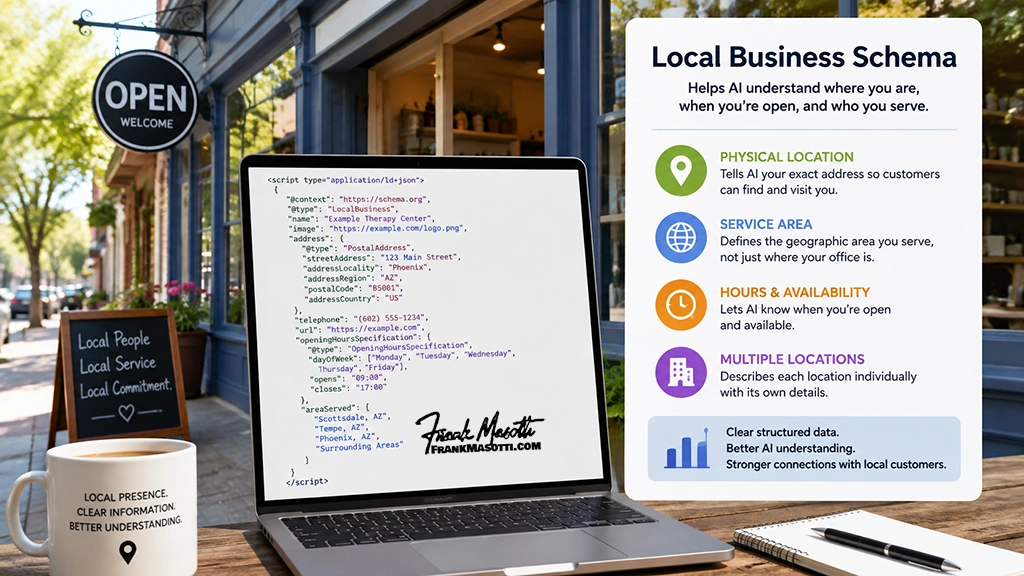
If someone has told you your website needs LocalBusiness schema, or you saw it flagged in an audit, you probably want to know what it is before you pay someone to implement it. The direct answer is this: LocalBusiness is a more specific version of Organization schema designed for businesses that customers visit in person or that serve a defined geographic area.
The distinction matters because LocalBusiness adds properties that Organization does not have. An address in prose on your website is information. An address stated in LocalBusiness schema is a property that AI can read, sort, and use to determine whether your business serves a particular area or whether a customer can visit you at a specific location. That difference is small on your website. It is significant in how AI understands you.
The Difference Between Organization and LocalBusiness
Organization schema describes a company. It states the company name, legal name, address, phone number, logo, website, and the profiles that represent it elsewhere on the web. It answers the question: what is this business?
LocalBusiness answers a different set of questions. It asks: where is this business? When is it open? How far does it reach? Does it have multiple locations? Can customers visit? LocalBusiness carries all of Organization’s properties and adds location specific ones on top.
This is why the schema type matters. If your business operates from a storefront, a clinic, an office that customers visit, or if you explicitly serve a geographic area like “Phoenix and surrounding areas,” those details are not incidental information. They are core to how prospects find and evaluate you. Organization schema has no place to put them in structured form. LocalBusiness does.
Why People Miss This Until It Is Flagged
Most business websites add Organization schema and consider the structural markup question settled. A validator confirms it is correctly formed. The name is there, the address is there, the phone is there. The job looks done.
What the validator does not check is whether you chose the right schema type for your business. It does not flag a business with a storefront using Organization instead of LocalBusiness. It does not check whether you omitted properties LocalBusiness provides. A green checkmark confirms the markup you wrote follows the rules. It does not confirm you wrote the right kind of markup.
So the gap stays invisible until a developer doing an audit points it out, or until you wonder why an AI model’s description of your business never mentions your service area even though it is central to your business.
What LocalBusiness Actually States
Strip out the technical details and LocalBusiness adds four groups of properties to what Organization already provides.
Physical location and accessibility. An address is an address, but LocalBusiness structures it as a property that means AI can extract and reason about it directly. This matters for businesses that operate from a building. A storefront, a medical office, a restaurant, or an agency with a physical address benefits immediately from structured location.
Service area. A property that explicitly states which geographic region a business serves. This is different from an address. A plumber can have their office in one area and serve multiple surrounding regions. LocalBusiness distinguishes between where the business is located and where it works. Organization schema has no place for this distinction.
Hours and availability. openingHoursSpecification lets you state when the business operates. This is not the same as prose saying “we are open 9 to 5 Monday through Friday.” Structured hours means AI can read that you close at 5 PM and will not tell a prospect that you are available at 6 PM. This property is often missing even from implementations that got everything else right.
Multiple locations. LocalBusiness can represent a single location, but when you have more than one, LocalBusiness allows you to describe each location individually with its own address, hours, and potentially different services. A business with three offices should not be marked as a single LocalBusiness point. Each location warrants its own entry.
The Property Everyone Needs and Almost No One Fills
The one property that does the most work and most often sits empty is the service area.
Service area answers a specific question: if I am a prospect in this geographic location, can this business serve me? A therapy practice in downtown Phoenix that serves clients in Scottsdale, Tempe, and the surrounding suburbs needs to state that explicitly. Without it, a model reading the website learns where the office is, but not where the therapist works.
This is where LocalBusiness connects to how AI builds a picture of your business from information across the web. Your service area is information AI would eventually infer from enough client locations or service mentions. But why let it infer when you can state it plainly?
Many implementations skip this because service area is not as obvious as an address. An address is visible on every page. A service area requires deliberate thought. What exactly does your business serve? Is it a city, a region, a metro area, or a radius around your office? Once you answer that, structured data can carry the answer.
LocalBusiness or Organization: How to Decide
The choice is straightforward, though many businesses overthink it.
If your business has any of these characteristics, LocalBusiness is the right fit:
- Customers visit you at a physical location
- You explicitly serve a defined geographic area
- Your hours of operation matter to your customers
- You have multiple locations
- Your address is part of your business identity
If none of those apply, Organization is correct. A software company with no customer facing office, an agency that works entirely remotely with clients worldwide, a freelancer with no service area restriction. These businesses have an address for legal purposes, but that address is not central to how they operate or how prospects find them.
The practical version is this: ask whether a prospect’s ability to visit you or whether you serving their geographic area is part of the sales conversation. If yes, LocalBusiness. If no, Organization.
What matters more than the choice is consistency. One business should be represented once, consistently, across all pages rather than shifting between types or restating the properties slightly differently on different pages. Variation is where conflicting information enters, and conflict reduces confidence rather than increasing it.
Multiple Locations: One LocalBusiness or Many
A common implementation question: if you have three offices, do you mark it as one LocalBusiness entry with three addresses, or three separate LocalBusiness entries?
The answer is three separate entries. Each location is a business entity with its own address, potentially its own hours, possibly its own services. A model needs to be able to distinguish them and connect them correctly to your company as a whole.
This is technical, but it matters. The parent Organization describes the company. Each LocalBusiness describes one location. The connection between them is stated in the markup, so a model reading your site knows that these three separate locations all belong to one company. This is the version that works: why AI thinks in entities and that includes understanding that a multi-location business is one entity expressed through multiple locations.
What LocalBusiness Cannot Do
LocalBusiness cannot override what schema stops at the edge of your website. If your business is also listed in a directory with outdated hours, your structured hours do not change the directory. Your markup states the current truth. The directory states an older one. A model encounters both and has to decide which is more reliable.
LocalBusiness also cannot establish that you are the best option in your area. It can state that you serve an area. It cannot persuade a prospect to choose you over a competitor who also serves that area. That is the difference between location clarity and location authority, and authority comes from other sources, not from markup.
The Business Consequence
The cost of using Organization instead of LocalBusiness when LocalBusiness is appropriate is subtler than an error. It is an absence.
AI can find your business and describe what it does. But prospects asking about your service area may not learn that you actually serve them. Multi-location customers may not know which location to contact. Hours stay as prose that a model has to interpret rather than a structured fact that it can read directly. The information was available on your website. The structure to make it reliably machine-readable was not.
This is increasingly important because more prospects are asking AI about local services before they click through to your website. If your service area is not structured, that information may not reach them in the AI answer.
Where the AI Business Understanding Report Fits
A schema validator can confirm that your LocalBusiness markup is correctly formed. It cannot tell you whether ChatGPT, Claude, and Gemini now understand your service area, whether they know your hours, or whether they connect your multiple locations correctly to your company.
That is what the AI Business Understanding Report answers. It examines what each of the three models currently understands about your business, including location, reach, and availability. If all three correctly identify where you are and where you serve, your LocalBusiness markup is doing its job. If they are missing your service area, or describing your hours incorrectly, or treating your three locations as three separate companies, you now know what needs to be clarified in the markup.
A Simpler Way to Think About It
Organization schema describes a company. LocalBusiness describes a company that exists in a specific place or serves a specific area, and it provides a structured way to say where and when.
If location and hours are part of how your customers find and evaluate you, LocalBusiness is not optional. If they are not, it is not necessary. The choice is not complicated. The implementation discipline is, which is why validation often misses it and why checking what AI actually understood is the only reliable way to know whether it is working.
Order the AI Business Understanding Report to see whether your location information is reaching AI models accurately. If it is not, LocalBusiness schema is usually part of the fix.