
How Schema Supports Entity Recognition
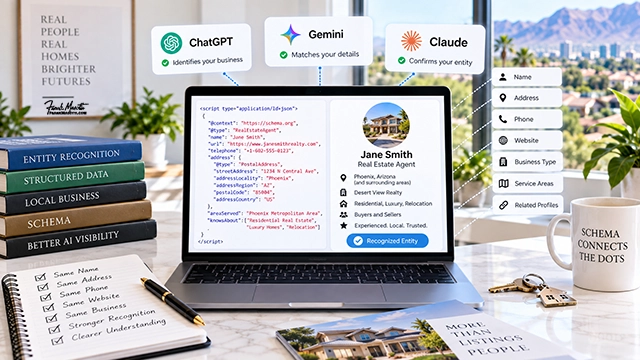
If you have been told your business needs entity schema and you want to know what that markup actually does for AI, here is the direct answer. Schema supports entity recognition by giving AI systems a reliable way to confirm which specific business a page is about. It does that with identifiers, not descriptions. A structured data block states your exact name, your address, your phone number, and your web address together in one place, gives that bundle a stable identifier, and points to the other profiles on the web that belong to the same company. That is what lets ChatGPT, Claude, or Gemini look at a mention and decide, with confidence, that it belongs in your file and nobody else’s.
Recognition is a narrower job than understanding, and it comes first. Before AI can conclude anything about what you do, it has to decide that the page in front of it is you. Most of the writing about schema skips this step and jumps straight to how markup describes services or improves visibility. But the description is only useful if it gets attached to the right entity, and attachment is the part schema is unusually good at.
That is worth understanding before you pay for another round of markup, because a business can have perfectly valid schema that describes it well and still be misrecognized, and the two problems call for different fixes.
Recognition Happens Before Understanding, and Nobody Tests It
When a business owner checks how AI sees the company, the question is almost always about understanding. Does the model know what we do? Does it describe our specialty correctly? Those are good questions, but they sit on top of an earlier one that rarely gets asked: when the model read the sources it learned from, did it correctly decide which of those sources were about us?
The reason this stays hidden is that a recognition failure looks exactly like an understanding failure. If AI has filed a competitor’s service list under your name, the answer it gives about your business is wrong, and the natural conclusion is that your website is unclear. So the owner rewrites the services page, adds more markup describing the services, and nothing changes, because the description was never the problem. The model understood the words fine. It attached them to the wrong entity, or attached someone else’s words to yours.
AI thinks in entities, distinct things with names and attributes, and your business name is one of those entities. Every fact AI holds about you is only as good as the decision that put it in your file. Schema is one of the few tools that directly supports that decision.
What Recognition Actually Requires
Think about what AI is doing when it reads a page that mentions a business. It is not looking the business up in a registry. It is asking a matching question: does this mention line up with an entity I already have, and if so, which one? The answer comes from the details that appear alongside the name. A name plus a city plus a category plus a phone number is a strong match. A name alone, in a sentence that could be about any of several companies, is a weak one.
The problem is that most mentions on the web are weak. A review names you and describes a job. A directory lists you with a category and a number. An article mentions you in passing. Each one carries a fragment of the identifying detail, and AI has to assemble the fragments and hope they resolve to one thing. When your name is common, or when a similarly named company exists anywhere, that resolution can go wrong, which is how entity confusion between similar businesses begins and why unique business names help so much.
Your own website is the one place where you can supply every identifying detail at once, in a form built to be matched rather than interpreted. That is the job schema does for recognition, and it does it in three specific ways.
The Three Ways Schema Makes You Recognizable
It puts the anchors in one block. Prose scatters your identifying details across a site. The name is in the header, the address is in the footer, the phone number is on the contact page, and the category has to be inferred from the copy. An Organization or LocalBusiness block states all of them together as properties of a single object: this name, this legal name, this street address, this phone, this web address, this type of business. AI no longer has to collect the fragments and guess whether they belong together. The markup asserts that they do. Organization Schema Explained and Local Business Schema Explained cover which properties carry that weight.
It gives the entity a stable identifier. Well built schema assigns your organization an identifier, a fixed web address that means “this business” and nothing else, and every other block on the site refers back to it. Your blog posts point to that identifier as the publisher. Your services point to it as the provider. Your people point to it as their employer. Instead of a hundred pages each describing the company slightly differently, the site says “this same entity” a hundred times. Recognition gets easier with every reference, because there is one thing to recognize rather than a hundred near duplicates to reconcile. This is the technical reason consistency across schema matters and why unstable or duplicated identifiers appear so often in common schema mistakes.
It connects your entity to records AI already holds. The sameAs property lists the other places on the web that are the same company: your LinkedIn page, your Google profile, your listing on an industry directory, a Wikidata entry if you have one. This is the closest thing schema has to a fingerprint. AI systems already hold records built from those platforms, and sameAs tells them that the entity on your site and the entity in those records are one and the same. Without it, the model has two or three separate files that happen to share a name and has to decide on its own whether to merge them. With it, the merge is stated rather than guessed.
Together, those three mechanisms turn your site from one more source that mentions your name into the source that defines what your name refers to. That is a different contribution from describing your services, and it is the one recognition depends on.
What This Does Not Do, and Where It Can Backfire
The limits matter as much as the mechanism, because misunderstanding them is what turns schema into wasted spend.
First, schema reaches only your own pages. The reviews, directories, and articles where recognition actually goes wrong do not read your markup. Schema stops at the edge of your website, and the mentions that mislead AI usually live beyond that edge. Schema makes your site a strong anchor. It cannot make every other source specify which company it means. That outward work is a consistency project, laid out in Building Entity Consistency, and schema supports it rather than replacing it.
Second, AI reads schema without verifying it. Recent testing has shown that large language models will extract details placed only inside a markup block, with no check against the visible page. That cuts both ways. Accurate identifiers get trusted. So do wrong ones. A sameAs link that points to a profile belonging to a similarly named company, or a legacy address left in a block after a move, is not a harmless error. It is a confident instruction to file your business under someone else’s records or at a location you left. This is the same trap described in What Schema Actually Does: a confident wrong label does more damage than no label.
Third, recognition is not understanding. One large study published earlier this year tracked nearly two thousand pages that added structured data and found no meaningful lift in AI citations from the markup on its own. That result surprises people who bought schema as a visibility tactic. It should not. Schema tells AI which entity a page is about. It does not make the page say anything more specific, and schema does not change what AI thinks, it changes what AI knows. Once you are correctly recognized, everything AI concludes about you still comes from what your content and the wider web actually say, and how well that content is connected to the questions people ask, which is the subject of Entity Relationships Matter.
The Business Consequence of Being Recognized Wrong
A recognition failure does not produce an error. It produces an answer about a business that is partly someone else. A prospect asks about your company and hears your name attached to a competitor’s price range, a review that was never about you, or a location across the country. Or they ask who handles your specialty in your area and you are missing, because the evidence that would have put you there was filed under a namesake with a deeper record. Your prospect may ask AI about you before contacting you, and when the answer is blended, they do not report it. They move on.
There is a second cost that lands on the fixes. When the real problem is recognition and the owner treats it as understanding, the money goes to rewriting pages that were already clear and adding markup that describes services in more detail. The description improves and the misfiling stays, because nothing in that work touched the identifiers that decide where the description lands.
Finding Out Whether AI Is Recognizing the Right Business
A schema validator will tell you your markup is well formed. It cannot tell you whether ChatGPT, Claude, and Gemini have resolved your name to your business, or whether one of them is confidently describing a company that shares your name and nothing else. That is a question about the output, and it can only be answered by looking at the output.
That is what the AI Business Understanding Report documents. It records how each of the three models describes your business, which is exactly where a recognition failure becomes visible: a borrowed detail, an address you never had, a specialty that belongs to someone else, or three models that disagree about who you are. Where the models describe you accurately and specifically, your identifiers are doing their job. Where they do not, the report shows whether the problem is recognition, understanding, or both, so the next dollar goes to the right fix.
Schema cannot make AI understand your business. It can make AI certain which business it is looking at, and that certainty is the foundation everything else rests on. If you want to know whether the foundation is holding, ordering a report is how you find out which business the three major AI systems currently recognize as yours.