
Why Incorrect Information Spreads
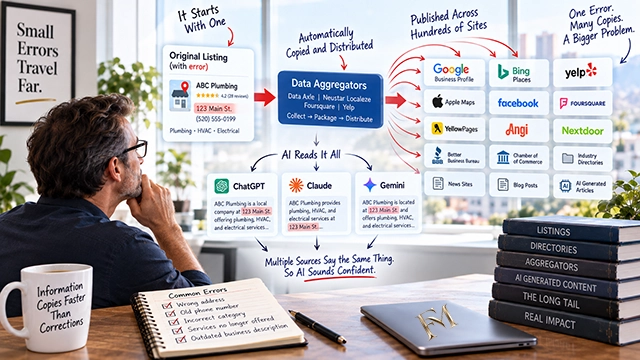
If one wrong detail about your business keeps turning up in AI answers, the reason is usually not that a single bad source is sitting somewhere waiting to be found and deleted. It is that the wrong detail has already been copied. Business information moves across the web through automated syndication, and copying happens without anyone reading what is being copied. By the time you notice the error, it is rarely one error anymore. It is one error with descendants.
That changes the shape of the problem. Most owners treat incorrect information as a repair job: find the source, correct it, done. But correction works on one record at a time, by hand, with a request and a wait. Replication works on hundreds of records at once, automatically, with no request required. Those two processes run at very different speeds, and the gap between them is where a wrong fact lives comfortably for years.
So the direct answer to why incorrect information spreads: because copying is cheaper than checking, and because every copy raises the confidence AI places in the original. The rest of this post covers the three engines doing the spreading, including one that did not exist three years ago.
Most Wrong Facts Start Small and Unimportant
Almost nothing in this category begins as a lie. It begins as a shortcut.
A tracking phone number gets used on a directory submission instead of the main line. A category gets selected quickly from a dropdown that had no good option. A service you have since dropped stays on a profile nobody remembered creating. An address keeps the old suite number. A description written for a chamber of commerce listing in 2019 describes the business accurately for 2019.
None of these feel consequential when they happen, and on their own they are not. What makes them consequential is what happens next, because business data does not sit still. It gets harvested. And once a record is harvested, nobody asks again whether it was correct at the moment it was taken.
Copying Is Automated. Correcting Is Not.
The engine most owners have never looked at is the data aggregator layer. A small number of companies, including Data Axle, Neustar Localeze, Foursquare, and Yelp, collect business records and distribute them to downstream directories, mapping services, and apps. Data Axle alone feeds dozens of partner sites. A single listing created years ago can produce a long tail of derivative listings on platforms you have never visited and could not name.
That inverts the usual assumption. You did not put your business on most of the sites that describe it. Something else did, on the strength of one record nobody verified. If that record carried an error, the error was distributed with it, faithfully, to every destination on the list.
Now compare the effort on each side. Spreading the error took one automated push. Removing it takes claiming each listing individually, submitting correction requests to platforms with their own review queues, and waiting weeks or months for the change to move through the same pipes that carried the mistake. Aggregators can also regenerate listings you already cleaned up, because their own records have not changed. The error travels by machine. The correction travels by permission.
This is a different problem from the one covered in Why Outdated Information Can Continue Shaping AI’s Understanding. That post is about why old information survives. This one is about why it multiplies while it survives.
Copies Do Not Announce That They Are Copies
Here is the part that turns a data problem into an AI problem.
When ChatGPT, Claude, or Gemini forms a picture of your business, it is weighing many sources at once, which is the process described in How AI Builds a Picture of Your Business From Information Across the Web. One of the strongest signals available to it is agreement. When forty sources say the same thing in slightly different words, that looks like independent confirmation, and confident answers are built on exactly that kind of pattern strength.
But forty syndicated copies are not forty sources. They are one source, quoted forty times, by systems that never evaluated it. Nothing in the text of a downstream listing says “syndicated from a record submitted in 2018 and never verified.” It reads exactly like a business profile written by whoever runs that site.
So the weakest possible evidence, a single unchecked record, ends up wearing the costume of the strongest possible evidence, broad agreement across independent publishers. That is the core mechanic. Incorrect information does not spread because AI is careless. It spreads because replication and corroboration look identical from the outside, and only one of them is real. It is also why more mentions do not automatically mean AI understands your business: volume is not the same as verification, and sometimes volume is just an echo.
The Newer Engine: AI Output Is Now Web Content
A second replication loop has only recently become significant, and it deserves an honest description rather than an alarming one. A large share of what gets published on the web is now machine drafted. Research from Graphite, using Common Crawl data through the first quarter of 2026 and three separate detectors, found that roughly half of new English language articles are primarily AI generated, a share that crossed the fifty percent line in late 2024 and has held there since. A separate analysis by Ahrefs of around 900,000 new pages found that about 74 percent contained some detectable AI writing, with only a small fraction produced entirely without human involvement.
The relevant point is narrow. Some of the pages that mention your business, including directory blurbs, roundup posts, and profile summaries, were drafted by a model working from what models already believed about you. If the belief was wrong, the new page is a fresh, well written, plausible looking source that says the wrong thing. It then joins the pool of evidence the next model reads.
Researchers have studied this recursion directly. A 2024 analysis published in Nature showed that models trained repeatedly on their own output drift away from reality, losing accuracy and variety with each pass. That is the extreme case, and Graphite also found that AI generated articles rarely reach the top of search results or AI answers. The everyday version matters more to you: an error about your business no longer needs a human to retype it in order to appear somewhere new.
Why You Never See the Spread Happening
Nothing about this process produces a notification. No alert when a listing is syndicated, no record of which sites received it, no report when a model repeats it to someone.
Meanwhile, the prospect asking AI about you before contacting you receives the copied fact stated in the same even tone as everything accurate in the answer. It may be one wrong detail inside an otherwise correct description, which is how accurate facts combine into an inaccurate conclusion and why AI does not need to get every fact wrong to misunderstand your business. One borrowed phone number, one retired service, one wrong category, and the person quietly decides you are not the right fit.
The spread is also uneven, because the three major models do not know the same things. A copied error may have reached Gemini and not ChatGPT, or the reverse. Checking one model and hearing a clean answer tells you very little about how far the copies actually traveled.
Finding the Copies Instead of Guessing at Them
You cannot clean up a spread you have not mapped, and the spread does not live on your website. Your own pages are one voice, and schema stops at the edge of your website, which means the copies doing the damage sit entirely outside your control and outside your view.
That is what the AI Business Understanding Report is built to document. I question ChatGPT, Claude, and Gemini about your business from many angles, read every answer myself, and identify which specific details are wrong, which are outdated, which appear in more than one model, and where the answers point back toward the sources feeding them. A detail repeated identically by all three systems tells you something a single test question never could, which is the point of One AI Question Cannot Show You How AI Understands Your Business.
Incorrect information spreads because the systems that carry it were built to copy rather than to verify. The only thing that stops a copy from multiplying is somebody noticing it. If you want to know which wrong details about your business are already circulating, and how far they have gotten, ordering a report is how you find out.