
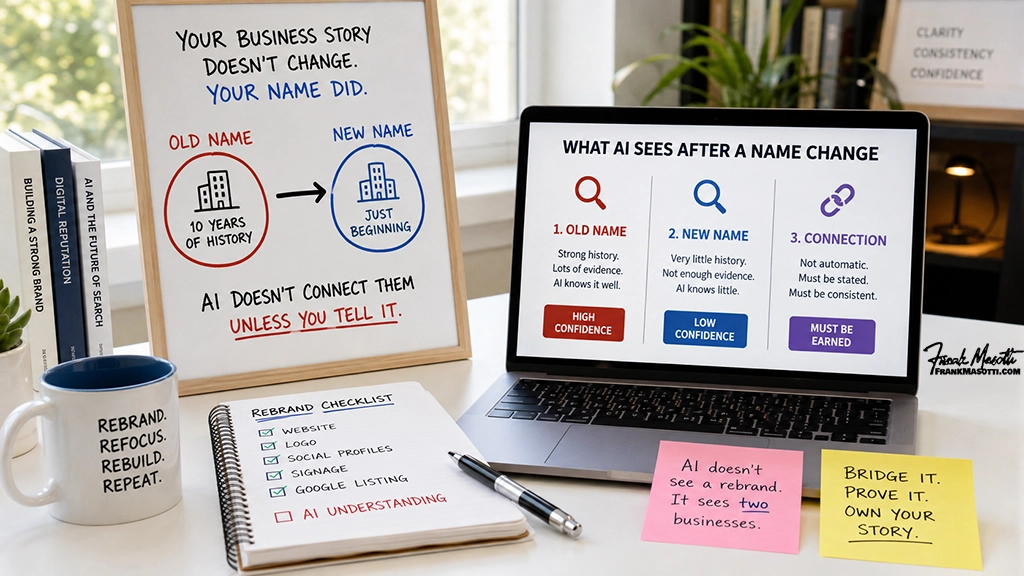
If you have changed your business name, or you are planning to, here is what actually happens on the AI side. The understanding AI built about your business does not transfer to the new name. It stays attached to the old one. To systems like ChatGPT, Claude, and Gemini, your name is not a label sitting on top of a stable identity. The name is the identity. It is the key that connects every review, mention, article, and directory listing into one picture of who you are. Change the key, and AI does not see an updated business. It sees a familiar entity it knows plenty about, and a new one it knows almost nothing about, with no obvious reason to believe they are the same company.
That is not how it works with your customers, which is why the problem catches so many owners off guard. A customer hears the announcement once and updates their mental picture immediately. The history, the trust, the reputation all carry over in their mind because they know it is the same business. AI has no equivalent of that moment. Nothing inside these systems processes a rebrand as an event. There is only evidence, and the day after a name change, nearly all of the evidence still points to the old name.
So the direct answer to the question in the title: your accumulated AI understanding does not move when your name does. It has to be rebuilt under the new name, or explicitly bridged to it, and until one of those happens, AI keeps confidently describing a business that no longer exists while barely recognizing the one that does.
Why the Understanding Stays Behind
AI systems organize what they know around entities, which is a technical way of saying distinct things with names. Business names are entities, and everything AI understands about your company is filed under yours. How AI Connects a Business Name With Its Services, People, and Locations walks through that structure in detail: the name sits at the center, and services, people, locations, and reputation attach to it.
Now consider what a name change does to that structure. Ten years of operation might mean ten years of mentions, reviews, local articles, directory listings, and customer discussion, all filed under the old name. The new name has whatever has been published since the announcement, which is usually a press release, an updated website, and not much else. AI does not weigh these two bodies of evidence as one company at two points in time. It weighs them as two separate entities, one with deep, consistent, repeated evidence and one with a thin file that started recently.
There is also a timing problem underneath this. AI models learn from snapshots of the web taken at a point in time. A rebrand that happened after that snapshot simply does not exist in what the model learned. Some AI tools supplement this with live search, but live search pulls from the same web where mentions of your old name may outnumber mentions of your new one by a hundred to one. Either way, the old name wins on volume, and AI tends to trust the information it has seen most often, not the information that happens to be newest.
The Three Ways This Plays Out
A name change tends to produce one of three outcomes in AI systems, and none of them is the clean handoff owners expect.
The first is that AI keeps answering under the old name as if nothing happened. Ask about the old name and you get a confident, reasonably accurate description of your business. Ask about the new name and you get uncertainty, a generic guess, or nothing. This is the most common outcome early on, and it is the situation described in AI Might Be Describing the Business You Used to Be, taken to its extreme. AI is not describing an older version of your business. It is describing a name your business no longer uses.
The second is that AI knows both names but does not connect them. It treats the old name and the new name as two different companies, sometimes even placing them in the same industry and the same city without concluding they are the same organization. This sounds implausible until you remember that AI does not infer identity. Two names are the same entity only when evidence says so. If nothing it has read states plainly that the new name is the former old name, there is nothing to merge, and your reputation sits split across two entities, each half as convincing as the whole.
The third is a partial merge, which can be the messiest of all. AI has absorbed some evidence connecting the names and starts blending the two files, but the old file is bigger, so outdated facts leak into descriptions of the new name. You get answers that use your new name while describing services you dropped, a location you left, or positioning you rebranded specifically to escape. This is the same mechanism covered in What Happens When Your Website Says One Thing and Older Sources Say Another: when sources conflict, AI does not automatically side with your website. It often sides with volume and repetition, and volume favors your past.
There is one more complication worth naming. Your new name may not be starting from zero. If another business somewhere already uses a similar name, AI may attach their evidence to your entity, and your fresh start begins with someone else’s history mixed in.
Why Nobody Notices Until It Costs Something
The rebrand checklist most businesses follow covers the things a business can see: the website, the signage, the social profiles, the Google listing. What it does not cover is the web that AI reads, because most of that web belongs to other people. Old news articles, industry directories, review platforms, supplier pages, and chamber of commerce listings all keep publishing your old name indefinitely, and no one is responsible for updating them. Your own properties switch over in a week. The evidence AI actually weighs can stay majority old name for years.
Meanwhile, the moment a rebrand happens is exactly when AI answers start to matter most. Prospects increasingly ask AI about a business before visiting its website. A prospect who hears your new name and asks ChatGPT about it gets the thin file: a hesitant answer, a wrong guess, or an honest admission that it does not know the company. There is no signal to you when this happens. The prospect does not call to say AI could not vouch for you. They just move to the next name on their list, one AI could describe with confidence. A rebrand that was meant to signal growth can read, through AI, as a disappearance.
What Actually Bridges the Two Names
The connection between your old name and your new one has to be stated, in plain language, in places AI reads. Sentences like “formerly known as” on your website, in announcement coverage, and in updated third party listings are what give AI permission to merge the two files. Your Organization schema can reinforce this by listing the former name as an alternate name, which Organization Schema Explained covers in more depth, though schema restates the bridge rather than replacing it. The claim itself has to exist in your content first, and then consistently across the sources AI trusts. Why Rebranding Can Create Confusion for AI makes the broader case: a rebrand is not one update but hundreds of small ones, and AI only follows along as far as the evidence does.
The problem is that you cannot manage what you cannot see. From inside the business, every fix looks done, and there is no dashboard showing which of your two names AI actually answers under, or what it says when it gets there.
That is the question the AI Business Understanding Report answers directly. It documents what ChatGPT, Claude, and Gemini currently say about your business, which after a rebrand means finding out whether AI knows your new name at all, whether it still answers under the old one, and whether the two are connected or split. If the models disagree, or one has merged the names while another has not, the report shows that too, which matters because what one model knows tells you little about the others. If you have changed your name in the last few years, ordering a report is how you find out which business AI is telling your prospects about: the one you are now, the one you used to be, or neither.