
Before AI Recommends Your Business, It Has to Understand What You Do
If you have asked ChatGPT, Claude, or Gemini for a recommendation in your own category and watched competitors come back instead of you, the explanation is usually not that AI has never heard of you. It is that AI could not match you to the question. A recommendation is not a popularity contest. It is a matching operation. The model takes the need someone described and reaches for the businesses whose understood description fits that need. If its understanding of what you do is vague, dated, or filed under the wrong category, there is nothing for the question to connect to, and you are left out with no explanation.
That is the direct answer. Recommendation sits downstream of understanding. AI cannot recommend a business for work it does not clearly believe that business does, and it cannot believe that clearly unless the information it has read says so in specific, consistent terms.
Most businesses approach this backward. They pursue mentions, citations, and visibility as if recommendation were a volume problem. The models are not counting how often you appear. They are checking whether what they understand about you answers what was asked.
A Recommendation Starts With the Question, Not With Your Name
There are two ways a prospect can bring your business into an AI conversation, and they run in opposite directions.
The first starts with your name. Someone has already found you and asks what you do, or whether you are a good fit for their project. The model looks up its picture of your business and evaluates it against the request, the moment I covered in What Does AI Tell a Customer Who Asks Whether Your Business Is a Good Choice? Your name is the entry point, so recognition alone gets you into the answer, even if the answer is lukewarm.
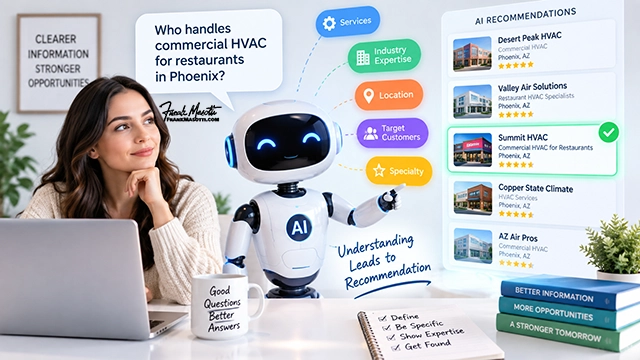
The second starts with a need. Who handles commercial HVAC for restaurants in Phoenix. Which accounting firms work with independent retailers. There is no name in the question, so the model has to work backward from the need to the businesses it associates with it. To land in that answer, your business has to already be filed under the thing being asked for, with enough specificity that the match is confident.
That is the practical difference between recognizing a business and recommending it. Recognition and recommendation are separate problems, and most owners only test the first, because it is easy. You type your own name. The second test means asking the questions your prospects ask, without your name in them, and seeing whether you appear at all.
Understanding Decides Which Questions You Can Be the Answer To
AI systems organize what they know around entities, a concept I unpacked in Why AI Thinks in Entities. Your business is one of those entities, and attached to it are whatever attributes the model has been able to extract: a category, a list of services, a location, a type of customer, a specialty. Those attachments are assembled from your website plus every directory, review, and article that carries your name, the process described in How AI Builds a Picture of Your Business From Information Across the Web.
The mechanical point that matters for recommendation is this. The set of questions your business can be an answer to is exactly the set of attributes AI holds about you. If the model understands you as a plumbing company in Phoenix, you are a candidate for one question, and it is the most generic and most crowded question in your market. If the model understands you as a commercial plumbing contractor in Phoenix that handles tenant improvements and restaurant build outs, you are a candidate for several questions, and in most of them the field is small.
Specificity is not decoration on the understanding. It is the understanding. Every specific fact the model holds is a door a question can come through. A vague understanding has one door, and a hundred competitors are standing in front of it. And since AI leads with what it has seen most often, the attribute repeated across the most sources is the one that gets matched first, whether or not it is the one you would choose.
Why Excellent Businesses Get Skipped
The frustrating version of this problem is a business that is the best in its market at exactly what was asked, and still does not get recommended. That happens for a few reasons, and none of them is about quality.
The specialty never made it into the understanding. The website says “solutions,” the reviews praise results without naming the service, and the directory listing uses the broadest category available. The model holds ten accurate facts about the business, and not one of them matches the question. Why AI May Recognize Your Business but Misunderstand Its Specialty covers how that gap forms, and it forms easily because AI takes your words literally rather than inferring a specialty from clues the way a customer would.
The silence got filled with defaults. When your material never says who you serve or how you differ, the model does not leave those attributes blank. It fills them with the industry average, a pattern explained in What Missing Information Can Reveal About AI’s Understanding of a Business. A business that reads as average is never the recommended one, because average matches no specific question.
The competitor is more legible, not better. AI is not ranking merit. It is ranking match confidence. Two companies with the same capabilities can land very differently in the same answer purely because one is described clearly and consistently everywhere it appears, which is the mechanism behind Why Two Similar Businesses Can Be Understood Very Differently by AI. The recommended business is the one the model can connect to the need without hesitating.
The question carried a qualifier your understanding does not cover. A business may appear for a general query and vanish when the question adds a location, a customer type, or a specific problem, a behavior covered in Why AI May Describe Your Business Differently Depending on How a Question Is Asked. Each qualifier is one more attribute the model has to hold about you, and if it does not, the qualifier filters you out.
The Order of Operations Most Owners Skip
The industry that has grown up around AI visibility mostly sells amplification. Get mentioned in more places. Get cited. Get listed. Those can help, but they build on understanding and cannot replace it. More mentions of a business the model understands vaguely produce a vaguely understood business that is mentioned a lot. If AI Mentions My Business, It Must Understand My Business. Not Necessarily makes that case, and being visible to AI is not the same as being understood by AI is the broader principle behind it.
There is a worse outcome than not being recommended, and it is being recommended for the wrong thing. A business whose old specialty is deeply understood and whose current specialty barely registers gets confidently recommended to prospects it no longer wants, while staying invisible to the ones it built the new work for. Amplifying that understanding only makes the mismatch louder. Understanding has to come first.
What This Costs
Recommendation questions are where the funnel now begins for a growing share of buyers. The prospect who asks “who does this kind of work” never had your name, and if the model cannot connect you to the need, they never will. No visit, no bounce, no abandoned form. The decision finished before any of your systems could observe it, the pattern described in AI Can Influence a Buying Decision Without Sending Anyone to Your Website. The business that got recommended instead absorbs the lead and credits it to a branded search or a phone call. The loss leaves no evidence in any report you receive, and it repeats every time a prospect phrases a need your understanding does not reach.
Finding Out What AI Is Matching Against
You cannot diagnose this by asking ChatGPT about your business once. A question with your name in it tests recognition, which was probably fine. The questions that matter are the ones without your name, asked the way your prospects ask them, across all three systems, because one AI question cannot show you how AI understands your business and all AI models do not know the same things. A model that recommends you for one phrasing may skip you on the next.
The AI Business Understanding Report runs both tests. I ask ChatGPT, Claude, and Gemini the name based questions and the need based questions a real prospect would ask, document which models surface your business, for which needs, and which competitors appear beside or instead of you, then trace those results back to the description each model is working from. You see the exact understanding that is producing the recommendation, or failing to.
AI is already answering recommendation questions in your category, from whatever it currently understands about you. Ordering a report is how you find out whether that understanding is specific enough to put you in the answer.