
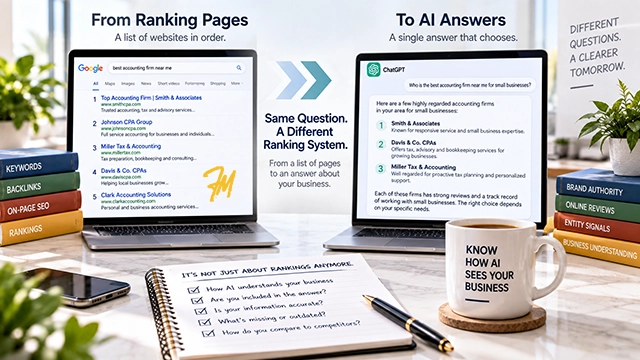
What Happens When AI Becomes the Search Ranking System?
If you are wondering what actually changes for your business when AI takes over the job of ranking search results, here is the direct answer. The thing being ranked changes. A search engine ranked pages. An AI system ranks its own understanding of your business, then decides whether that understanding fits the question well enough to name you. Your page still contributes to it. Your page is no longer the thing on trial.
Three consequences follow. The ranking now happens in two stages, retrieval and then composition, and every habit you have was built for the first one. There is no longer a position to hold, because an answer naming three businesses has no fourth place. And nothing arrives to tell you where you landed. Ranking did not end. It became an invisible judgment about what your business is, made fresh every time someone asks.
This is a description of the present. At Google I/O on May 19, 2026, Liz Reid, who runs Search, announced the biggest change to the search box in more than 25 years and folded AI Overviews and AI Mode into one surface, with AI Mode already past a billion monthly users. She also said the classic results still exist, which is true and largely beside the point: they now sit beneath an answer most people never scroll past. Inside ChatGPT, Claude, and Gemini there was never a list to demote.
The Ranking Used to Evaluate Pages. Now It Evaluates You.
For two decades, ranking was a contest between pages. Google took a query, found the pages that matched it, and ordered them. The unit of competition was the URL, which is why SEO grew up around pages: one for each service, one for each city, one for each question.
An AI system does not think in pages. It thinks in entities, and your business is one of them. When a model receives a question, it is not hunting for the best page. It is consulting a picture of your company it has assembled from your website, directories, reviews, coverage, and everything else carrying your name, then deciding whether that picture fits what was asked. Your best page feeds the picture. It does not stand in for it.
This is why a strong ranking and a strong AI answer have come apart. Moz analyzed nearly 40,000 queries in February 2026 and found that only about 12 percent of citations in Google AI Mode matched a URL in the organic top ten for the same query. At the domain level, only about one in five cited sites appeared in that top ten at all. Read those numbers as two separate contests. One ranks pages against a phrase. The other ranks businesses against a need. I wrote about the gap in A Strong Google Ranking Does Not Guarantee a Strong AI Interpretation, and the version I see most often is a company holding position one for its main service while AI calls it a general provider and names two competitors instead.
Ranking Now Happens Twice, and You Only Optimized for the First
Here is the mechanism most businesses have not absorbed. An AI answer is produced in two stages, and both of them are a ranking.
The first stage is retrieval. Google calls its version query fan out: the system breaks the question it was asked into a batch of related searches it runs in the background, then pulls passages from what those searches return. ChatGPT and Gemini do something comparable when they search live. This stage still resembles the old game. Pages compete, and pages get selected.
The second stage is composition. The model reads what it retrieved, combines it with what it already believed about the businesses involved, and writes an answer naming the few that fit. There is no page in this stage. It is a judgment about entities, and it is where inclusion is decided. A business can win the first stage and lose the second: its page was fetched, its passages were read, and the model still concluded that another company was the better fit. Being crawled is not the same as being understood, and being retrieved is not the same as being named. Almost nothing in the standard playbook addresses that second stage, because it did not exist when the playbook was written.
The Scoreboard Is What You Actually Lost
A results page has ten slots, and slot seven is still a slot. An AI answer names two or three businesses in prose and stops. On a given question, on a given day, you are in it or you are not a business at all. I covered the buyer’s side of that in Why Being Included in an AI Answer May Matter More Than Being Listed in Search Results. The ranking system’s side is stranger: a rank you cannot hold is not really a rank.
It cannot be held because it is never stored. A search position was standing, and stable enough to track week over week. An AI answer is composed at the moment of the question, out of background searches that shift with the phrasing, the earlier turns in the conversation, the person’s location, and the model they happen to be using. AI may describe your business differently depending on how a question is asked, and differently again across ChatGPT, Claude, and Gemini, because all AI models do not know the same things. You do not have a rank. You have a probability of being chosen, and it moves.
Reporting has not filled the gap. Google launched its Generative AI performance report in Search Console on June 3, 2026 and finished rolling it out worldwide on August 31. It shows impressions only. No clicks, no queries, no position. You learn that a page of yours appeared inside an AI feature somewhere, without learning what was asked, what was said, or who appeared beside you. Inside ChatGPT, Claude, and Gemini there is not even that much.
Nor does the system explain itself. Search had ranking factors that were studied and argued over for years. A model composing an answer applies whatever made it confident about each business, which comes down to how consistent and repeated the evidence is, not to any list of factors you can audit. You cannot reconstruct it by testing yourself either, because your session is not your prospect’s. One AI question cannot show you how AI understands your business.
What the New Ranking Actually Rewards
None of this makes the outcome random. It rewards specific things, just not the ones the old system rewarded.
It rewards a clear picture. A business described the same way everywhere, with the same name, specialty, and terminology, gives the model a strong pattern to lean on. One that rotated its vocabulary for keyword variety, or still has old services and old addresses circulating in third party listings, gives it a weak pattern, and a weak pattern produces vagueness or somebody else’s name. That is the practical case for writing for understanding instead of keywords and for consistent terminology.
It also rewards evidence you do not own. Muck Rack’s May 2026 study of more than 25 million links cited by ChatGPT, Claude, and Gemini found 84 percent of citations pointing to earned sources rather than a brand’s own pages, with paid and advertorial content at 0.3 percent. The picture being ranked is assembled mostly from what other people publish about you, and schema stops at the edge of your website. Page level work reaches the retrieval stage. It barely touches the one where the decision is made.
The Business That Wins the Old Game and Loses the New One
Put it together and a specific company comes into focus. It ranks well. Its traffic looks stable. Its monthly report is full of green arrows. And when a prospect asks an AI system who to call, it is not in the answer, because the picture the model holds of it is vague, dated, or blended with a similarly named company. Nothing in the report shows this. Every number in it belongs to the old ranking system, and the old system is still reporting a win. AI can influence a buying decision without sending anyone to your website, which means it can exclude you from one without leaving a trace either.
The cost is not that you rank lower. It is that a second ranking system, one you cannot see or track, is now sorting your prospects by how well it understands you.
Reading the Ranking You Cannot Track
You cannot audit this by checking positions, and you cannot audit it by asking ChatGPT about yourself once. What you can do is examine the judgments it is already producing, which is what the AI Business Understanding Report is built to do. I question ChatGPT, Claude, and Gemini about your business the way a buyer would, including the recommendation and fit questions where inclusion gets decided, and I document what each model believes you do, whether it names you, who it names beside you, and where its picture has drifted from the business you actually run. It is not a scorecard and not a task list, a distinction I explain in how this differs from SEO and automated audits. It is a written record of what the new ranking system has concluded about you, one business at a time.
Your rankings tell you how you are doing in the contest that used to decide everything. Ordering a report tells you how you are doing in the one that decides now.