
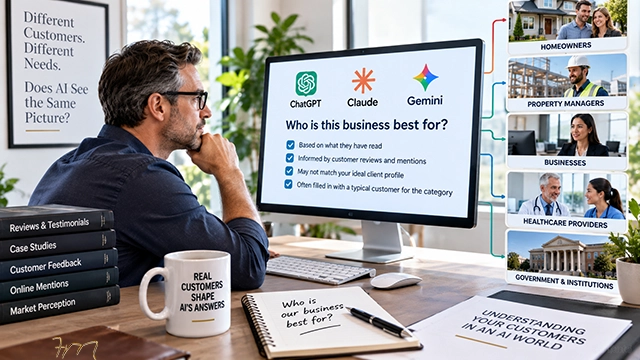
What Does AI Actually Know About Who Your Business Is Best For?
Less than you would expect, and most of it did not come from you. When ChatGPT, Claude, or Gemini decides who your business is a good fit for, it is not reading your ideal client profile. It is reading the evidence of who you have already served, mostly as those customers described themselves in reviews, testimonials, and mentions across the web. Where that evidence is thin, it fills in the typical customer for your category. The client you built the business around, the one in your head and your sales deck, is often not in the picture at all.
That matters because “who is this best for” is the question most AI conversations about hiring a business eventually turn on. People no longer type three words and scan a list. They describe themselves. Similarweb found that ChatGPT prompts average around 60 words, against 3.4 for a typical Google search, and the extra words are mostly context: the size of the company, the budget, the kind of project, whether this is the first time. Each of those details is a description of the asker, and AI has to hold them up against a description of your customers to decide whether you belong in the answer.
So the direct answer is this. AI knows who your business is best for only to the extent that your customers have been visibly described, in words that match how the next customer will describe themselves. For most businesses, that description is skewed, dated, or missing.
“Best For” Is a Match Between Two Descriptions
When someone writes “I manage three small apartment buildings and need an electrician who handles tenant calls,” the model is not ranking electricians by quality. It is comparing a person to a set of businesses, looking for the one whose record looks most like people in that situation.
One side of that comparison arrives fresh with every question. The other side, the portrait of who each business serves, has to already exist in what the model has read. This is a narrower thing than the fit judgment described in What Does AI Tell a Customer Who Asks Whether Your Business Is a Good Choice?, and narrower than the general traits covered in What Attributes Does AI Associate With Your Business?. It is one specific piece of your profile: the customer AI pictures when it pictures you. If that picture is a landlord with small buildings, you match. If it is a homeowner with a flickering light, you do not, however many landlords you actually serve.
Your Customers Wrote Your Audience Profile
AI builds its picture of your business from information across the web, and the audience part of that picture comes from a specific kind of sentence: the one where a customer says who they are. “As a first time buyer, I had no idea what to expect.” “We run a small restaurant and they worked around our hours.” “Our HOA has used them for six years.” Reviewers identify themselves constantly without meaning to, and those self descriptions accumulate into a profile.
Case studies and testimonials add to it when they name the client type. A client list full of hospital systems says something about who you serve that no tagline can. What rarely adds to it is the audience language businesses write about themselves, for reasons that come down to wording.
The Customers Who Review Are Not Your Customer Base
Here is the distortion most owners never consider. The people who write reviews are not a random sample of the people who pay you.
Homeowners review contractors. Property managers and facilities directors who hire the same contractor for commercial work mostly do not; they just award the next job. Patients review medical practices, but the referring physicians who send half the volume never post anything. A one time customer with a strong reaction writes a review; the client who has quietly renewed for eight years has no reason to.
The result is that the loudest segment becomes the whole profile. A company doing sixty percent of its revenue in commercial work, with a review record written almost entirely by homeowners, gets pictured by AI as a residential company. Nothing in the record is false. It is simply lopsided, and the model has no way of knowing which of your customers stayed silent. This is how a business ends up with the right services and the wrong audience, a close cousin of the problem in Why AI May Recognize Your Business but Misunderstand Its Specialty.
Your Words for Your Customers Are Not Their Words
Businesses describe their audience in segment language: small and midsize businesses, growth stage companies, discerning homeowners, the professional community. That vocabulary comes from marketing plans. Nobody describes themselves that way to a chatbot.
The prospect writes “I own a landscaping company with eleven employees,” not “I am an SMB.” They write “we just had our second kid and the house feels small,” not “I am a growing family seeking lifestyle solutions.” Because AI takes your words literally, the match works best when the words on your side resemble the words on theirs. Segment labels give the model a category to file you under, but not a person to recognize, and flattering ones like “discerning” read as marketing rather than fact.
Then there is the most common audience statement of all: “we serve clients of all sizes.” It feels inclusive. To AI, it says nothing. With no stated audience, the model does what it does with every blank and substitutes the category default, as described in What Missing Information Can Reveal About AI’s Understanding of a Business. A firm that genuinely serves everyone gets described as serving the typical client, which is usually the smallest and most price sensitive one.
The Portrait Lags Behind the Business
Audiences change more often than services do. A remodeler moves upmarket. An accounting firm stops taking individual returns to focus on business clients. The website gets updated in an afternoon.
The customer record does not. Five years of reviews from the old clientele stay published, and AI may trust old information about your business because there is so much more of it. So the model keeps pairing you with the customers you moved away from, and keeps missing the ones you moved toward. It is the audience version of the pattern in Can AI Tell When a Business Has Changed Direction?, and it is harder to spot, because your name, category, and services all look right.
What a Wrong Audience Profile Costs
This problem costs twice, and only one of the costs is visible.
The visible cost is the wrong inquiries. When AI pictures your customer as someone you no longer want, those people keep calling: the small jobs, the tight budgets, the projects outside your range. Owners usually blame their marketing or their market for these calls, never suspecting that an AI answer sent them.
The invisible cost is the right customers who never call. A July 2026 survey of 2,338 US adults by Exploding Topics, published through Semrush, found that 87 percent of people who use AI to research companies would at least occasionally consult it before hiring a local business, and that 57.5 percent of AI users had decided against a purchase based on what a chatbot told them. When the prospect you want describes themselves and AI does not see you in that description, you are quietly left off the shortlist, in a decision that never touches your website. Often this is the real reason AI recommends your competitors but not you: the competitor’s customers simply look more like the person asking.
Making Your Audience Something AI Can Read
The fixes are plain. Say who you serve in the words those customers use about themselves, with concrete markers: “Most of our clients are restaurants and retailers with fewer than thirty employees.” State thresholds and exclusions, such as project minimums or the work you no longer take, because a stated limit tells AI who you are for as clearly as any description. Publish case studies that name the client type. And ask your quiet segments for reviews, because a handful of property managers describing themselves in their own words can rebalance a record built by homeowners. Then use the same terms everywhere so the picture holds together.
None of that tells you what AI believes right now, and you cannot find out by asking about your own name. Audience surfaces only when the question carries a self description, which is one more reason one AI question cannot show you how AI understands your business. The three major models also draw on different sources, so each may picture a different customer.
Finding Out Who AI Thinks You Are For
The AI Business Understanding Report examines this directly. I question ChatGPT, Claude, and Gemini the way your prospects do, including questions where the asker describes their situation, their size, and their budget, and I document which kinds of customers each model pairs you with, which it steers away from you, and whether that portrait matches the clients you actually want. The methodology explains how every response is preserved and compared across all three.
You know who your business is best for. AI has its own answer, built from whoever happened to describe you. Ordering a report shows you what that answer is, and who it is sending your way.