
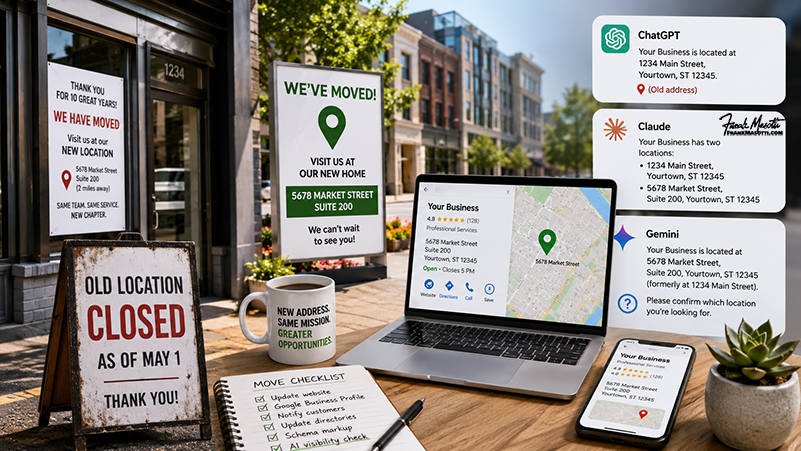
If your business has moved and your old address is still showing up online, here is the situation you are actually in. The old address does not fade away on its own. It competes with the new one. To systems like ChatGPT, Claude, and Gemini, your address is not a setting you update once. It is a fact they have seen repeated across directories, review platforms, articles, and listings, sometimes for years. The day after you move, nearly all of that evidence still points to the old location, and AI tends to trust the information it has seen most often, not the information that happens to be newest.
So the direct answer: as long as the old address remains in enough places AI reads, AI can keep sending people there. It may state the old address with complete confidence, hedge between the two, or do something stranger that most owners never anticipate, which is treat the move as an expansion and describe your business as having two locations. Which of those you get depends on evidence you mostly do not control, and you will not know which answer prospects are receiving unless you go looking.
Updating your website and your Google listing feels like finishing the job. For your customers, it largely is. For AI, it is the opening move in a much longer process, and understanding why explains almost everything else about this problem.
Why the Old Address Outlives the Move
AI systems do not experience your move as an event. There is no moment where the model registers that you packed up and relocated. There is only evidence, and AI builds its picture of your business from information across the web, most of which lives on pages you do not own. Industry directories, local news articles that mentioned your address years ago, review platforms, supplier pages, event listings, chamber of commerce entries. Each one is a small, dated assertion about where your business is, and no one is responsible for updating them. Your own properties switch over in a week. The rest of the web can keep publishing your old address indefinitely.
There is a timing problem underneath this too. AI models learn from snapshots of the web taken at a point in time. A move that happened after that snapshot does not exist in what the model learned, so the model’s baseline knowledge places you at the old address no matter what your website says today. Some AI tools supplement this with live search, but live search pulls from the same web where mentions of your old address may outnumber mentions of your new one many times over. Either way, the old location wins on volume and repetition, which is exactly the dynamic covered in What Happens When Your Website Says One Thing and Older Sources Say Another. When sources conflict, AI does not automatically side with the most accurate one. It often sides with the most repeated one, and repetition favors your past.
Your address is also not an isolated fact. Everything AI understands about your company is organized around your business as an entity, and the location is one of the core attachments to that entity, alongside your services, your people, and your reputation. A location that held for ten years is deeply woven into that structure. A location that appeared three months ago is a loose thread. Pulling the old one out takes far more than a single update.
The Three Answers Prospects Might Be Getting
In practice, an unresolved move tends to produce one of three outcomes in AI systems, and none of them is the clean handoff owners expect.
The first is that AI keeps stating the old address as if nothing happened. This is the most common outcome early on, and it is the location version of a broader pattern: AI might be describing the business you used to be. The answer sounds confident, the rest of the description may be perfectly accurate, and the one detail that physically directs a customer to your door is wrong. Confidence is what makes this outcome dangerous. A prospect has no reason to doubt an answer that shows no doubt, and AI can sound certain even when its understanding is incomplete.
The second is the two location illusion. AI has absorbed some evidence of the new address without letting go of the old one, and rather than choosing, it combines them. Your single location business gets described as having a branch across town, or an office you left last year gets presented as still active alongside the new one. Nothing in the evidence says the old location closed, so AI has no basis to retire it. Each individual fact it holds was true at some point, and this is how accurate facts get combined into an inaccurate conclusion.
The third is visible uncertainty. AI hedges, offers both addresses, or attaches qualifiers to a detail that should be the easiest fact about your business to state. That kind of wobble costs more than it appears to, because a model that cannot commit to where you are starts sounding unsure about you in general. The cost of contradictory information is rarely one wrong fact. It is the erosion of confidence across the whole answer.
There is one more complication worth naming. Buildings do not stay empty. If another business has moved into your old address, the evidence trail at that location now points to them, and AI can begin blending the two. Your name attached to their storefront, their hours attached to your entity. This is how a simple relocation drifts into entity confusion between similar businesses, and it gets harder to untangle the longer it runs.
Why This Costs More Than a Wrong Pin on a Map
A wrong address used to mean an occasional confused phone call. The context has changed. Customers are asking AI about businesses before they visit their websites, which means the AI answer often arrives before your website gets a chance to correct it. A prospect who drives to your old address and finds an empty unit, or a different company’s sign, does not usually conclude that AI was out of date. They conclude that you closed. That is the quiet cost of this problem: a move that signaled growth from the inside can read, through AI, as a disappearance.
And there is no feedback loop to warn you. The prospect who was sent to the wrong address does not call to report it. They move on to the next business on their list, one whose location AI could state without hesitation. From inside the business, everything looks handled, because everything you can see has been updated. The gap is in what you cannot see.
What Actually Retires the Old Address
The move has to be stated, in plain language, in places AI reads. Sentences like “now located at” and “formerly at” on your website and in updated third party listings are what give AI a basis to connect the two addresses instead of holding them side by side. Chasing down the directories and platforms that still list the old location matters more than it seems, because every uncorrected listing is another vote for your past. Your LocalBusiness schema should carry the new address consistently, and Local Business Schema Explained covers how that works, though schema restates the correction rather than replacing it. The claim has to exist in your content first, then echo across the sources AI trusts, because schema stops at the edge of your website and the old address lives beyond that edge.
But you cannot manage what you cannot see, and nothing shows you which address ChatGPT gives when someone asks where you are, or whether Gemini thinks you have two locations, or whether Claude has started associating your name with the business now occupying your old space.
That is the question the AI Business Understanding Report answers directly. It documents what ChatGPT, Claude, and Gemini currently say about your business, which after a move means finding out whether AI has your new address, still holds the old one, or is blending the two. If the models disagree, the report shows that too, which matters because what one model knows tells you little about the others. If you have moved in the last few years, ordering a report is how you find out where AI is actually sending your prospects: to your door, to an empty unit, or to whoever occupies it now.