
Why Plain English Often Wins
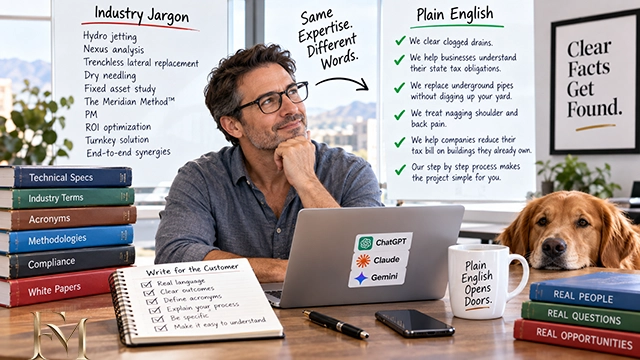
If you have been told AI systems prefer plain writing, and you are wondering whether that means flattening work that is genuinely technical, here is the direct answer. Plain English wins because your prospect does not ask their question in your vocabulary. They ask in theirs. Before an AI system can put your business forward as the answer, it has to connect the words the customer used to the words you published, and every part of that connection you leave unwritten gets supplied by the model, from general knowledge of your category rather than knowledge of you.
That is the whole mechanism. When your page already states your specialized work in the language an outsider would use, there is nothing left to bridge. When it does not, the bridge is built from industry averages, and those describe your competitors as well as they describe you.
The word often in the title is doing real work, though. Plain is not the same as simple, and it is definitely not the same as generic. Written badly, plain becomes vague, and vague is its own failure.
The Question Arrives in the Customer’s Words
A homeowner does not ask an AI assistant who performs hydro jetting. They ask who can fix a drain that keeps backing up. A business owner does not ask for a firm handling nexus analysis. They ask whether they owe taxes in a state where they just hired someone. The question arrives in the language of the problem, because the person asking does not yet know the name of the solution.
AI systems handle that gap by reformulating. One question becomes several internal searches, rephrased in different ways, each looking for material that answers part of it. The model is not hunting for your page. It is hunting for text that connects this problem to a provider, so the match happens in the customer’s vocabulary rather than yours. If your specialty appears only inside a term the customer has never typed, your page is not in that conversation. The model still answers, using what it knows about your category generally, which is the outcome described in How AI Decides What Your Business Is Known For. It leads with what it can confirm, and it can only confirm what somebody wrote down in terms it can attach to the question.
Expert Writing Fails the Same Test Marketing Writing Fails
Vague marketing copy fails because it never states a fact, a set of patterns I covered in Why AI Can Misread Marketing Language. Expert copy has the reverse problem. It states facts constantly, written by someone who knows the work cold. The trouble is that the information is encoded in a vocabulary shared by a few thousand people, most of whom are your competitors rather than your customers.
Both produce the same result. The marketing page gives the model nothing specific to file. The technical page gives it something specific it cannot connect to any question a buyer would ask. One is empty, one is locked, and both come out as the category default.
There is a trap inside this. Technical language signals expertise to a reader who already recognizes it, so the pages needing plain English most are usually the ones a business is proudest of. Nobody reviews their own specification page and thinks it is unclear. It is not unclear. It is unclear from outside, and AI is permanently outside, with no relationship to your industry and no way to ask what something means.
Three Ways Precision Turns Into Silence
Acronyms doing load bearing work. PM is project management, preventive maintenance, particulate matter, or property management, depending on who is reading. When an acronym carries a fact and the expansion appears nowhere near it, the model picks a reading silently. That is the fork described in Ambiguous Sentences Create Ambiguous AI Answers, sitting inside a single word, which is why definitions matter more than they appear to. A definition written once on the page is a fact. One living only in your head is a gap.
Method names standing in for outcomes. Trenchless lateral replacement. Dry needling. A fixed asset study. Each is the correct professional term, and none tells a system matching a customer problem that this is what you do when a yard would otherwise be dug up, when a shoulder will not stop aching, or when a company wants to lower the tax bill on a building it already owns. The outcome is the searchable half, and it is the half most often left unwritten because it feels obvious to everyone in the room.
Proprietary names presented as descriptions. A named process or service tier reads to AI as a proper noun with no content. The Meridian Method tells a model nothing unless a plain sentence nearby says what it consists of. Branded naming is good business, but it cannot carry meaning alone, and when it is the headline, the property it was meant to establish never gets established, the pattern behind Why AI May Recognize Your Business but Misunderstand Its Specialty.
In all three cases nothing on the page is wrong. The information simply never becomes retrievable, and as covered in What Missing Information Can Reveal About AI’s Understanding of a Business, a gap does not stay a gap. It gets filled with what is typical for your category.
Where Plain English Stops Winning
Plain is not a setting you turn up until nothing is left.
Your technical terms are your anchors. They separate a firm doing one specific thing from the thousand firms doing the general version of it. Strip them out for accessibility and you have a page that reads easily and identifies nobody. Compression does the same damage from the other direction, as covered in Why Shorter Is Not Always Better, because shortening a sentence usually means cutting the modifiers, and the modifiers are where your qualifying detail lives.
So the pattern that wins is not replacement. It is pairing. Keep the precise term and state it plainly in the same breath, using the same words each time, because consistent terminology matters as much as the plain version does. We perform trenchless lateral replacement, which repairs a broken sewer line under a yard without excavating it. One sentence. The expert reader gets the term proving you know the work. The model gets the link between your specialty and the question a homeowner will actually ask. Nothing was dumbed down. Something was made reachable.
That is the division of labor described in Why Clear Writing Beats Clever Writing for AI, applied to a different register. There the competing instinct was personality. Here it is professionalism. Either way, the plain statement is what lets the rest of the writing count.
What the Translation Gap Costs
The cost lands on your best work rather than your weakest. The more specialized you are, the more of your value sits inside vocabulary, so the questions you are most qualified to win are the ones phrased furthest from your language. Your prospect is increasingly asking before anything else happens, and when the answer omits you, nothing registers on your side. No visit, no form, no bounce. A specialist quietly gets treated as a generalist, and the description arrives with full confidence, because AI sounds certain whether or not its understanding is complete.
It is also uneven. Your website is one source among many, and AI builds its picture of your business from information across the web, including directory listings and partner blurbs written in whatever words those people had. Because the three major systems weigh different material, one model translating your specialty correctly tells you nothing about the other two.
Finding Out Which Version of Your Vocabulary Landed
You cannot test this by rereading your own pages. You know what every term means, so every sentence looks clear, and the translation step you never wrote is invisible to the one person who could not possibly miss it. The only honest test is the output. That is what the AI Business Understanding Report documents. I question ChatGPT, Claude, and Gemini about your business the way a prospect would, in plain language rather than industry terms, and record what comes back: whether your specialty appears at all, whether it appears in words a customer would recognize, whether the models flattened you into your category, and where the three disagree. Then I trace those answers back toward what produced them, frequently a page that was precise and unreadable from outside at once.
Plain English wins when it carries your precision to someone who does not have it yet. It stops winning the moment it replaces that precision. If you want to know which of those your writing has produced in the systems your prospects are already asking, ordering a report is how you find out.