
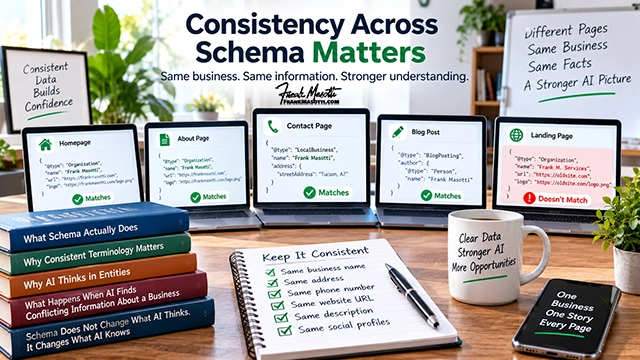
If your website has schema on more than one page, here is the direct answer to whether it needs to agree with itself. Yes, and more than most people assume. Schema is not a single description of your business. It is the same description repeated on every page that carries markup, and each repetition is read by AI as a separate declaration. When those declarations match, they reinforce each other into one confident picture. When they drift, even slightly, your site is now making several competing claims about who you are, in the one format built to be trusted without interpretation.
That is the part that catches people. A contradiction buried in prose is a contradiction AI has to notice and weigh. A contradiction in structured data is a contradiction handed over in a form that requires no reading at all. You did not just disagree with yourself. You disagreed with yourself in the language AI trusts most.
Most business owners never see this because every individual page passes its check. The homepage validates. The contact page validates. The blog posts validate. What no validator ever does is put those blocks side by side and ask whether they describe the same company. That comparison only happens inside ChatGPT, Claude, and Gemini, and the result is delivered to your prospects rather than to you.
Where the Drift Comes From
Almost no website has one author for its schema. The SEO plugin generates an Organization block on every page because that is its default. The theme adds a LocalBusiness block to the contact page because that is what the template shipped with. A developer hand coded a block on the homepage two years ago. The blog platform attaches a publisher node to every post. A page builder added its own markup when a landing page was built last spring.
Each of those sources was configured on a different day, by a different person, with whatever information was handy. One has your trading name. Another has your legal name. One has the old suite number. One carries a description written for a directory in 2021. They all validate, because validation only asks whether each block follows the specification, a limit covered in What Schema Actually Does. None of them was ever checked against the others, because nobody was assigned the job of noticing that the site describes the same business five different ways.
This is the markup version of the vocabulary problem in Why Consistent Terminology Matters. The difference is that vocabulary drift lives in sentences a model has to interpret. Schema drift lives in declarations a model is designed to accept.
Why AI Treats Schema Drift as More Than a Typo
AI systems organize what they learn around entities, distinct things with names and attributes, which is the reason AI thinks in entities rather than in pages. Structured data is valuable precisely because it feeds that process directly. A block that says this organization has this name, this address, this phone number, and these profiles is a set of attributes ready to attach to an entity without any inference in between.
Now consider what five slightly different blocks look like from that side. A model reading your site is not looking at pages in sequence. It is collecting every claim about the organization behind the site and deciding whether those claims describe one entity or several. Two blocks with the same name and the same address merge easily. A block with a different name, a different address, and no link back to the others looks like a different declaration about a possibly different thing. The model has to decide, and it decides silently. The outcomes are the ones described in What Happens When AI Finds Conflicting Information About a Business: pick one version, blend them, or hedge. Except here the conflicting sources are not a stale directory and your current site. They are your own site, on different pages, both speaking in the definitive register.
That register is what makes this expensive. Schema Does Not Change What AI Thinks. It Changes What AI Knows makes the point that markup raises confidence in a claim. When two confident claims contradict each other, the effect is not that one wins cleanly. The effect is that the whole set of claims becomes less reliable, and the model falls back on whatever it can confirm from elsewhere, which is often older, thinner, or somebody else’s.
There is also a naming failure that runs deeper than any single field. Each schema block can carry an identifier that tells machines this block refers to the same thing as that block over there. Most implementations leave it out, or each plugin generates its own. Without a shared identifier, your Organization block on the homepage, your LocalBusiness block on the contact page, and the publisher node on every blog post are three unlinked assertions. They might be recognized as the same company. Nothing says they must be.
The Four Places It Breaks Most Often
Name. The trading name on one page, the legal name on another, an abbreviated name in the blog publisher node. Each is a real name for your company. To a model, each is also a candidate key for a separate entity, and a name mismatch inside your own markup is one of the quieter routes into the problem described in Entity Confusion Between Similar Businesses. You do not need a namesake across the country when your own site supplies two versions of you.
Type. Organization on the homepage, LocalBusiness on the contact page, ProfessionalService on a services page, all for the same company. The types are related, but they are not identical claims, and a business declared as three different kinds of thing has told AI something about category that it did not intend. Category is the one attribute that cannot hold two values at once, and How Conflicting Business Categories Can Confuse AI covers what happens when it is forced to.
Location and contact. An old address in a block that was never updated after a move. Two phone numbers because one plugin pulled from an old setting. A service area on one page and a street address on another with no statement that both belong to the same business. Local Business Schema Explained covers what these properties should say. What matters here is that they say it the same way everywhere.
People and connections. The founder named one way in the Organization block and another way in Person markup on the about page. Profile links on the homepage that differ from the ones on the contact page. Person Schema Explained and Organization Schema Explained each describe their own block. Consistency is what makes the two blocks describe one relationship instead of two.
Even structural markup joins in. Breadcrumb Schema and Context shows what happens when the breadcrumb calls a section Services while the navigation and the schema call it something else. One label per thing applies to markup as strictly as it applies to prose.
What It Costs
The cost is an absence, not an error. A prospect asks about your business and gets a description that reaches for a name you rarely use, a location you left, or a category you did not choose. Or they get a hedge, because the model saw your own site disagreeing with itself and decided not to commit. Nothing in that exchange comes back to you. The prospect just does not call.
Even a crawl based audit that finds duplicate Organization blocks usually reports the duplication as a technical note, not as a contradiction with consequences. The drift only becomes visible when you read the markup the way AI reads it, as one accumulated set of claims, and almost nobody does that on their own site. And because what makes AI confident in an answer is agreement across sources, a site whose markup agrees with itself is handing AI the strongest possible signal about identity. A site whose markup disagrees with itself is handing AI a reason to look elsewhere for the answer, and elsewhere is where the old and borrowed information lives.
Getting Schema to Say One Thing
The fix is less technical than it sounds. Decide on one name, one type, one address, one phone number, one description, one set of profile links. Write the organization down once. Then find every place on the site that emits markup about the company and make it either match that record exactly or point back to it. Turn off the plugin defaults that generate a second, unmanaged block. Give the blocks a shared identifier so the connection is stated rather than inferred.
What that work cannot tell you is whether the drift already shaped what AI believes. Schema stops at the edge of your website, and the understanding your old markup produced is sitting inside the models, not inside your validator. The only way to know what three AI systems concluded from a site that spent two years describing itself five ways is to look at the answers.
That is what the AI Business Understanding Report documents. It records how ChatGPT, Claude, and Gemini each describe your business, which is exactly where inconsistent markup shows up: as a name you do not lead with, a category you did not pick, a location that is not current, or three models that cannot agree on the basics. It works from the output side rather than from a checklist, which is the distinction drawn in how this differs from an automated AI SEO report. If your site has more than one source of schema and nobody has ever compared them, ordering a report is how you find out whether your own markup has been quietly arguing with itself in front of your prospects.